
Roads melt in Europe’s heatwave: Why Indian roads withstand temperatures above 50°C
So why are the European roads failing at temperatures Indian roads laugh off every summer? Find out here
- Jul 1, 2026,
- Updated Jul 1, 2026 2:39 PM IST
Europe heatwave news: Europe is melting — and so are its roads. The UK's tarmac is softening and buckling as heatwave temperatures climb past 40°C, causing chaos on roads that simply weren't built for this.
But India has been building roads for exactly this. Temperatures of 50°C, 55°C — a reality Indian engineers have been solving for generations.
So why are the European roads failing at temperatures Indian roads laugh off every summer? The answer is hiding in plain sight — and it says a lot about how the world is going to have to rethink infrastructure in the age of climate change.
Why are roads melting in Europe?
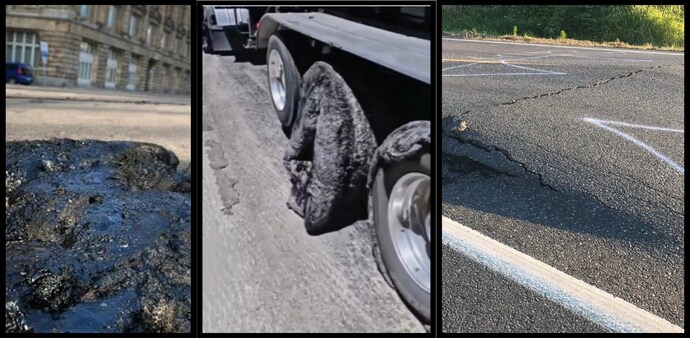
Roads across the UK are softening and deforming under the traffic, just like chocolate melts in heat due to the ongoing heatwave in Europe. Roads in Europe are primarily engineered to withstand freeze-thaw cycles where water enters cracks, freezes, expands and damages pavement.
Most countries use asphalt mixes with higher bitumen content and finer aggregates, making them flexible in cold weather. In extreme heat, the bitumen softens and causes roads to become sticky and develop ruts under heavy vehicles.
This has prompted some UK councils to deploy gritting lorries to spread sand over roads to reduce the side effects of softened bitumen.
DO CHECKOUT | Zero-cooling crisis: How 40°C became India’s irreversible new summer normal
Why does India fare better in this department?
Back home, roads are built for extreme heat conditions and designed to withstand summer temperatures of 40-55°C. Engineers use harder grades of bitumen such as VG-30 and VG-40, due to which Indian roads don't soften under intense heat.
They further choose pavement thickness and material composition to minimise rutting, bleeding, and deformation. In contrast, UK and European roads are designed primarily for freezing winters. Softer asphalt mixes perform well in cold weather but can soften during prolonged heatwaves.
Differences in Indian and European architecture
Indian architecture has evolved to cope with heat as it typically comprises higher ceilings that allow hot air to rise, courtyards and verandas that improve ventilation, thick walls and stone floors that absorb heat slowly, and windows positioned for cross-ventilation. By comparison, European homes are insulated to retain heat during winter.
Europe heatwave news: Europe is melting — and so are its roads. The UK's tarmac is softening and buckling as heatwave temperatures climb past 40°C, causing chaos on roads that simply weren't built for this.
But India has been building roads for exactly this. Temperatures of 50°C, 55°C — a reality Indian engineers have been solving for generations.
So why are the European roads failing at temperatures Indian roads laugh off every summer? The answer is hiding in plain sight — and it says a lot about how the world is going to have to rethink infrastructure in the age of climate change.
Why are roads melting in Europe?
Roads across the UK are softening and deforming under the traffic, just like chocolate melts in heat due to the ongoing heatwave in Europe. Roads in Europe are primarily engineered to withstand freeze-thaw cycles where water enters cracks, freezes, expands and damages pavement.
Most countries use asphalt mixes with higher bitumen content and finer aggregates, making them flexible in cold weather. In extreme heat, the bitumen softens and causes roads to become sticky and develop ruts under heavy vehicles.
This has prompted some UK councils to deploy gritting lorries to spread sand over roads to reduce the side effects of softened bitumen.
DO CHECKOUT | Zero-cooling crisis: How 40°C became India’s irreversible new summer normal
Why does India fare better in this department?
Back home, roads are built for extreme heat conditions and designed to withstand summer temperatures of 40-55°C. Engineers use harder grades of bitumen such as VG-30 and VG-40, due to which Indian roads don't soften under intense heat.
They further choose pavement thickness and material composition to minimise rutting, bleeding, and deformation. In contrast, UK and European roads are designed primarily for freezing winters. Softer asphalt mixes perform well in cold weather but can soften during prolonged heatwaves.
Differences in Indian and European architecture
Indian architecture has evolved to cope with heat as it typically comprises higher ceilings that allow hot air to rise, courtyards and verandas that improve ventilation, thick walls and stone floors that absorb heat slowly, and windows positioned for cross-ventilation. By comparison, European homes are insulated to retain heat during winter.