
Saudi attacked by Houthis, Turkey targeted by Israel: So what is the Mecca Pact doing?
Saudi attacked by Houthis, Turkey targeted by Israel: So what is the Mecca Pact doing?
No sign of Mecca Accords allies jumping into action or the alliance itself being relevant. That can change over time, but for now it is not playing a role, says West Asia expert Vali Nasr
Saurabh Sharma
- Aug 24, 2026,
- Updated Aug 24, 2026 6:23 PM IST
The Mecca defence pact between Saudi Arabia, Turkey, and Pakistan is facing an early test.
Iranian-American academic and Iran expert Vali Nasr says there is little sign of the alliance responding as its members confront security threats.
"Important to note regarding Saudi-Turkey-Pakistan Mecca Accords: Houthis are attacking Saudi and Israel is attacking Turkey in Syria, and no sign of Mecca Accords allies jumping into action or the alliance itself being relevant," Nasr wrote on Monday. "That can change over time, but for now it is not playing a role."
Advertisement
Yemen's Iran-aligned Houthis said last Thursday that they had carried out two drone attacks on Saudi Arabia. The attacks targeted Najran airport and an Aramco facility in Najran.
Separately, Israel launched airstrikes on the Abu al-Duhur airbase in northern Syria last Tuesday. Israel said the strikes were aimed at blocking a planned Turkish military deployment there.
"Turkey moved to expand its military presence in Syria toward Israel's border. Israel detected the threat and acted before it escalated," a spokesperson for Prime Minister Benjamin Netanyahu's office said on Friday.
Advertisement
What Is The Mecca Pact?
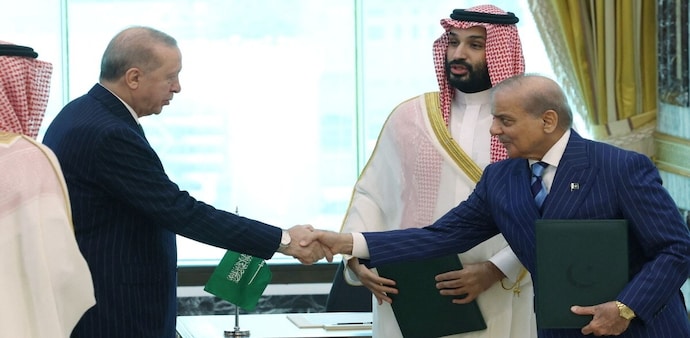
The Mecca Joint Defence Agreement, also known as the Mecca Agreement, was signed by Pakistan, Saudi Arabia, and Turkey on August 7.
The pact establishes a collective security arrangement modelled on Article 5 of NATO. Under the pact, any armed attack against any one of the three states shall be regarded as an attack against them all.
But the pact has not been invoked despite the Houthi attacks on Saudi Arabia and Israeli strikes against Turkey-linked military activity in Syria.
External Affairs Minister S Jaishankar, too, had pointed this out last week when asked whether the defence pact was a concern for India. "You refer to it as a defence pact. There are live military situations, which each of the signatories face. What has the Mecca pact done in response to that?" Jaishankar said at the Economic Times World Leaders Forum.
Advertisement
Don't Miss: 'Having Pakistan negotiate was nuts': Ex-CIA chief Leon Panetta on where Trump faltered in Iran war
'Elephant In A Dark Room'
Security expert and ORF senior fellow Sushant Sareen has also questioned what the pact actually means.
"It (Mecca pact) is like that elephant in a dark room. Everybody is feeling around and trying to make out what they make out of it," Sareen said in a podcast. He said the actual text of the pact has not been made public and that the three countries have deliberately maintained ambiguity.
The principle that an attack on one would be treated as an attack on all has been widely highlighted, Sareen said. But he questioned whether that language would translate into actual military action.
"There have been times in the past where the Chinese have gone to Pakistan and have said that Pakistan's security is China's security. It's like the normal diplomacy that is often used by many of these countries."
Sareen also pointed to competing ambitions within the Islamic world. Iran, Saudi Arabia, and Turkey are all vying for leadership, he said, though each has a different position.
"There is no compatibility among all three on what they want," he said. "One aspect of that non-compatibility is that there are three countries in the Islamic world that are vying for leadership. There is Iran, which has a problem because it is predominantly Shia. There is Saudi Arabia, which for the last over 100 years has been the traditional leader. And there is Turkey, which, before Saudi Arabia and its riches gave it the leadership position, was the hegemon of the Islamic world under the Ottoman Empire, which Erdogan wants to reclaim. So there is that factor also, which is going to come into play."
The Mecca defence pact between Saudi Arabia, Turkey, and Pakistan is facing an early test.
Iranian-American academic and Iran expert Vali Nasr says there is little sign of the alliance responding as its members confront security threats.
"Important to note regarding Saudi-Turkey-Pakistan Mecca Accords: Houthis are attacking Saudi and Israel is attacking Turkey in Syria, and no sign of Mecca Accords allies jumping into action or the alliance itself being relevant," Nasr wrote on Monday. "That can change over time, but for now it is not playing a role."
Advertisement
Yemen's Iran-aligned Houthis said last Thursday that they had carried out two drone attacks on Saudi Arabia. The attacks targeted Najran airport and an Aramco facility in Najran.
Separately, Israel launched airstrikes on the Abu al-Duhur airbase in northern Syria last Tuesday. Israel said the strikes were aimed at blocking a planned Turkish military deployment there.
"Turkey moved to expand its military presence in Syria toward Israel's border. Israel detected the threat and acted before it escalated," a spokesperson for Prime Minister Benjamin Netanyahu's office said on Friday.
Advertisement
What Is The Mecca Pact?
The Mecca Joint Defence Agreement, also known as the Mecca Agreement, was signed by Pakistan, Saudi Arabia, and Turkey on August 7.
The pact establishes a collective security arrangement modelled on Article 5 of NATO. Under the pact, any armed attack against any one of the three states shall be regarded as an attack against them all.
But the pact has not been invoked despite the Houthi attacks on Saudi Arabia and Israeli strikes against Turkey-linked military activity in Syria.
External Affairs Minister S Jaishankar, too, had pointed this out last week when asked whether the defence pact was a concern for India. "You refer to it as a defence pact. There are live military situations, which each of the signatories face. What has the Mecca pact done in response to that?" Jaishankar said at the Economic Times World Leaders Forum.
Advertisement
Don't Miss: 'Having Pakistan negotiate was nuts': Ex-CIA chief Leon Panetta on where Trump faltered in Iran war
'Elephant In A Dark Room'
Security expert and ORF senior fellow Sushant Sareen has also questioned what the pact actually means.
"It (Mecca pact) is like that elephant in a dark room. Everybody is feeling around and trying to make out what they make out of it," Sareen said in a podcast. He said the actual text of the pact has not been made public and that the three countries have deliberately maintained ambiguity.
The principle that an attack on one would be treated as an attack on all has been widely highlighted, Sareen said. But he questioned whether that language would translate into actual military action.
"There have been times in the past where the Chinese have gone to Pakistan and have said that Pakistan's security is China's security. It's like the normal diplomacy that is often used by many of these countries."
Sareen also pointed to competing ambitions within the Islamic world. Iran, Saudi Arabia, and Turkey are all vying for leadership, he said, though each has a different position.
"There is no compatibility among all three on what they want," he said. "One aspect of that non-compatibility is that there are three countries in the Islamic world that are vying for leadership. There is Iran, which has a problem because it is predominantly Shia. There is Saudi Arabia, which for the last over 100 years has been the traditional leader. And there is Turkey, which, before Saudi Arabia and its riches gave it the leadership position, was the hegemon of the Islamic world under the Ottoman Empire, which Erdogan wants to reclaim. So there is that factor also, which is going to come into play."
Read more!