
‘Strategic recalibration’: Brahma Chellaney says Trump peace plan reflects US urgency to refocus on China
The longer the West remains bogged down in Ukraine, the greater the likelihood that Beijing sees a strategic opening to coerce or blockade Taiwan. “An America tied down in Europe clearly serves Chinese President Xi Jinping’s expansionist ambitions,” Chellaney said.
- Nov 30, 2025,
- Updated Nov 30, 2025 3:39 PM IST
President Donald Trump’s proposed Ukraine peace plan has set off a political shockwave across Kyiv and Western capitals, exposing deep divisions over whether the grinding war can – or should – be brought to the negotiating table. The reactions, analysts say, reveal more about shifting global priorities than about the plan itself.
At the heart of Trump’s proposal is a bid to pressure Ukrainian President Volodymyr Zelensky into talks he has long resisted. But the plan also seeks major concessions from Moscow: Russia would be required to channel $100 billion of its frozen central bank reserves into a US-led reconstruction of Ukraine, with Washington taking 50% of the profits, while the remaining $200 billion-plus in frozen assets would be moved into a joint US-Russia investment vehicle.
Geostrategist Brahma Chellaney, in an article in The Globe and Mail, argues that Washington’s urgency to end the conflict reflects a profound strategic recalibration. The proxy war with Russia, he says, no longer advances core US, Canadian, or even European interests, especially as the United States confronts a more consequential challenge: a rising, revisionist China.
China now shapes US strategic calculus
Chellaney warns that the prolonged war in Ukraine distracts the US from Beijing’s intensifying bid to displace American power. If Russia’s invasion strained the global order, a Chinese strike on Taiwan could “shatter it altogether,” he writes.
The longer the West remains bogged down in Ukraine, the greater the likelihood that Beijing sees a strategic opening to coerce or blockade Taiwan. “An America tied down in Europe clearly serves Chinese President Xi Jinping’s expansionist ambitions,” Chellaney notes.
Under former president Joe Biden, the US closed off diplomatic avenues with Moscow and pledged indefinite support to Kyiv. The 2023 G7 summit cemented this stance with heavy conditions, including demands for Russia’s full withdrawal from Ukrainian territory — an outcome analysts now call unrealistic.
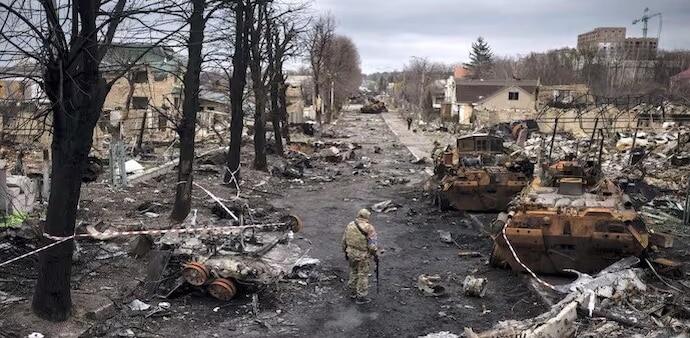
Two years on, Russia has entrenched its gains and continues to advance. Ukraine, despite substantial Western weapons shipments, lacks the capacity to defeat a stronger adversary on the battlefield. Russian aerial strikes are intensifying, and Kyiv is facing an acute manpower crisis as draft-age Ukrainians flee to EU states.
Chellaney highlights another concern: The war has exposed severe weaknesses within Western defence industries. Munitions stockpiles are being consumed far faster than they can be replenished, and US weapons manufacturing still falls short of great-power competition requirements.
Deepening Russia-China partnership
A prolonged conflict, Chellaney warns, is accelerating a strategic alignment between Moscow and Beijing. China has become Russia’s industrial and financial lifeline, buying discounted oil, supplying electronics, and helping Moscow circumvent sanctions. A de facto Eurasian axis, with China at the centre, is now taking shape.
Against this backdrop, Trump’s peace plan aims to compel Kyiv to negotiate not because Ukraine’s cause lacks merit, but because continuing the war risks undermining long-term Western interests.
Critics argue that compromising with Russia could embolden China. But Chellaney counters that Beijing’s opportunism is already well established — from the South China Sea to the Himalayas. What would truly embolden China, he says, is a militarily overstretched and strategically distracted United States.
For Washington, the calculus is shifting. A negotiated settlement:
- would halt a war with diminishing strategic returns,
- allow the U.S. and NATO to rebuild depleted stockpiles,
- and free up resources to reinforce the Indo-Pacific—now the world’s geopolitical and economic pivot.
Chellaney notes that Canada, too, would benefit from reduced economic burdens and the ability to focus more on Indo-Pacific priorities. Trump’s peace plan, though controversial, underscores a hardening reality: ending the war may now align more closely with Western interests than sustaining it indefinitely.
President Donald Trump’s proposed Ukraine peace plan has set off a political shockwave across Kyiv and Western capitals, exposing deep divisions over whether the grinding war can – or should – be brought to the negotiating table. The reactions, analysts say, reveal more about shifting global priorities than about the plan itself.
At the heart of Trump’s proposal is a bid to pressure Ukrainian President Volodymyr Zelensky into talks he has long resisted. But the plan also seeks major concessions from Moscow: Russia would be required to channel $100 billion of its frozen central bank reserves into a US-led reconstruction of Ukraine, with Washington taking 50% of the profits, while the remaining $200 billion-plus in frozen assets would be moved into a joint US-Russia investment vehicle.
Geostrategist Brahma Chellaney, in an article in The Globe and Mail, argues that Washington’s urgency to end the conflict reflects a profound strategic recalibration. The proxy war with Russia, he says, no longer advances core US, Canadian, or even European interests, especially as the United States confronts a more consequential challenge: a rising, revisionist China.
China now shapes US strategic calculus
Chellaney warns that the prolonged war in Ukraine distracts the US from Beijing’s intensifying bid to displace American power. If Russia’s invasion strained the global order, a Chinese strike on Taiwan could “shatter it altogether,” he writes.
The longer the West remains bogged down in Ukraine, the greater the likelihood that Beijing sees a strategic opening to coerce or blockade Taiwan. “An America tied down in Europe clearly serves Chinese President Xi Jinping’s expansionist ambitions,” Chellaney notes.
Under former president Joe Biden, the US closed off diplomatic avenues with Moscow and pledged indefinite support to Kyiv. The 2023 G7 summit cemented this stance with heavy conditions, including demands for Russia’s full withdrawal from Ukrainian territory — an outcome analysts now call unrealistic.
Two years on, Russia has entrenched its gains and continues to advance. Ukraine, despite substantial Western weapons shipments, lacks the capacity to defeat a stronger adversary on the battlefield. Russian aerial strikes are intensifying, and Kyiv is facing an acute manpower crisis as draft-age Ukrainians flee to EU states.
Chellaney highlights another concern: The war has exposed severe weaknesses within Western defence industries. Munitions stockpiles are being consumed far faster than they can be replenished, and US weapons manufacturing still falls short of great-power competition requirements.
Deepening Russia-China partnership
A prolonged conflict, Chellaney warns, is accelerating a strategic alignment between Moscow and Beijing. China has become Russia’s industrial and financial lifeline, buying discounted oil, supplying electronics, and helping Moscow circumvent sanctions. A de facto Eurasian axis, with China at the centre, is now taking shape.
Against this backdrop, Trump’s peace plan aims to compel Kyiv to negotiate not because Ukraine’s cause lacks merit, but because continuing the war risks undermining long-term Western interests.
Critics argue that compromising with Russia could embolden China. But Chellaney counters that Beijing’s opportunism is already well established — from the South China Sea to the Himalayas. What would truly embolden China, he says, is a militarily overstretched and strategically distracted United States.
For Washington, the calculus is shifting. A negotiated settlement:
- would halt a war with diminishing strategic returns,
- allow the U.S. and NATO to rebuild depleted stockpiles,
- and free up resources to reinforce the Indo-Pacific—now the world’s geopolitical and economic pivot.
Chellaney notes that Canada, too, would benefit from reduced economic burdens and the ability to focus more on Indo-Pacific priorities. Trump’s peace plan, though controversial, underscores a hardening reality: ending the war may now align more closely with Western interests than sustaining it indefinitely.