
‘Trojan horse moment for Russia’: How a $1,200 Ukrainian drone wreaked havoc creating history
One of the key sites hit was Belaya Air Base, located about 85 km from Irkutsk in Siberia. Known for housing Russia’s Tu-95MS, Tu-160, and Tu-22M3 bombers armed with Kh-101, Kh-555, and Kh-55 cruise missiles, Belaya is a hub for Russia’s long-range offensive capabilities.
- Jun 1, 2025,
- Updated Jun 1, 2025 10:46 PM IST
Reigniting the legendary Greek mythological move using a wooden horse to destroy Troy's unbreachable walls, Ukraine’s security services launched one of the most audacious drone operations in modern military history under the cloak of night and across 4,000 kilometers of hostile territory.
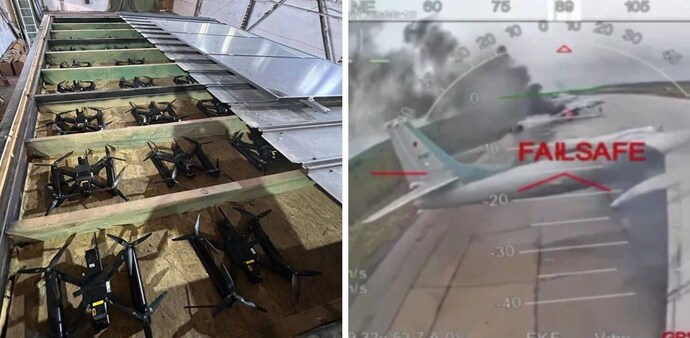
A fleet of remotely triggered FPV drones, hidden inside makeshift wooden cabins mounted on trucks, struck five Russian airbases deep in Siberia — targeting more than 40 strategic bombers. If confirmed, this would be Ukraine’s most damaging drone attack of the war, reshaping the battlefield far beyond the frontlines.
Ukraine’s SBU domestic intelligence agency is believed to have executed the covert operation, delivering drone-laden trucks inside Russia and parking them close to major military airbases. At a remote signal, the roofs of these cabins opened, releasing swarms of drones that hammered Russia’s long-range bomber fleet.
Social media videos showed plumes of fire and damaged Tu-95 and Tu-22 aircraft — bombers central to Russia’s cruise missile strikes against Ukraine and originally designed for nuclear payloads.
According to security experts, the drones were camouflaged in mobile cabins, driven across Russia’s vast interior under the radar. Once launched, the drones struck strategic targets before the trucks self-destructed, erasing evidence of deployment.
One of the key sites hit was Belaya Air Base, located about 85 km from Irkutsk in Siberia. Known for housing Russia’s Tu-95MS, Tu-160, and Tu-22M3 bombers armed with Kh-101, Kh-555, and Kh-55 cruise missiles, Belaya is a hub for Russia’s long-range offensive capabilities. Its distance from Ukraine — nearly 4,000 km — makes this Ukraine’s deepest drone strike of the war.
Military analysts warn that the loss of these bombers could deal a severe blow to Russia’s aerial capabilities, as the country can no longer manufacture many of these aircraft.
According to unverified reports, explosions and smoke were reported in Severomorsk, the main base of the Russian Northern Fleet and key port for nuclear-armed submarines. The base hosts two-thirds of Russia’s nuclear subs, including Yasen, Oscar II, Sierra II, and special-purpose vessels.
The operation also highlights the growing potency of Ukraine’s FPV drone fleet. At a cost of just $1,200 each, these drones have become the front-line soldiers of Ukraine’s defense — capable of taking out tanks and equipment worth millions. Reports suggest Ukraine is producing 200,000 FPV drones per month, with a shift toward domestic manufacturing reducing reliance on foreign parts.
This attack not only showcases Ukraine’s technological agility but also signals a new phase of warfare, where cheap, agile drones can deliver strategic blows across vast distances.
Reigniting the legendary Greek mythological move using a wooden horse to destroy Troy's unbreachable walls, Ukraine’s security services launched one of the most audacious drone operations in modern military history under the cloak of night and across 4,000 kilometers of hostile territory.
A fleet of remotely triggered FPV drones, hidden inside makeshift wooden cabins mounted on trucks, struck five Russian airbases deep in Siberia — targeting more than 40 strategic bombers. If confirmed, this would be Ukraine’s most damaging drone attack of the war, reshaping the battlefield far beyond the frontlines.
Ukraine’s SBU domestic intelligence agency is believed to have executed the covert operation, delivering drone-laden trucks inside Russia and parking them close to major military airbases. At a remote signal, the roofs of these cabins opened, releasing swarms of drones that hammered Russia’s long-range bomber fleet.
Social media videos showed plumes of fire and damaged Tu-95 and Tu-22 aircraft — bombers central to Russia’s cruise missile strikes against Ukraine and originally designed for nuclear payloads.
According to security experts, the drones were camouflaged in mobile cabins, driven across Russia’s vast interior under the radar. Once launched, the drones struck strategic targets before the trucks self-destructed, erasing evidence of deployment.
One of the key sites hit was Belaya Air Base, located about 85 km from Irkutsk in Siberia. Known for housing Russia’s Tu-95MS, Tu-160, and Tu-22M3 bombers armed with Kh-101, Kh-555, and Kh-55 cruise missiles, Belaya is a hub for Russia’s long-range offensive capabilities. Its distance from Ukraine — nearly 4,000 km — makes this Ukraine’s deepest drone strike of the war.
Military analysts warn that the loss of these bombers could deal a severe blow to Russia’s aerial capabilities, as the country can no longer manufacture many of these aircraft.
According to unverified reports, explosions and smoke were reported in Severomorsk, the main base of the Russian Northern Fleet and key port for nuclear-armed submarines. The base hosts two-thirds of Russia’s nuclear subs, including Yasen, Oscar II, Sierra II, and special-purpose vessels.
The operation also highlights the growing potency of Ukraine’s FPV drone fleet. At a cost of just $1,200 each, these drones have become the front-line soldiers of Ukraine’s defense — capable of taking out tanks and equipment worth millions. Reports suggest Ukraine is producing 200,000 FPV drones per month, with a shift toward domestic manufacturing reducing reliance on foreign parts.
This attack not only showcases Ukraine’s technological agility but also signals a new phase of warfare, where cheap, agile drones can deliver strategic blows across vast distances.