
Ukraine hits Moscow: Largest-ever drone assault strikes key oil refinery. Watch
The attack was part of a much wider Ukrainian drone campaign across Russian territory. Russia's Defence Ministry said nearly 1,000 drones were intercepted overnight across various regions, including areas near the Sea of Azov, indicating the scale of the operation.
- Jun 18, 2026,
- Updated Jun 18, 2026 4:42 PM IST
Ukraine launched what appeared to be its largest drone offensive against Moscow since the start of Russia's full-scale invasion, striking a key oil refinery, disrupting air traffic and underlining the growing reach of Kyiv's long-range drone capabilities.
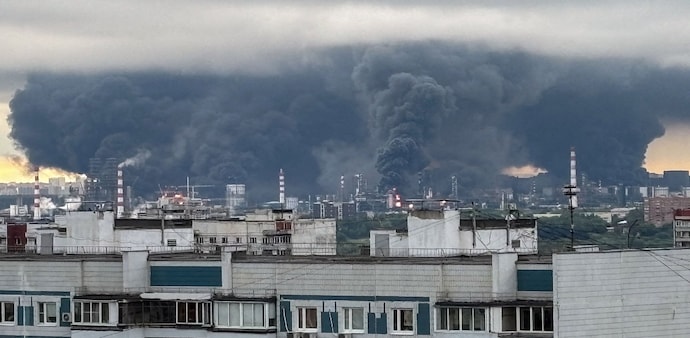
The overnight barrage targeted multiple locations across the Russian capital and surrounding region, with the Moscow oil refinery in the Kapotno district among the main targets. The facility was reportedly hit for the second time in a week, triggering fires and prompting an emergency response.
Moscow Mayor Sergei Sobyanin said Russian air defence systems intercepted 194 drones heading towards the capital, but several drones still got through, causing damage to the refinery and the Sadovod shopping centre in south-eastern Moscow.
The attack was part of a much wider Ukrainian drone campaign across Russian territory. Russia's Defence Ministry said nearly 1,000 drones were intercepted overnight across various regions, including areas near the Sea of Azov, indicating the scale of the operation.
The strikes also disrupted daily life in Moscow. Traffic was temporarily halted on sections of the city's ring road near the refinery, while flight operations at Vnukovo, Sheremetyevo and Zhukovsky airports were suspended before gradually resuming.
The scale and intensity of the attack appeared to surprise many residents of Moscow, a city that rarely faces direct wartime disruption and generally does not issue air raid alerts. Images and reports shared on social media showed debris falling across several districts, causing concern among residents.
Ukrainian President Volodymyr Zelensky described the attacks as retaliation for continued Russian strikes on Ukrainian cities and infrastructure. In remarks shared with reporters, he said Ukraine did not seek the war but warned that continued Russian aggression would bring consequences inside Russia.
He also renewed calls for Europe and the United States to tighten sanctions on Russia's defence industry, energy sector and broader economy, saying stronger economic pressure remained one of the most effective ways to force President Vladimir Putin to end the conflict.
Kyiv has increasingly focused on Russian energy infrastructure in recent months, viewing such facilities as critical to Moscow's war effort. The latest attack suggested that Ukraine's drone programme had evolved significantly since the war began, allowing deeper and more frequent strikes far from the front lines.
The offensive marked a new phase in the conflict, with long-range drone warfare increasingly bringing the effects of the war to Russia's largest cities. As both sides continue to expand their use of unmanned systems, strategic infrastructure is becoming a more important battleground in a conflict that shows little sign of ending.
Ukraine launched what appeared to be its largest drone offensive against Moscow since the start of Russia's full-scale invasion, striking a key oil refinery, disrupting air traffic and underlining the growing reach of Kyiv's long-range drone capabilities.
The overnight barrage targeted multiple locations across the Russian capital and surrounding region, with the Moscow oil refinery in the Kapotno district among the main targets. The facility was reportedly hit for the second time in a week, triggering fires and prompting an emergency response.
Moscow Mayor Sergei Sobyanin said Russian air defence systems intercepted 194 drones heading towards the capital, but several drones still got through, causing damage to the refinery and the Sadovod shopping centre in south-eastern Moscow.
The attack was part of a much wider Ukrainian drone campaign across Russian territory. Russia's Defence Ministry said nearly 1,000 drones were intercepted overnight across various regions, including areas near the Sea of Azov, indicating the scale of the operation.
The strikes also disrupted daily life in Moscow. Traffic was temporarily halted on sections of the city's ring road near the refinery, while flight operations at Vnukovo, Sheremetyevo and Zhukovsky airports were suspended before gradually resuming.
The scale and intensity of the attack appeared to surprise many residents of Moscow, a city that rarely faces direct wartime disruption and generally does not issue air raid alerts. Images and reports shared on social media showed debris falling across several districts, causing concern among residents.
Ukrainian President Volodymyr Zelensky described the attacks as retaliation for continued Russian strikes on Ukrainian cities and infrastructure. In remarks shared with reporters, he said Ukraine did not seek the war but warned that continued Russian aggression would bring consequences inside Russia.
He also renewed calls for Europe and the United States to tighten sanctions on Russia's defence industry, energy sector and broader economy, saying stronger economic pressure remained one of the most effective ways to force President Vladimir Putin to end the conflict.
Kyiv has increasingly focused on Russian energy infrastructure in recent months, viewing such facilities as critical to Moscow's war effort. The latest attack suggested that Ukraine's drone programme had evolved significantly since the war began, allowing deeper and more frequent strikes far from the front lines.
The offensive marked a new phase in the conflict, with long-range drone warfare increasingly bringing the effects of the war to Russia's largest cities. As both sides continue to expand their use of unmanned systems, strategic infrastructure is becoming a more important battleground in a conflict that shows little sign of ending.