
Washington Post lays off one-third of staff; critics blast Jeff Bezos
The layoffs include a reduction in overseas correspondents, the closure of the books department, and the suspension of the Post Reports podcast
- Feb 5, 2026,
- Updated Feb 5, 2026 3:39 PM IST
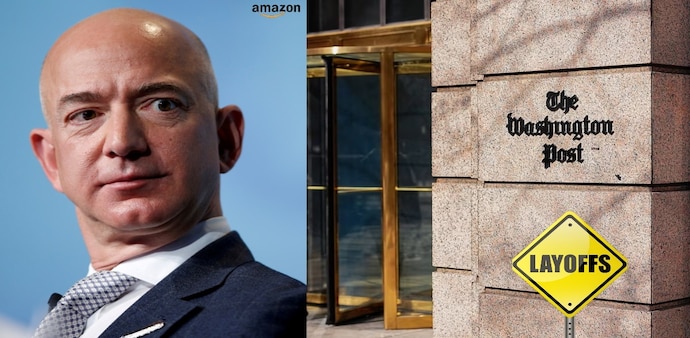
The Washington Post on Wednesday announced large-scale job cuts impacting nearly all news departments, including the elimination of its sports department. While the newspaper did not disclose the scale of the layoffs, The New York Times reported that more than 300 journalists - roughly one-third of the Post's staff - were affected.
The layoffs also include a reduction in overseas correspondents, the closure of the books department, and the suspension of the Post Reports podcast. The scale of the cuts marks a major moment for a publication long associated with landmark investigations, including its reporting on Watergate.
The decision was first announced by executive editor Matt Murray during a Zoom meeting with staff. Later, Murray in a statement posted on X said: "As we shared in our live stream earlier, the company is taking actions today to place The Washington Post on a stronger footing and better position us in this rapidly changing era of new technologies and evolving user habits. These moves include substantial newsroom reductions impacting nearly all news departments."
Murray said the pressure to act had intensified. He said that a "more flexible, sustainable model will help us better navigate unprecedented volatility, competition, technological change, news-consumption habits, and cost pressure."
He acknowledged that financial strain had been building for some time. "They have affected us in multiple rounds of cost cuts and buyouts, along with periodic constraints on other kinds of spending."
The decision triggered sharp reactions from political leaders and commentators, many of whom targeted Bezos directly.
US Senator Bernie Sanders questioned the rationale behind the decision, comparing the newsroom reductions with Bezos's recent personal spending. "If Jeff Bezos could afford to spend $75 million on the Melania movie & $500 million for a yacht to sail off to his $55 million wedding to give his wife a $5 million ring, please don't tell me he needed to fire one-third of the Washington Post staff," Sanders said.
Political analyst Ian Bremmer saw the cuts as part of a broader shift in Bezos's relationship with the paper, arguing that its ownership had long ceased to be about strengthening independent journalism. "The Washington Post is a political access play for Bezos, it's not about supporting independent media or promoting democracy," Bremmer wrote, adding that the moment made that reality harder to ignore. "If I had Bezos's resources I'd happily buy it from him today and expand the number of international correspondents."
Former US ambassador to Russia Michael McFaul, who previously wrote a monthly column for the paper, described the layoffs as a blow not just to the institution but to public understanding. "Such as a sad day at @washingtonpost," he wrote. "Bezos has destroyed one of the best newspapers of my lifetime." McFaul added that the consequences would extend beyond the newsroom: "Americans and the world will understand less about the world now when we need to understand more."
The Washington Post on Wednesday announced large-scale job cuts impacting nearly all news departments, including the elimination of its sports department. While the newspaper did not disclose the scale of the layoffs, The New York Times reported that more than 300 journalists - roughly one-third of the Post's staff - were affected.
The layoffs also include a reduction in overseas correspondents, the closure of the books department, and the suspension of the Post Reports podcast. The scale of the cuts marks a major moment for a publication long associated with landmark investigations, including its reporting on Watergate.
The decision was first announced by executive editor Matt Murray during a Zoom meeting with staff. Later, Murray in a statement posted on X said: "As we shared in our live stream earlier, the company is taking actions today to place The Washington Post on a stronger footing and better position us in this rapidly changing era of new technologies and evolving user habits. These moves include substantial newsroom reductions impacting nearly all news departments."
Murray said the pressure to act had intensified. He said that a "more flexible, sustainable model will help us better navigate unprecedented volatility, competition, technological change, news-consumption habits, and cost pressure."
He acknowledged that financial strain had been building for some time. "They have affected us in multiple rounds of cost cuts and buyouts, along with periodic constraints on other kinds of spending."
The decision triggered sharp reactions from political leaders and commentators, many of whom targeted Bezos directly.
US Senator Bernie Sanders questioned the rationale behind the decision, comparing the newsroom reductions with Bezos's recent personal spending. "If Jeff Bezos could afford to spend $75 million on the Melania movie & $500 million for a yacht to sail off to his $55 million wedding to give his wife a $5 million ring, please don't tell me he needed to fire one-third of the Washington Post staff," Sanders said.
Political analyst Ian Bremmer saw the cuts as part of a broader shift in Bezos's relationship with the paper, arguing that its ownership had long ceased to be about strengthening independent journalism. "The Washington Post is a political access play for Bezos, it's not about supporting independent media or promoting democracy," Bremmer wrote, adding that the moment made that reality harder to ignore. "If I had Bezos's resources I'd happily buy it from him today and expand the number of international correspondents."
Former US ambassador to Russia Michael McFaul, who previously wrote a monthly column for the paper, described the layoffs as a blow not just to the institution but to public understanding. "Such as a sad day at @washingtonpost," he wrote. "Bezos has destroyed one of the best newspapers of my lifetime." McFaul added that the consequences would extend beyond the newsroom: "Americans and the world will understand less about the world now when we need to understand more."