
Why Greenland matters to Trump suddenly: The defence logic behind America's Arctic push
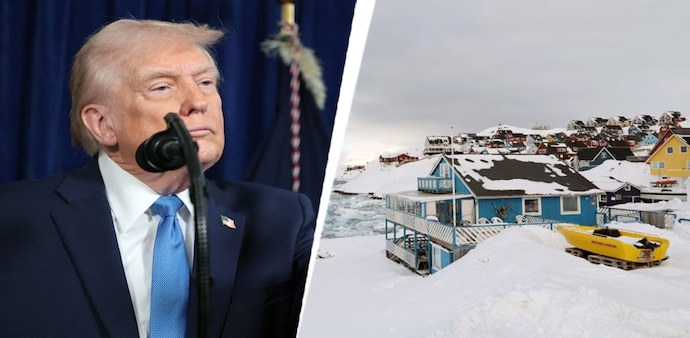
Greenland, a semiautonomous territory of Denmark, sits between Europe and North America and borders both the Arctic and North Atlantic Oceans - areas that are increasingly central to military planning as polar ice melts.
- Jan 20, 2026,
- Updated Jan 20, 2026 4:52 PM IST
US President Donald Trump has intensified his public push to bring Greenland under American control. He has repeatedly argued that Greenland's geography, resources, and Arctic location make it central to US national security. "If we don't do (acquire) it, Russia or China will," Trump told reporters in January.
Greenland, a semiautonomous territory of Denmark, sits between Europe and North America and borders both the Arctic and North Atlantic Oceans - areas that are increasingly central to military planning as polar ice melts. The US and Denmark are NATO allies, with a long-standing bilateral defence partnership that already includes shared patrols around Greenland.
Trump has argued that acquiring Greenland would allow Washington to expand its military, air, naval, and space operations in the Arctic, even though US forces already operate on the island.
Why Greenland has become strategically important
Security experts say Greenland has become more important because of melting ice, changing military technology, and great-power competition in the Arctic.
"Greenland is growing in importance as we find ourselves in a global competition with China and in a new technological revolution with regards to warfare," Rebecca Pincus, director of the Wilson Center Polar Institute, told Radio Free Europe/Radio Liberty. "So, Greenland is important from a missile-defense perspective, from a space perspective, and from a global competition perspective."
Former Indian Army Lieutenant General Syed Ata Hasnain, in an opinion piece, says Greenland occupies a commanding position astride the shortest air and missile routes between Eurasia and North America.
During the Cold War, Hasnain states, the Greenland–Iceland–United Kingdom gap was central to NATO strategy, allowing Western forces to monitor Soviet submarine movement into the Atlantic. "For decades, the Arctic functioned as a frozen buffer - remote, inaccessible, and largely immune to sustained military competition," he writes in Firstpost.
However, that buffer, he adds, no longer exists. "Climate change is steadily transforming the Arctic from a barrier into an active domain. Melting ice is opening sea routes, extending operational windows, and making sustained presence feasible," Hasnain said.
According to the former general, advances in military technology - hypersonic missiles, long-range precision strike, space-based sensors, missile defence, and undersea capabilities - are collapsing distance in unprecedented ways.
"In such a world, Greenland ceases to be peripheral and becomes forward space. Distance, once a source of security, is shrinking; reaction time is reducing; strategic warning for the US homeland is compressing," Hasnain explains.
The US military presence in Greenland
The US already maintains a military footprint on Greenland. The island is home to the Pituffik Space Base, the US Defense Department's northernmost base, where around 150 American troops are stationed. The facility serves as a first line of defence against a missile attack originating over the Arctic and plays a key role in space surveillance and early-warning systems.
Hasnain points out that Russia has re-militarised significant portions of the Arctic, reopening bases and expanding its northern capabilities. China, too, has declared itself a 'near-Arctic state', and has steadily increased its polar footprint through research stations, investments, and diplomatic engagement. "One should not expect American strategic complacency in such circumstances," he adds.
Russia and China in the Arctic
Russia holds the largest territorial footprint in the Arctic. Its coastline accounts for more than half of the region's shoreline. Military activity there, which was extensive during the Soviet era, has increased again in recent years as Moscow has reopened bases and expanded operations.
Moscow considers the Arctic its number one maritime priority, former US 2nd Fleet commander Vice Admiral Dan Dwyer said during a Navy League conference last year. Russia is operating six dual-use military bases, a dozen airfields, and a fleet of at least 40 icebreakers, according to the US Navy.
China, meanwhile, has expanded its Arctic presence. It operates four icebreakers - compared with roughly forty for Russia and just one for the United States - and has made increasingly visible moves northward.
In 2014, Chinese President Xi Jinping said China aspired to become a polar power. In 2024, China sent three icebreakers into Arctic waters for the first time, according to the Council on Foreign Relations (CFR).
Why Trump's 'Golden Dome' matters
Trump has increasingly linked Greenland to his proposed 'Golden Dome' missile system, describing the island as indispensable to the project. "The United States needs Greenland for the purpose of National Security," Trump wrote on Truth Social. "It is vital for the Golden Dome that we are building. NATO should be leading the way for us to get it. IF WE DON’T, RUSSIA OR CHINA WILL, AND THAT IS NOT GOING TO HAPPEN!"
Trump has said Greenland's position would strengthen early-warning, tracking, and interception capabilities under the Golden Dome concept, which he has described as a shield against advanced missile threats.
An executive order signed last May said Trump's Golden Dome system would protect the US from foreign missile attacks. Trump claims the system would be capable of shooting down hypersonic, ballistic, and advanced cruise missiles, as well as drones - even if they are launched from the other side of the world or from space.
Hasnain argues that while Trump's rhetoric is unsettling, the underlying strategic concern is real. "Seen in this light, the question is not why Donald Trump seems obsessed with Greenland, but why Greenland has become relevant now," he says. "Any US administration with a realist strategic approach and confronted with a rapidly militarising Arctic and shrinking strategic depth would eventually be forced to reckon with Greenland's significance."
US President Donald Trump has intensified his public push to bring Greenland under American control. He has repeatedly argued that Greenland's geography, resources, and Arctic location make it central to US national security. "If we don't do (acquire) it, Russia or China will," Trump told reporters in January.
Greenland, a semiautonomous territory of Denmark, sits between Europe and North America and borders both the Arctic and North Atlantic Oceans - areas that are increasingly central to military planning as polar ice melts. The US and Denmark are NATO allies, with a long-standing bilateral defence partnership that already includes shared patrols around Greenland.
Trump has argued that acquiring Greenland would allow Washington to expand its military, air, naval, and space operations in the Arctic, even though US forces already operate on the island.
Why Greenland has become strategically important
Security experts say Greenland has become more important because of melting ice, changing military technology, and great-power competition in the Arctic.
"Greenland is growing in importance as we find ourselves in a global competition with China and in a new technological revolution with regards to warfare," Rebecca Pincus, director of the Wilson Center Polar Institute, told Radio Free Europe/Radio Liberty. "So, Greenland is important from a missile-defense perspective, from a space perspective, and from a global competition perspective."
Former Indian Army Lieutenant General Syed Ata Hasnain, in an opinion piece, says Greenland occupies a commanding position astride the shortest air and missile routes between Eurasia and North America.
During the Cold War, Hasnain states, the Greenland–Iceland–United Kingdom gap was central to NATO strategy, allowing Western forces to monitor Soviet submarine movement into the Atlantic. "For decades, the Arctic functioned as a frozen buffer - remote, inaccessible, and largely immune to sustained military competition," he writes in Firstpost.
However, that buffer, he adds, no longer exists. "Climate change is steadily transforming the Arctic from a barrier into an active domain. Melting ice is opening sea routes, extending operational windows, and making sustained presence feasible," Hasnain said.
According to the former general, advances in military technology - hypersonic missiles, long-range precision strike, space-based sensors, missile defence, and undersea capabilities - are collapsing distance in unprecedented ways.
"In such a world, Greenland ceases to be peripheral and becomes forward space. Distance, once a source of security, is shrinking; reaction time is reducing; strategic warning for the US homeland is compressing," Hasnain explains.
The US military presence in Greenland
The US already maintains a military footprint on Greenland. The island is home to the Pituffik Space Base, the US Defense Department's northernmost base, where around 150 American troops are stationed. The facility serves as a first line of defence against a missile attack originating over the Arctic and plays a key role in space surveillance and early-warning systems.
Hasnain points out that Russia has re-militarised significant portions of the Arctic, reopening bases and expanding its northern capabilities. China, too, has declared itself a 'near-Arctic state', and has steadily increased its polar footprint through research stations, investments, and diplomatic engagement. "One should not expect American strategic complacency in such circumstances," he adds.
Russia and China in the Arctic
Russia holds the largest territorial footprint in the Arctic. Its coastline accounts for more than half of the region's shoreline. Military activity there, which was extensive during the Soviet era, has increased again in recent years as Moscow has reopened bases and expanded operations.
Moscow considers the Arctic its number one maritime priority, former US 2nd Fleet commander Vice Admiral Dan Dwyer said during a Navy League conference last year. Russia is operating six dual-use military bases, a dozen airfields, and a fleet of at least 40 icebreakers, according to the US Navy.
China, meanwhile, has expanded its Arctic presence. It operates four icebreakers - compared with roughly forty for Russia and just one for the United States - and has made increasingly visible moves northward.
In 2014, Chinese President Xi Jinping said China aspired to become a polar power. In 2024, China sent three icebreakers into Arctic waters for the first time, according to the Council on Foreign Relations (CFR).
Why Trump's 'Golden Dome' matters
Trump has increasingly linked Greenland to his proposed 'Golden Dome' missile system, describing the island as indispensable to the project. "The United States needs Greenland for the purpose of National Security," Trump wrote on Truth Social. "It is vital for the Golden Dome that we are building. NATO should be leading the way for us to get it. IF WE DON’T, RUSSIA OR CHINA WILL, AND THAT IS NOT GOING TO HAPPEN!"
Trump has said Greenland's position would strengthen early-warning, tracking, and interception capabilities under the Golden Dome concept, which he has described as a shield against advanced missile threats.
An executive order signed last May said Trump's Golden Dome system would protect the US from foreign missile attacks. Trump claims the system would be capable of shooting down hypersonic, ballistic, and advanced cruise missiles, as well as drones - even if they are launched from the other side of the world or from space.
Hasnain argues that while Trump's rhetoric is unsettling, the underlying strategic concern is real. "Seen in this light, the question is not why Donald Trump seems obsessed with Greenland, but why Greenland has become relevant now," he says. "Any US administration with a realist strategic approach and confronted with a rapidly militarising Arctic and shrinking strategic depth would eventually be forced to reckon with Greenland's significance."