
‘The best we could get…’: EU signs trade deal with US with 15% tariff
US-EU trade deal: Under the terms of the deal, the European Union has committed to purchasing $750 billion worth of US energy, including liquefied natural gas and nuclear fuel, over the coming years.
- Jul 28, 2025,
- Updated Jul 28, 2025 8:06 AM IST
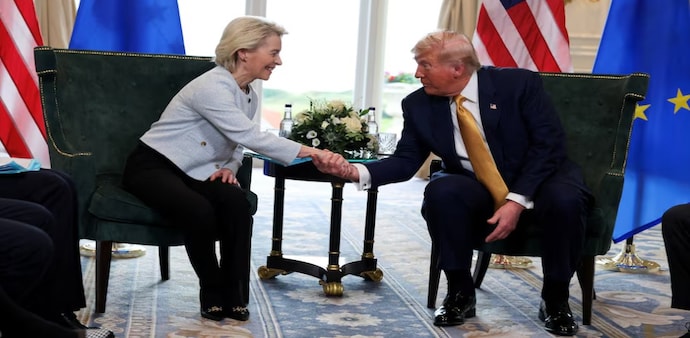
The United States and the European Union have signed a landmark trade agreement, imposing a 15 per cent import tariff on most EU goods, a reduction from the previously threatened 30 per cent rate. This agreement was announced by US President Donald Trump and European Commission President Ursula von der Leyen at Trump's golf course in Scotland.
The agreement averts a potential trade war between the US and the EU, which together account for nearly a third of global trade. The 15 per cent tariff, though lower than initially feared, is still significant, with von der Leyen describing it as "the best we could get." The zero-for-zero tariff rate was agreed upon for strategic products like aircraft and certain chemicals.
Under the terms of the deal, the European Union has committed to purchasing $750 billion worth of US energy, including liquefied natural gas and nuclear fuel, over the coming years. Von der Leyen emphasised the significance of the agreement in stabilising and bringing predictability to the global trade environment.
German Chancellor Friedrich Merz welcomed the deal, as it avoids a trade conflict that could severely impact Germany's export-driven economy, especially its large automotive sector, which had been facing a 27.5 per cent US tariff on car and parts imports. The deal is expected to benefit many EU companies if all details are adhered to faithfully.
The agreement still leaves several issues unresolved, such as the tariff rates on spirits, a point of contention on both sides of the Atlantic. The deal mirrors aspects of a previous framework accord with Japan. Trump maintains the right to increase tariffs if commitments are not met, underscoring the ongoing need for diplomatic engagement.
The euro saw a slight appreciation against the dollar following the announcement, reflecting market approval. Von der Leyen remarked, "We still have too much Russian LNG that is coming through the back door," highlighting the EU's commitment to reducing dependency on Russian energy imports.
Ultimately, von der Leyen declared, "Today's deal creates certainty in uncertain times, delivers stability and predictability.”
The United States and the European Union have signed a landmark trade agreement, imposing a 15 per cent import tariff on most EU goods, a reduction from the previously threatened 30 per cent rate. This agreement was announced by US President Donald Trump and European Commission President Ursula von der Leyen at Trump's golf course in Scotland.
The agreement averts a potential trade war between the US and the EU, which together account for nearly a third of global trade. The 15 per cent tariff, though lower than initially feared, is still significant, with von der Leyen describing it as "the best we could get." The zero-for-zero tariff rate was agreed upon for strategic products like aircraft and certain chemicals.
Under the terms of the deal, the European Union has committed to purchasing $750 billion worth of US energy, including liquefied natural gas and nuclear fuel, over the coming years. Von der Leyen emphasised the significance of the agreement in stabilising and bringing predictability to the global trade environment.
German Chancellor Friedrich Merz welcomed the deal, as it avoids a trade conflict that could severely impact Germany's export-driven economy, especially its large automotive sector, which had been facing a 27.5 per cent US tariff on car and parts imports. The deal is expected to benefit many EU companies if all details are adhered to faithfully.
The agreement still leaves several issues unresolved, such as the tariff rates on spirits, a point of contention on both sides of the Atlantic. The deal mirrors aspects of a previous framework accord with Japan. Trump maintains the right to increase tariffs if commitments are not met, underscoring the ongoing need for diplomatic engagement.
The euro saw a slight appreciation against the dollar following the announcement, reflecting market approval. Von der Leyen remarked, "We still have too much Russian LNG that is coming through the back door," highlighting the EU's commitment to reducing dependency on Russian energy imports.
Ultimately, von der Leyen declared, "Today's deal creates certainty in uncertain times, delivers stability and predictability.”