
USS Abraham Lincoln reaches Middle East: Trump says fleet sent 'just in case' amid Iran tensions
The United States Navy's Abraham Lincoln carrier strike group arrived in the United States Central Command area of responsibility on Monday, after being redirected from operations in the Indo-Pacific amid tensions with Iran
- Jan 27, 2026,
- Updated Jan 27, 2026 8:35 AM IST
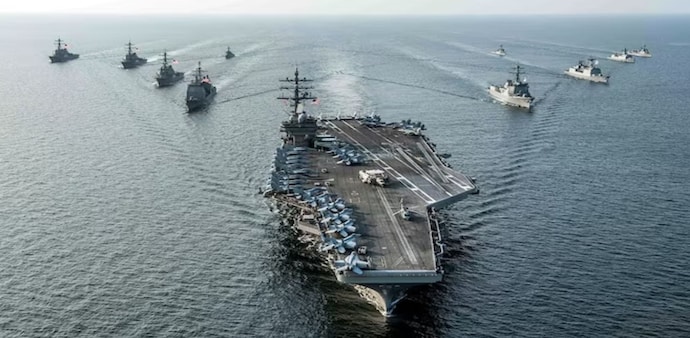
A US aircraft carrier strike group led by the USS Abraham Lincoln has entered Middle East waters, signalling a fresh escalation in Washington’s military posture as tensions with Iran deepen. The move has revived speculation that US President Donald Trump could order airstrikes on Tehran, amid pressure on Iran over its crackdown on nationwide protests.
The United States Navy's Abraham Lincoln carrier strike group arrived in the United States Central Command area of responsibility on Monday, after being redirected from operations in the Indo-Pacific amid tensions with Iran. The USS Abraham Lincoln (CVN-72), a Nimitz-class nuclear-powered aircraft carrier and the lead vessel of Carrier Strike Group 3, passed through the Strait of Malacca on January 19.
The transit was accompanied by three Arleigh Burke-class guided-missile destroyers, USS Frank E. Petersen Jr. (DDG-121), USS Spruance (DDG-111) and USS Michael Murphy (DDG-112), which provided escort during the passage.
In a post on social media, United States Central Command said the carrier and its strike group "is currently deployed to the Middle East to promote regional security and stability."
The deployment adds thousands of US service members to the region and marks the first time a carrier has been in the Middle East since October, when the USS Gerald R. Ford was sent to the Caribbean.
Trump links the build-up to pressure over Iran protests
Trump has tied the military build-up to pressure on Iran over its handling of nationwide protests, which began in late December and have drawn international criticism. Last week, he told reporters the ships were sent "just in case."
"We have a massive fleet heading in that direction, and maybe we won’t have to use it," he said, pointing to a strategy built around both deterrence and uncertainty.
Earlier, Trump threatened possible military action if Iran carried out mass executions of prisoners or killed peaceful demonstrators. Activists say nearly 6,000 people have died and more than 41,800 have been detained in the country’s crackdown, though Iran’s official toll is lower, according to the Associated Press.
Trump later suggested Iran had paused planned executions of more than 800 detainees, a claim Tehran’s top prosecutor dismissed as completely false.
Pentagon adds more assets near Iran
The Lincoln strike group’s arrival comes as the Pentagon also moves additional assets into the region, including fighter jets and military cargo flights, expanding America’s military footprint near Iran.
With the carrier now in the region, Washington has a broader range of operational options if Trump decides to intensify pressure on Tehran. Iran’s leadership has warned that any attack would be met with force, sharpening regional concerns over escalation.
A US aircraft carrier strike group led by the USS Abraham Lincoln has entered Middle East waters, signalling a fresh escalation in Washington’s military posture as tensions with Iran deepen. The move has revived speculation that US President Donald Trump could order airstrikes on Tehran, amid pressure on Iran over its crackdown on nationwide protests.
The United States Navy's Abraham Lincoln carrier strike group arrived in the United States Central Command area of responsibility on Monday, after being redirected from operations in the Indo-Pacific amid tensions with Iran. The USS Abraham Lincoln (CVN-72), a Nimitz-class nuclear-powered aircraft carrier and the lead vessel of Carrier Strike Group 3, passed through the Strait of Malacca on January 19.
The transit was accompanied by three Arleigh Burke-class guided-missile destroyers, USS Frank E. Petersen Jr. (DDG-121), USS Spruance (DDG-111) and USS Michael Murphy (DDG-112), which provided escort during the passage.
In a post on social media, United States Central Command said the carrier and its strike group "is currently deployed to the Middle East to promote regional security and stability."
The deployment adds thousands of US service members to the region and marks the first time a carrier has been in the Middle East since October, when the USS Gerald R. Ford was sent to the Caribbean.
Trump links the build-up to pressure over Iran protests
Trump has tied the military build-up to pressure on Iran over its handling of nationwide protests, which began in late December and have drawn international criticism. Last week, he told reporters the ships were sent "just in case."
"We have a massive fleet heading in that direction, and maybe we won’t have to use it," he said, pointing to a strategy built around both deterrence and uncertainty.
Earlier, Trump threatened possible military action if Iran carried out mass executions of prisoners or killed peaceful demonstrators. Activists say nearly 6,000 people have died and more than 41,800 have been detained in the country’s crackdown, though Iran’s official toll is lower, according to the Associated Press.
Trump later suggested Iran had paused planned executions of more than 800 detainees, a claim Tehran’s top prosecutor dismissed as completely false.
Pentagon adds more assets near Iran
The Lincoln strike group’s arrival comes as the Pentagon also moves additional assets into the region, including fighter jets and military cargo flights, expanding America’s military footprint near Iran.
With the carrier now in the region, Washington has a broader range of operational options if Trump decides to intensify pressure on Tehran. Iran’s leadership has warned that any attack would be met with force, sharpening regional concerns over escalation.