
'We can be our own best customer': Canada’s Mark Carney hits back at Trump’s 100% tariff threat
Trump warned that Canada would face the tariff if it moved ahead with a trade deal with China.
- Jan 25, 2026,
- Updated Jan 25, 2026 10:45 AM IST
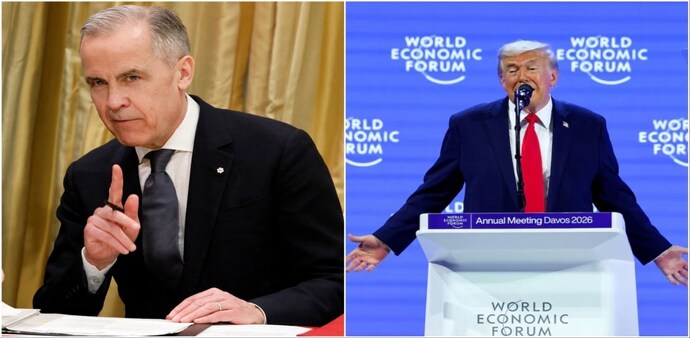
Canadian Prime Minister Mark Carney on Saturday called on Canadians to support homegrown products after US President Donald Trump threatened to impose a sweeping 100% tariff on Canadian imports, raising fresh concerns for businesses and workers.
“With our economy under threat from abroad, Canadians have made a choice to focus on what we can control,” Carney said in a video message. “We can’t control what other nations do, we can be our own best customer.”
Trump warned that Canada would face the tariff if it moved ahead with a trade deal with China. He also said China would “eat Canada alive, completely devour it, including the destruction of their businesses, social fabric, and general way of life".
The warning came weeks after Carney travelled to China to repair strained ties and reached an agreement with Canada’s second-largest trading partner after the US.
Trump initially welcomed the move.
Ottawa later clarified that the engagement did not amount to a free trade agreement, but focused on resolving several important tariff issues.
China’s embassy in Canada said Beijing was ready to work with Ottawa to implement the “important consensus” reached by the two countries’ leaders.
Trump on Saturday also accused China of trying to use Canada as a route to bypass US tariffs. “If Governor Carney thinks he is going to make Canada a ‘Drop Off Port’ for China to send goods and products into the United States, he is sorely mistaken,” he said.
In another post, Trump added, “The last thing the World needs is to have China take over Canada. It’s NOT going to happen, or even come close to happening!”
Economists warn that if imposed, the tariff would sharply raise costs for Canadian exporters, hitting sectors such as metal manufacturing, autos and machinery, and increasing uncertainty for workers dependent on cross-border trade.
Canadian Prime Minister Mark Carney on Saturday called on Canadians to support homegrown products after US President Donald Trump threatened to impose a sweeping 100% tariff on Canadian imports, raising fresh concerns for businesses and workers.
“With our economy under threat from abroad, Canadians have made a choice to focus on what we can control,” Carney said in a video message. “We can’t control what other nations do, we can be our own best customer.”
Trump warned that Canada would face the tariff if it moved ahead with a trade deal with China. He also said China would “eat Canada alive, completely devour it, including the destruction of their businesses, social fabric, and general way of life".
The warning came weeks after Carney travelled to China to repair strained ties and reached an agreement with Canada’s second-largest trading partner after the US.
Trump initially welcomed the move.
Ottawa later clarified that the engagement did not amount to a free trade agreement, but focused on resolving several important tariff issues.
China’s embassy in Canada said Beijing was ready to work with Ottawa to implement the “important consensus” reached by the two countries’ leaders.
Trump on Saturday also accused China of trying to use Canada as a route to bypass US tariffs. “If Governor Carney thinks he is going to make Canada a ‘Drop Off Port’ for China to send goods and products into the United States, he is sorely mistaken,” he said.
In another post, Trump added, “The last thing the World needs is to have China take over Canada. It’s NOT going to happen, or even come close to happening!”
Economists warn that if imposed, the tariff would sharply raise costs for Canadian exporters, hitting sectors such as metal manufacturing, autos and machinery, and increasing uncertainty for workers dependent on cross-border trade.