
BT Exclusive: India's first flex-fuel car delivers 11.8 kmpl mileage. But that's not the big surprise
Can an 85% ethanol-powered car feel just like a regular petrol vehicle? That's the question Business Today set out to answer after becoming one of the first news organisations in India to drive Maruti Suzuki's E85 flex-fuel Wagon R.
- Jul 3, 2026,
- Updated Jul 3, 2026 6:09 PM IST
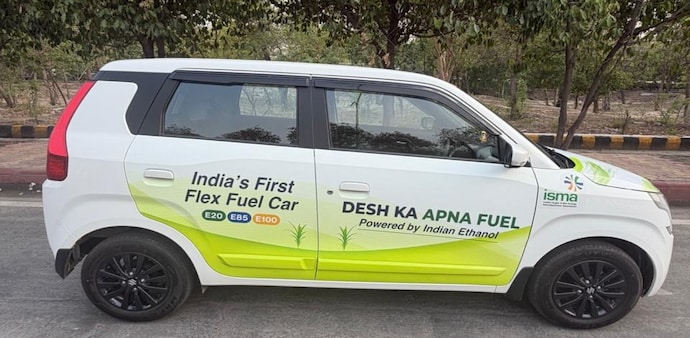
The Wagon R Flex Fuel is India's first passenger car capable of running on E85 — a blend of 85% ethanol and 15% petrol. The vehicle represents the next stage of India's ethanol-blending roadmap as the government looks beyond E20 petrol to reduce crude oil imports and increase the use of domestically produced biofuels.
But before talking about ethanol, octane ratings or fuel economics, one simple question needed an answer: Does it drive any differently from a regular Wagon R?
Feels surprisingly familiar
Business Today drove the E85-powered Wagon R for nearly 30 kilometres across Delhi, covering city traffic, flyovers and open stretches.
The biggest surprise wasn't the fuel. It was how familiar the car felt.
Despite running on E85, the Wagon R did not feel noticeably different from its petrol sibling in everyday driving. Engine refinement remained largely unchanged, throttle response was predictable, and there was no obvious lack of performance during city driving. Whether negotiating traffic or cruising on open stretches, the car behaved much like a conventional petrol-powered Wagon R.
At one point during the drive, the vehicle continued to pull cleanly even in higher gears at lower speeds, reinforcing the impression that Maruti Suzuki has calibrated the engine well for everyday usability.
A simple vibration test
One common concern around higher ethanol blends is whether they make engines rougher.
To check this, Business Today performed a simple experiment by placing a water bottle on the running engine.
The bottle remained largely stable, indicating that engine vibrations at idle were comparable to those of a regular petrol Wagon R.
The fuel itself also did not have any unusually strong or distinctive smell compared to what one would normally associate with petrol.
What mileage did it return?
During Business Today's mixed driving route, the Wagon R's multi-information display (MID) indicated an average fuel efficiency of 11.8 kmpl.
However, this should not be treated as the vehicle's definitive real-world mileage.
The drive included heavy Delhi traffic, repeated stops for filming, idling, multiple acceleration runs and performance checks. A longer controlled fuel economy test would be required to establish the vehicle's actual real-world efficiency.
Why is E85 different?
Ethanol has a significantly higher octane rating than regular petrol, giving it better resistance to engine knock. However, ethanol also contains less energy per litre than petrol, which generally results in lower fuel economy.
That is why the economics of E85 vehicles will ultimately depend not just on mileage, but also on the retail price of E85 fuel and its widespread availability.
Real challenge isn't the car
If the drive proved one thing, it is that the technology itself appears ready. The bigger challenge now lies outside the vehicle.
For flex-fuel vehicles to become mainstream, India will need a widespread E85 fuel distribution network, competitive fuel pricing and sufficient ethanol production to support higher blending levels.
Until that ecosystem develops, E85 vehicles are likely to remain a niche offering despite demonstrating that higher ethanol blends can power a conventional passenger car without dramatically altering the everyday driving experience.
The Wagon R Flex Fuel is India's first passenger car capable of running on E85 — a blend of 85% ethanol and 15% petrol. The vehicle represents the next stage of India's ethanol-blending roadmap as the government looks beyond E20 petrol to reduce crude oil imports and increase the use of domestically produced biofuels.
But before talking about ethanol, octane ratings or fuel economics, one simple question needed an answer: Does it drive any differently from a regular Wagon R?
Feels surprisingly familiar
Business Today drove the E85-powered Wagon R for nearly 30 kilometres across Delhi, covering city traffic, flyovers and open stretches.
The biggest surprise wasn't the fuel. It was how familiar the car felt.
Despite running on E85, the Wagon R did not feel noticeably different from its petrol sibling in everyday driving. Engine refinement remained largely unchanged, throttle response was predictable, and there was no obvious lack of performance during city driving. Whether negotiating traffic or cruising on open stretches, the car behaved much like a conventional petrol-powered Wagon R.
At one point during the drive, the vehicle continued to pull cleanly even in higher gears at lower speeds, reinforcing the impression that Maruti Suzuki has calibrated the engine well for everyday usability.
A simple vibration test
One common concern around higher ethanol blends is whether they make engines rougher.
To check this, Business Today performed a simple experiment by placing a water bottle on the running engine.
The bottle remained largely stable, indicating that engine vibrations at idle were comparable to those of a regular petrol Wagon R.
The fuel itself also did not have any unusually strong or distinctive smell compared to what one would normally associate with petrol.
What mileage did it return?
During Business Today's mixed driving route, the Wagon R's multi-information display (MID) indicated an average fuel efficiency of 11.8 kmpl.
However, this should not be treated as the vehicle's definitive real-world mileage.
The drive included heavy Delhi traffic, repeated stops for filming, idling, multiple acceleration runs and performance checks. A longer controlled fuel economy test would be required to establish the vehicle's actual real-world efficiency.
Why is E85 different?
Ethanol has a significantly higher octane rating than regular petrol, giving it better resistance to engine knock. However, ethanol also contains less energy per litre than petrol, which generally results in lower fuel economy.
That is why the economics of E85 vehicles will ultimately depend not just on mileage, but also on the retail price of E85 fuel and its widespread availability.
Real challenge isn't the car
If the drive proved one thing, it is that the technology itself appears ready. The bigger challenge now lies outside the vehicle.
For flex-fuel vehicles to become mainstream, India will need a widespread E85 fuel distribution network, competitive fuel pricing and sufficient ethanol production to support higher blending levels.
Until that ecosystem develops, E85 vehicles are likely to remain a niche offering despite demonstrating that higher ethanol blends can power a conventional passenger car without dramatically altering the everyday driving experience.