
Can Tata Sierra do what Curvv couldn’t for India's third largest carmaker?
Tata Motors has reignited its SUV ambitions with the launch of the all-new Sierra, aiming to break into India’s fiercely contested mid-size SUV market. Despite strong positions in compact SUVs, the homegrown automaker has long struggled to gain traction in the mid-size category. With rivals Hyundai Creta, Maruti Victoris and others dominating the space, Tata is betting big on the Sierra to revive momentum and reclaim lost ground.
- Nov 26, 2025,
- Updated Nov 26, 2025 8:20 PM IST
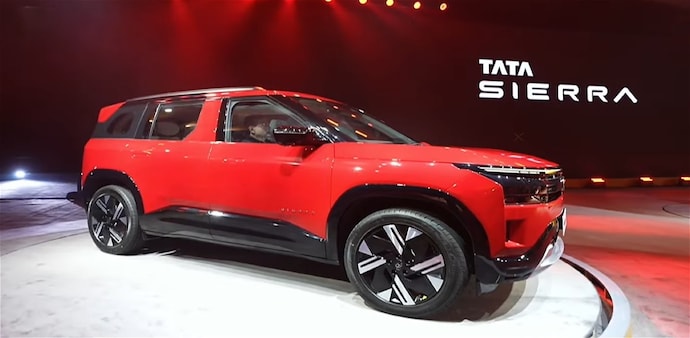
Tata Motors Passenger Vehicles on Tuesday launched the Sierra SUV (sport-utility vehicle), as India’s third-largest carmaker by volume hopes to gain a foothold in the crowded mid-size SUV segment.
The homegrown automaker has struggled to gain market share in the mid-size SUV space. Even though it entered the segment with the launch of the Curvv SUV last year, volumes have remained muted. Currently, South Korean carmaker Hyundai Motor India Ltd dominates this segment with the Creta. Japanese carmaker Maruti Suzuki India Ltd, too, is vying for the pole position after it launched the Victoris in September, its second mid-size SUV after the Grand Vitara.
Other significant models include Toyota Hyryder and Kia Seltos.
Tata Motors badly needs a blockbuster product in the mid-SUV segment, says Puneet Gupta, Director, India & ASEAN Automotive Market at S&P Global Mobility.
“If you see the previous launches, they somehow have not been able to scale volumes, for example, the Curvv was not able to excite consumers even though it was available in multiple powertrain options of petrol, diesel and electric,” says Gupta.
The Sierra launch, according to Gupta, is very critical for Tata Motors, primarily because the mid-size segment is a “sweet spot” for all OEMs in the country. “It is a profitable segment due to aspirational customers. It’s a win-win for OEMs. It’s important for Tata Motors to be present in this segment aggressively because they have been losing their ranking on the pecking order while rival Mahindra & Mahindra is growing,” says Gupta.
About 55% of 4 million cars sold in India are SUVs. Of this, nearly 1 million sales come from mid-size SUVs. The Indian SUV market comprises mainly three segments: entry (sub-4-metre), mid-size (4.3 metre) and premium (over 4.5 metre). In the entry SUV segment, Tata Motors is among the leading carmakers with compact SUVs -- the Nexon and the Punch.
The Tata Punch was the top-selling car in 2024, while the Nexon became the best-seller in October 2025. In the premium SUV segment, M&M is the market leader with the XUV700 and Scorpio N. Tata’s Safari and Harrier are far behind. “The Scorpio, it is doing 14,000-15,000 units a month while the XUV700 has been doing 5,000-7,000 units a month. So, Tata has been clearly missing something. They clearly needed to push Sierra to the levels above 10,000 units if they really want to do justice to the product and the legacy it carries as a brand,” says Gupta. With prices starting from Rs 11.49 lakh (ex-showroom), the all-new Tata Sierra is named after the original Tata Sierra of the 1990s.
Gupta says that Tata should not forget that they are competing in a segment which is already very competitive and none of the players are going to cede it so easily. “Hyundai is dependent a lot on the Creta. Similarly, Maruti is banking on the Victoris. It’s not going to be a cakewalk for Tata. That’s why the entry-level pricing has been very aggressive. It should not be all about entry pricing. They need to make pricing of the top variants attractive,” he says. The carmaker is expected to announce the full price list in December.
One advantage that Tata has is that they offer cars in multiple powertrains: ICE and electric, says Gupta. The Sierra EV is slated to be launched next year. Secondly, the product is also very different from its competitors, he adds. Aside from volumes, Tata is also counting on the Sierra to drive profitability, which took a hit in the September quarter.
Tata Motors Passenger Vehicles’ ICE EBITDA margins came in at 6.4%, almost 2% down year-on-year, owing to higher commodity costs and adverse pricing.
“The challenge for us is on the ICE side. EBITDA margin in the last one year have dropped by 2%. Commodity inflation over the last two quarters has been steep. There hasn’t been an opportunity to take a price increase. ICE profitability will remain muted for one more quarter and it is expected to come back very strongly in Q4 with price increases, lower VME and fresh launches,” Shailesh Chandra, MD & CEO, Tata Motors Passenger Vehicles, said in a media conference call after the company announced its second-quarter earnings. “In Q3, we can’t increase prices due to the GST rate cut. We will definitely take it in Q4,” he said.
Tata Motors Passenger Vehicles on Tuesday launched the Sierra SUV (sport-utility vehicle), as India’s third-largest carmaker by volume hopes to gain a foothold in the crowded mid-size SUV segment.
The homegrown automaker has struggled to gain market share in the mid-size SUV space. Even though it entered the segment with the launch of the Curvv SUV last year, volumes have remained muted. Currently, South Korean carmaker Hyundai Motor India Ltd dominates this segment with the Creta. Japanese carmaker Maruti Suzuki India Ltd, too, is vying for the pole position after it launched the Victoris in September, its second mid-size SUV after the Grand Vitara.
Other significant models include Toyota Hyryder and Kia Seltos.
Tata Motors badly needs a blockbuster product in the mid-SUV segment, says Puneet Gupta, Director, India & ASEAN Automotive Market at S&P Global Mobility.
“If you see the previous launches, they somehow have not been able to scale volumes, for example, the Curvv was not able to excite consumers even though it was available in multiple powertrain options of petrol, diesel and electric,” says Gupta.
The Sierra launch, according to Gupta, is very critical for Tata Motors, primarily because the mid-size segment is a “sweet spot” for all OEMs in the country. “It is a profitable segment due to aspirational customers. It’s a win-win for OEMs. It’s important for Tata Motors to be present in this segment aggressively because they have been losing their ranking on the pecking order while rival Mahindra & Mahindra is growing,” says Gupta.
About 55% of 4 million cars sold in India are SUVs. Of this, nearly 1 million sales come from mid-size SUVs. The Indian SUV market comprises mainly three segments: entry (sub-4-metre), mid-size (4.3 metre) and premium (over 4.5 metre). In the entry SUV segment, Tata Motors is among the leading carmakers with compact SUVs -- the Nexon and the Punch.
The Tata Punch was the top-selling car in 2024, while the Nexon became the best-seller in October 2025. In the premium SUV segment, M&M is the market leader with the XUV700 and Scorpio N. Tata’s Safari and Harrier are far behind. “The Scorpio, it is doing 14,000-15,000 units a month while the XUV700 has been doing 5,000-7,000 units a month. So, Tata has been clearly missing something. They clearly needed to push Sierra to the levels above 10,000 units if they really want to do justice to the product and the legacy it carries as a brand,” says Gupta. With prices starting from Rs 11.49 lakh (ex-showroom), the all-new Tata Sierra is named after the original Tata Sierra of the 1990s.
Gupta says that Tata should not forget that they are competing in a segment which is already very competitive and none of the players are going to cede it so easily. “Hyundai is dependent a lot on the Creta. Similarly, Maruti is banking on the Victoris. It’s not going to be a cakewalk for Tata. That’s why the entry-level pricing has been very aggressive. It should not be all about entry pricing. They need to make pricing of the top variants attractive,” he says. The carmaker is expected to announce the full price list in December.
One advantage that Tata has is that they offer cars in multiple powertrains: ICE and electric, says Gupta. The Sierra EV is slated to be launched next year. Secondly, the product is also very different from its competitors, he adds. Aside from volumes, Tata is also counting on the Sierra to drive profitability, which took a hit in the September quarter.
Tata Motors Passenger Vehicles’ ICE EBITDA margins came in at 6.4%, almost 2% down year-on-year, owing to higher commodity costs and adverse pricing.
“The challenge for us is on the ICE side. EBITDA margin in the last one year have dropped by 2%. Commodity inflation over the last two quarters has been steep. There hasn’t been an opportunity to take a price increase. ICE profitability will remain muted for one more quarter and it is expected to come back very strongly in Q4 with price increases, lower VME and fresh launches,” Shailesh Chandra, MD & CEO, Tata Motors Passenger Vehicles, said in a media conference call after the company announced its second-quarter earnings. “In Q3, we can’t increase prices due to the GST rate cut. We will definitely take it in Q4,” he said.