
China's auto industry profit margin crashes from 9% to 3.6%: Is the world's largest car market in crisis?
China's auto industry profit margin crashes from 9% to 3.6%: Is the world's largest car market in crisis?
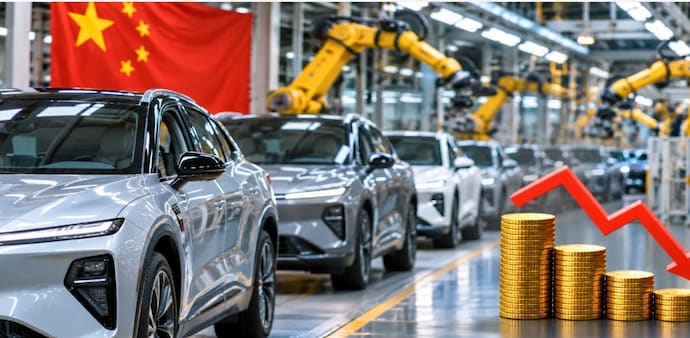
China's automotive industry is facing a profitability crisis, with margins falling from 9% in 2014 to 3.6% in the first eight months of 2026. Despite its EV dominance and surging exports, weak domestic demand, fierce price wars and massive overcapacity are squeezing manufacturers' earnings.
Business Today Desk
- Nov 16, 2026,
- Updated Nov 16, 2026 1:40 AM IST
China's automotive industry is grappling with one of its most prolonged profitability squeezes, as years of aggressive capacity expansion collide with weakening domestic demand and intensifying competition.
According to China Passenger Car Association (CPCA) data cited by The Kobeissi Letter, the industry's profit margin declined to 3.6% during January–August 2026, its lowest level in at least 12 years.
Advertisement
The decline marks a sharp deterioration from 9% in 2014, with margins falling almost continuously over the past decade. Profitability stood at 5% in 2023, slipped to 4.3% in 2024 and declined further to 4.1% in 2025.
Domestic demand collapses despite EV expansion
China's automotive slowdown has intensified as consumers postpone major purchases amid economic uncertainty and a prolonged property market downturn.
According to CPCA figures, domestic passenger vehicle retail sales plunged 27.1% year-on-year in October 2026 to approximately 1.64 million units, extending the contraction to 12 consecutive months.
During January–October, domestic passenger vehicle sales declined 22.3% compared with the corresponding period last year.
Full-year domestic passenger vehicle sales are projected at approximately 18.5 million units, potentially their lowest level since 2014.
Advertisement
The downturn has also affected premium manufacturers. Mercedes-Benz CEO Ola Källenius recently indicated that China's luxury vehicle market had contracted approximately 30% year-to-date.
China's 63-million-vehicle capacity problem
One of the biggest challenges facing Chinese automakers is excess manufacturing capacity.
According to a Wall Street Journal investigation cited in the industry analysis, China's annual light-vehicle production capacity stands near 63 million units, more than three times projected domestic passenger vehicle sales.
Advertisement
MUST READ: Tata Motors PV mulls bigger price hikes in Q4 as commodity costs bite: MD & CEO Shailesh Chandra
Years of investment in factories, battery technology and electric vehicle production have created a highly competitive market.
However, weaker demand has left manufacturers struggling to utilise production facilities efficiently.
The pressure has intensified discounting, with Chinese vehicle prices reportedly falling nearly 20% since early 2023, according to consulting firm AlixPartners.
Lower selling prices, combined with fixed manufacturing expenses, are squeezing industry margins.
Exports surge as domestic sales weaken
Despite the domestic downturn, Chinese automakers are expanding rapidly overseas.
Passenger vehicle exports jumped 68.5% year-on-year in October to approximately 928,000 units, according to CPCA figures.
During January–October, exports increased 74.6% to around 7.9 million vehicles.
Manufacturers including BYD, Geely and Chery are increasingly targeting international markets to offset slowing domestic demand.
However, stronger exports do not automatically guarantee higher profitability, particularly as manufacturers face tariffs, overseas distribution expenses and additional investment requirements.
Advertisement
Can China's auto industry recover?
The profitability squeeze could accelerate consolidation among China's numerous automotive manufacturers.
Companies with stronger balance sheets, efficient production networks and established export operations may be better positioned to withstand prolonged price competition.
For investors, the critical indicators will be operating margins, cash generation, factory utilisation and sustainable overseas growth.
Ultimately, China's challenge is no longer simply producing more vehicles, but converting its enormous manufacturing capacity and global market presence into durable profits.
China's automotive industry is grappling with one of its most prolonged profitability squeezes, as years of aggressive capacity expansion collide with weakening domestic demand and intensifying competition.
According to China Passenger Car Association (CPCA) data cited by The Kobeissi Letter, the industry's profit margin declined to 3.6% during January–August 2026, its lowest level in at least 12 years.
Advertisement
The decline marks a sharp deterioration from 9% in 2014, with margins falling almost continuously over the past decade. Profitability stood at 5% in 2023, slipped to 4.3% in 2024 and declined further to 4.1% in 2025.
Domestic demand collapses despite EV expansion
China's automotive slowdown has intensified as consumers postpone major purchases amid economic uncertainty and a prolonged property market downturn.
According to CPCA figures, domestic passenger vehicle retail sales plunged 27.1% year-on-year in October 2026 to approximately 1.64 million units, extending the contraction to 12 consecutive months.
During January–October, domestic passenger vehicle sales declined 22.3% compared with the corresponding period last year.
Full-year domestic passenger vehicle sales are projected at approximately 18.5 million units, potentially their lowest level since 2014.
Advertisement
The downturn has also affected premium manufacturers. Mercedes-Benz CEO Ola Källenius recently indicated that China's luxury vehicle market had contracted approximately 30% year-to-date.
China's 63-million-vehicle capacity problem
One of the biggest challenges facing Chinese automakers is excess manufacturing capacity.
According to a Wall Street Journal investigation cited in the industry analysis, China's annual light-vehicle production capacity stands near 63 million units, more than three times projected domestic passenger vehicle sales.
Advertisement
MUST READ: Tata Motors PV mulls bigger price hikes in Q4 as commodity costs bite: MD & CEO Shailesh Chandra
Years of investment in factories, battery technology and electric vehicle production have created a highly competitive market.
However, weaker demand has left manufacturers struggling to utilise production facilities efficiently.
The pressure has intensified discounting, with Chinese vehicle prices reportedly falling nearly 20% since early 2023, according to consulting firm AlixPartners.
Lower selling prices, combined with fixed manufacturing expenses, are squeezing industry margins.
Exports surge as domestic sales weaken
Despite the domestic downturn, Chinese automakers are expanding rapidly overseas.
Passenger vehicle exports jumped 68.5% year-on-year in October to approximately 928,000 units, according to CPCA figures.
During January–October, exports increased 74.6% to around 7.9 million vehicles.
Manufacturers including BYD, Geely and Chery are increasingly targeting international markets to offset slowing domestic demand.
However, stronger exports do not automatically guarantee higher profitability, particularly as manufacturers face tariffs, overseas distribution expenses and additional investment requirements.
Advertisement
Can China's auto industry recover?
The profitability squeeze could accelerate consolidation among China's numerous automotive manufacturers.
Companies with stronger balance sheets, efficient production networks and established export operations may be better positioned to withstand prolonged price competition.
For investors, the critical indicators will be operating margins, cash generation, factory utilisation and sustainable overseas growth.
Ultimately, China's challenge is no longer simply producing more vehicles, but converting its enormous manufacturing capacity and global market presence into durable profits.
Read more!