
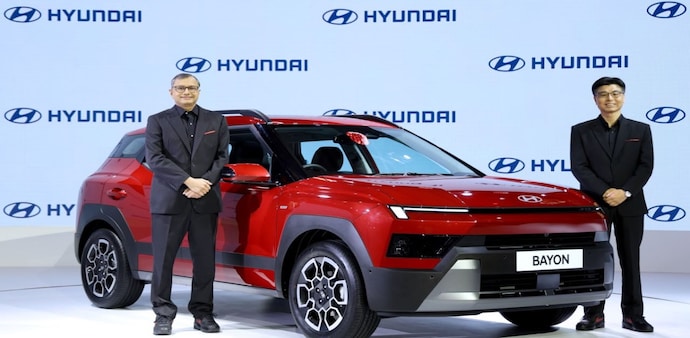
Hyundai's AI-powered Bayon SUV launched at Rs 9.99 lakh; CNG model to arrive in January
Hyundai expects its Creta and newly unveiled Bayon to together clock sales of 2.5 lakh units in calendar 2027.
- Oct 26, 2026,
- Updated Oct 26, 2026 1:55 PM IST
Hyundai Motor India Ltd on Monday launched the Bayon midsize sport utility vehicle (SUV), priced from Rs 9.99 lakh (ex-showroom), as the South Korean carmaker seeks to maintain its lead in the midsize SUV segment.
A compressed natural gas (CNG) variant of the Bayon will be launched in January, but the new Hyundai SUV will not be offered with a diesel powertrain.
“I don’t think offering all powertrains in a model is a good strategy. It confuses the customer,” Hyundai Motor India Managing Director and CEO Tarun Garg told reporters ahead of the launch.
“It is very difficult to manage so many options. We want to optimise,” Garg said, adding that diesel would remain an integral part of the automaker’s other midsize SUV, the Creta.
Hyundai expects the Creta and the newly unveiled Bayon to together clock sales of 2,50,000 units in calendar year 2027.
“We are very confident that 2,50,000 is what we are looking at: Creta plus Bayon put together,” Garg said.
Read More: Why Mahindra is shifting gears to join the CNG SUV race
Hyundai currently sells around 1.7 lakh Creta units annually and remains a leader in the mid-size SUV segment. Garg said the Bayon would complement rather than replace the Creta, with the two models targeting different customer profiles.
The Bayon is positioned as a technology-led product aimed at consumers who are quicker to adopt new features, including artificial intelligence. The new SUV features a generative AI-powered voice assistant, over-the-air software updates, Level 2 advanced driver assistance systems and a 115 PS petrol engine.
The Bayon also marks the beginning of Hyundai’s new product push in the Indian market where it has ceded some of its market share to homegrown rivals.
The mid-size SUV segment, where the Bayon and the Creta compete, already accounts for 16.5% of India's passenger vehicle market and is growing rapidly.
The South Korean automaker is also betting on the Bayon and the upcoming compact electric SUV to increase SUV penetration in its portfolio from around 70% currently to 80% by next year.
The Bayon is a global model that will be manufactured in India for domestic sales and exports. Garg said Hyundai generally begins exporting a new product three to six months after its domestic launch, with details of the Bayon's export markets to be announced separately.
Hyundai aims to increase exports to 30% of its total sales over the next five years, from 24.5% last year. Garg said exports had risen from around 20% of sales in 2021, reflecting the growing importance of India as a manufacturing and export base for the automaker.
The Middle East conflict, however, has disrupted shipments to a key export region. Garg said around 40-45% of Hyundai India's exports go to the Middle East, where logistical constraints and congestion at ports have affected deliveries.
“Demand is not less. Middle East customers are waiting for HMIL-produced cars,” he said, adding that the company had partly offset the impact through shipments to Central and South America, including Mexico.