
JSW plugs into India’s electric truck and bus race with Amp Star
JSW Group Director Parth Jindal says Amp Star will first serve the group’s own truck and bus demand, before chasing B2B orders from other conglomerates
- Sep 22, 2026,
- Updated Sep 22, 2026 6:41 PM IST
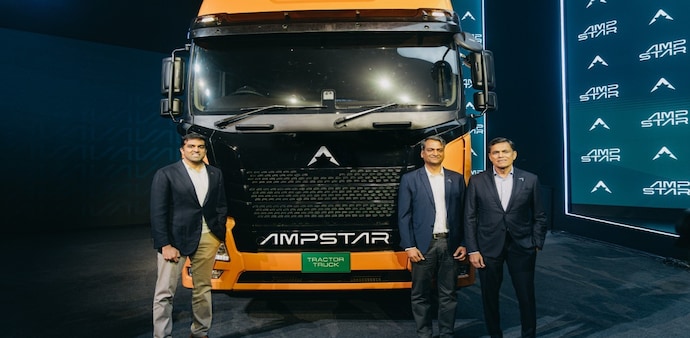
The Sajjan Jindal-led JSW Group has forayed into the electric commercial vehicle market with the launch of the Amp Star brand, as the steel-to-cement conglomerate looks to drive deeper sourcing synergies between its passenger and commercial vehicle businesses.
Auto component companies are lining up investments for the JSW ecosystem in Maharashtra’s Chhatrapati Sambhaji Nagar, Parth Jindal, the JSW Group scion, said at a media roundtable on the sidelines of the Amp Star brand launch.
“We talk to our suppliers as a group. We have very little discussion individually. It’s always as a group. When Amp Star is ordering a new paint shop, JSW Motors and MG Motor are also ordering paint shops. We club the requirements of all our companies and go to suppliers. That’s how we get the benefit,” Jindal explained.
READ THIS: JSW Combat is coming! The new SUV betting big on hybrid power and rugged looks
Part of JSW Greentech, Amp Star will initially cater to JSW Group’s internal demand for electric buses and trucks, while also pursuing business-to-business (B2B) orders.
“JSW Group requires 10,000 trucks. We need to ramp up our production. There is huge inherent demand within the JSW Group and even bigger demand within the O.P. Jindal Group,” Jindal said, adding that several other conglomerates have reached out to the group for commercial EVs. “There is just not enough capacity in India for electric trucks,” he added.
Citing the example of five electric trucks JSW purchased from the Murugappa Group some years ago, Jindal said the group saw the potential to cut logistics costs across its businesses. “When we looked at our own businesses—steel, cement, paints and power—and the number of trucks we utilise, we saw how that cost keeps rising every year. Most of our businesses are commodities and margins are always thin,” he said.
“We have a lot of point-to-point movement and we saw a significant reduction in our costs,” Jindal said. “All the industry players we talk to through Ficci, CII or Assocham want to go electric, but there is just not enough supply in the market,” he added.
That supply gap convinced JSW Group to enter the electric commercial vehicle segment.
“Now that we have understood the passenger vehicle space, we can make a foray into commercial vehicles,” Jindal said.
Jindal said trucks and buses account for about 40% of diesel consumption in India. “We felt this is an amazing opportunity to go electric,” he said.
ALSO READ: TVS Motor updates entire premium motorcycle range ahead of festive season
The automaker has so far invested Rs 2,500 crore to build commercial vehicle capacity of 15,000 units at Chhatrapati Sambhaji Nagar. The facility is fungible between buses and trucks.
“The average selling price would be Rs 80 lakh. At full capacity, this factory can potentially do a top line of Rs 12,000 crore,” Jindal claimed. “From return on invested capital, equity or any financial metric, this is a far more attractive business than our traditional businesses,” he added.
The automaker plans to offer battery swapping as well as fast charging for its vehicles, depending on customer needs.
The Sajjan Jindal-led JSW Group has forayed into the electric commercial vehicle market with the launch of the Amp Star brand, as the steel-to-cement conglomerate looks to drive deeper sourcing synergies between its passenger and commercial vehicle businesses.
Auto component companies are lining up investments for the JSW ecosystem in Maharashtra’s Chhatrapati Sambhaji Nagar, Parth Jindal, the JSW Group scion, said at a media roundtable on the sidelines of the Amp Star brand launch.
“We talk to our suppliers as a group. We have very little discussion individually. It’s always as a group. When Amp Star is ordering a new paint shop, JSW Motors and MG Motor are also ordering paint shops. We club the requirements of all our companies and go to suppliers. That’s how we get the benefit,” Jindal explained.
READ THIS: JSW Combat is coming! The new SUV betting big on hybrid power and rugged looks
Part of JSW Greentech, Amp Star will initially cater to JSW Group’s internal demand for electric buses and trucks, while also pursuing business-to-business (B2B) orders.
“JSW Group requires 10,000 trucks. We need to ramp up our production. There is huge inherent demand within the JSW Group and even bigger demand within the O.P. Jindal Group,” Jindal said, adding that several other conglomerates have reached out to the group for commercial EVs. “There is just not enough capacity in India for electric trucks,” he added.
Citing the example of five electric trucks JSW purchased from the Murugappa Group some years ago, Jindal said the group saw the potential to cut logistics costs across its businesses. “When we looked at our own businesses—steel, cement, paints and power—and the number of trucks we utilise, we saw how that cost keeps rising every year. Most of our businesses are commodities and margins are always thin,” he said.
“We have a lot of point-to-point movement and we saw a significant reduction in our costs,” Jindal said. “All the industry players we talk to through Ficci, CII or Assocham want to go electric, but there is just not enough supply in the market,” he added.
That supply gap convinced JSW Group to enter the electric commercial vehicle segment.
“Now that we have understood the passenger vehicle space, we can make a foray into commercial vehicles,” Jindal said.
Jindal said trucks and buses account for about 40% of diesel consumption in India. “We felt this is an amazing opportunity to go electric,” he said.
ALSO READ: TVS Motor updates entire premium motorcycle range ahead of festive season
The automaker has so far invested Rs 2,500 crore to build commercial vehicle capacity of 15,000 units at Chhatrapati Sambhaji Nagar. The facility is fungible between buses and trucks.
“The average selling price would be Rs 80 lakh. At full capacity, this factory can potentially do a top line of Rs 12,000 crore,” Jindal claimed. “From return on invested capital, equity or any financial metric, this is a far more attractive business than our traditional businesses,” he added.
The automaker plans to offer battery swapping as well as fast charging for its vehicles, depending on customer needs.