
Nitin Gadkari to launch Toyota's flex-fuel Innova Hycross in November; says carmakers gearing up for 100% ethanol cars
After Maruti Suzuki, Tata Motors Passenger Vehicles, Mahindra & Mahindra, Toyota Kirloskar Motor, and Hyundai Motor India are preparing to launch flex-fuel vehicles capable of running on up to 100% ethanol, says Union Minister Nitin Gadkari
- Nov 2, 2026,
- Updated Nov 2, 2026 9:26 PM IST
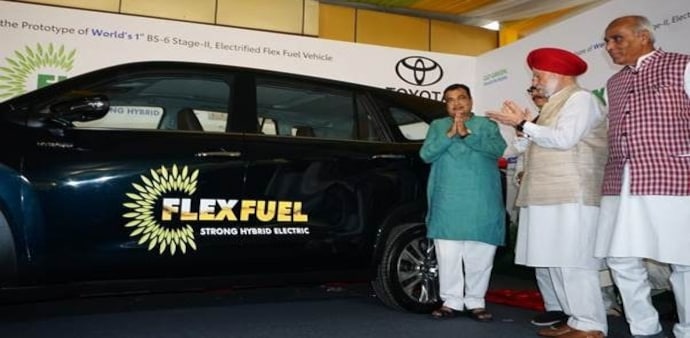
Union Minister for Road Transport and Highways Nitin Gadkari on Monday said that he will launch Toyota’s flex-fuel Innova Hycross in November as India’s ethanol push gathers pace despite pushback from several motorists who claim that fuel efficiency has come down after E20 was implemented nationwide in 2025.
“In this month, I am going to launch the flex-fuel car Toyota Innova, which is on 100% bioethanol,” Gadkari said at the ENRich 2026 energy conference organised by KPMG in New Delhi.
The Toyota Innova Hycross flex-fuel car will be capable of running on 100% bioethanol, Gadkari said, adding that he has been using a pilot variant of the Toyota Innova Hycross that runs entirely on bioethanol for the past one-and-a-half years.
In Case You Missed It: World's first flex-fuel ethanol-powered car, Toyota Innova HyCross unveiled in India by Nitin Gadkari: All you need to know
This will be India’s second flex-fuel vehicle after Maruti Suzuki launched the WagonR Bioflex in June 2026. Gadkari said more automakers are expected to follow suit.
“Now, Tata Motors, Mahindra & Mahindra, Toyota, Suzuki and Hyundai, all are going to launch flex-fuel cars capable of running on 100% ethanol,” said Gadkari.
To be clear, Maruti Suzuki has sold just 20 units of its flex-fuel car, the WagonR Bioflex since its launch in June, according to VAHAN registration data. Meanwhile, two-wheeler maker Hero MotoCorp has clocked sales of 8,145 flex-fuel motorcycles after launching two models in July.
The petroleum ministry rolled out E85 fuel, a blend comprising 85% ethanol and 15% petrol, at Rs 82 per litre at select petrol pumps in Delhi. According to industry experts, the price difference between E20 and E85 is roughly about 20%, making E85 less attractive for flex-fuel vehicle buyers as ethanol delivers roughly one-third less energy per litre than petrol.
Read More | E20 debate: '100% ethanol car to be launched soon in India,' says Nitin Gadkari
Speaking about India's dependence on imported fossil fuels, Gadkari said the country currently spends around Rs 22 lakh crore on fossil fuel imports annually, describing this as both an economic and environmental challenge. He added that fossil fuels account for 40% of air pollution in Delhi.
"Since 2004, I have been constantly working on the mission to divert agriculture towards the energy and power sector," the minister said, reiterating the government's focus on fuels that are import substitutes, cost-effective, pollution-free and indigenous.
Recalling a visit to Brazil during Atal Bihari Vajpayee's tenure as Prime Minister, Gadkari said an Indian delegation led by the then petroleum minister had studied the country's biofuel production and alternative energy ecosystem.
“Today, in India, we have a success story of E20. We have four crore four-wheelers and 20 crore two-wheelers on E20,” Gadkari said, alleging that there was some propaganda against E20 fuel.
Beyond ethanol, Gadkari highlighted the government's GOBARdhan scheme, which has a total outlay of Rs 23,731 crore and aims to produce compressed biogas (CBG) from biomass.
Burning of rice straw in Haryana and Delhi is a major contributor to pollution in the national capital, said Gadkari. Citing the availability of around 2.18 lakh tonnes of rice straw, he said the government is working towards establishing 3,000 CBG plants under the scheme, of which 280 have already started operations.
Gadkari said five tonnes of rice straw can produce one tonne of bio-CNG, underlining the potential of agricultural waste as an energy resource. "This is the time to diversify our agriculture towards the energy sector," he said.
The Union minister also spoke about ongoing trials of isobutanol at the Automotive Research Association of India (ARAI). “Isobutanol trials are currently on at ARAI. We can add up to 15% isobutanol in diesel,” Gadkari said, adding that the trial reports are awaited.
Speaking at the 17th edition of KPMG's energy and resources conclave, Yezdi Nagporewalla, CEO of KPMG India, said the disruption in energy markets was having repercussions well beyond the energy sector, affecting industries such as fertilisers and agriculture and, consequently, food prices, household spending, inflation and economic growth.