
How AI careers are reshaping study-abroad choices for Indian students as they look beyond 'Big 4s'
At the course level, Data Science and AI emerged as the single strongest trend, appearing in 15.4% of student conversations
- May 21, 2026,
- Updated May 21, 2026 11:49 AM IST
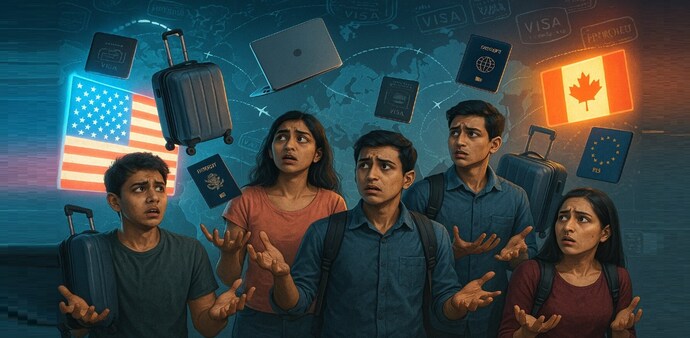
Indian students are no longer defaulting to the usual suspects when planning their education abroad. There's now a clear shift in how students are thinking about global education in 2026, with career outcomes, particularly in AI and data science, driving the conversation as much as the destination itself, according to a report by Leap Scholar.
Singapore rises, Europe widens
The UK remains the most discussed study destination, but Singapore has emerged as a strong second, appearing in 26.6% of student conversations tracked by Leap Scholar. The figure signals that students are looking beyond conventional markets and evaluating destinations that offer stronger industry exposure and post-study pathways.
The trend extends across Europe as well. Countries outside the traditional UK-Germany axis. including the Netherlands, Finland, Sweden, and Denmark, appeared in 17.6% of conversations, suggesting that students are comparing a broader range of options on parameters such as affordability, employability, and long-term value.
ALSO READ: Why are Indian graduates looking abroad for studies, but still betting on India for their careers?
AI and data science lead the course conversation
At the course level, Data Science and AI emerged as the single strongest trend, appearing in 15.4% of student conversations. The number reflects a wider shift towards career-linked education; students are increasingly aligning their destination choices with job-market demand rather than prestige alone.
The appetite makes sense given where the global job market is heading. Universities worldwide are rolling out programmes built around the demands of an AI-driven economy, spanning ethical AI development and governance, data science applied to global challenges, robotics and human-AI collaboration, and AI's intersection with the humanities. Many of these programmes are structured around project-based learning, with students working on real-world problems alongside international teams.
What an AI-focused degree could lead to
For students weighing these choices, the career possibilities are broadening rapidly. AI is not just generating new roles; it is reshaping existing ones. Graduates with international AI exposure are increasingly being positioned for careers as AI ethicists and policy advisors, cross-cultural AI project managers, global data analysts, and remote AI developers working across borders. The combination of a global mindset and AI proficiency, recruiters and universities increasingly argue, is what will set candidates apart.
DO CHECKOUT: Gen Z is smarter about study abroad than you think: Expert explains which factors are they considering more
What students need to keep in mind
Beyond picking the right course and destination, analysts tracking this space point to a set of fundamentals that matter in the AI era. AI literacy, understanding how these systems work, including their limitations, is now considered essential rather than optional. Critical thinking remains irreplaceable, given the volume of AI-generated information students will encounter and need to evaluate.
Adaptability is equally critical, since the pace of change means that what is relevant today may look different in three years. And despite AI's growing role in facilitating communication across languages and cultures, genuine intercultural understanding remains something no tool can substitute.
Indian students are no longer defaulting to the usual suspects when planning their education abroad. There's now a clear shift in how students are thinking about global education in 2026, with career outcomes, particularly in AI and data science, driving the conversation as much as the destination itself, according to a report by Leap Scholar.
Singapore rises, Europe widens
The UK remains the most discussed study destination, but Singapore has emerged as a strong second, appearing in 26.6% of student conversations tracked by Leap Scholar. The figure signals that students are looking beyond conventional markets and evaluating destinations that offer stronger industry exposure and post-study pathways.
The trend extends across Europe as well. Countries outside the traditional UK-Germany axis. including the Netherlands, Finland, Sweden, and Denmark, appeared in 17.6% of conversations, suggesting that students are comparing a broader range of options on parameters such as affordability, employability, and long-term value.
ALSO READ: Why are Indian graduates looking abroad for studies, but still betting on India for their careers?
AI and data science lead the course conversation
At the course level, Data Science and AI emerged as the single strongest trend, appearing in 15.4% of student conversations. The number reflects a wider shift towards career-linked education; students are increasingly aligning their destination choices with job-market demand rather than prestige alone.
The appetite makes sense given where the global job market is heading. Universities worldwide are rolling out programmes built around the demands of an AI-driven economy, spanning ethical AI development and governance, data science applied to global challenges, robotics and human-AI collaboration, and AI's intersection with the humanities. Many of these programmes are structured around project-based learning, with students working on real-world problems alongside international teams.
What an AI-focused degree could lead to
For students weighing these choices, the career possibilities are broadening rapidly. AI is not just generating new roles; it is reshaping existing ones. Graduates with international AI exposure are increasingly being positioned for careers as AI ethicists and policy advisors, cross-cultural AI project managers, global data analysts, and remote AI developers working across borders. The combination of a global mindset and AI proficiency, recruiters and universities increasingly argue, is what will set candidates apart.
DO CHECKOUT: Gen Z is smarter about study abroad than you think: Expert explains which factors are they considering more
What students need to keep in mind
Beyond picking the right course and destination, analysts tracking this space point to a set of fundamentals that matter in the AI era. AI literacy, understanding how these systems work, including their limitations, is now considered essential rather than optional. Critical thinking remains irreplaceable, given the volume of AI-generated information students will encounter and need to evaluate.
Adaptability is equally critical, since the pace of change means that what is relevant today may look different in three years. And despite AI's growing role in facilitating communication across languages and cultures, genuine intercultural understanding remains something no tool can substitute.