
From Devbhoomi to industrial destination: Uttarakhand’s manufacturing moment
With GSVA up 143% in a decade, Uttarakhand is moving beyond its tourism-led identity, using stronger connectivity, infrastructure and industrial policies to attract manufacturers and deepen its economic base.
- Aug 21, 2026,
- Updated Aug 21, 2026 8:30 PM IST
From Devbhoomi — the land of the gods — to an emerging industrial hub, Uttarakhand is undergoing an economic transition, with the state looking to harness better connectivity, infrastructure and its proximity to the National Capital Region (NCR) to drive manufacturing growth.
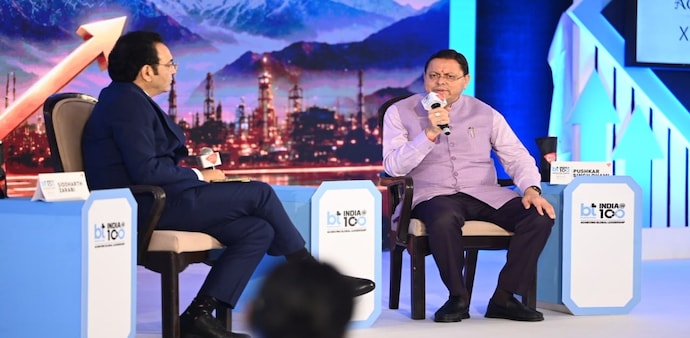
The transformation was in focus at Business Today’s flagship India@100 Summit, where the Business Today Manufacturing Special was unveiled by Uttarakhand Chief Minister Pushkar Singh Dhami. The magazine was unveiled by Kalli Purie, Vice Chairperson and Executive Editor-in-Chief, India Today Group; Dinesh Bhatia, Group CEO, India Today Group; Alok Nair, COO, Business Today; and Siddharth Zarabi, Group Editor, Business Today, in the presence of Hyundai Motor India MD & CEO Tarun Garg and Maruti Suzuki India MD & CEO Hisashi Takeuchi.
Speaking at the summit, Dhami said the perception of Uttarakhand as an investment destination had changed significantly in recent years. The state, he said, has been working to make it easier for companies to set up operations while improving connectivity and industrial infrastructure.
The shift is reflected in the state’s economic numbers too. According to a Deloitte India study, Uttarakhand’s Gross State Value Added (GSVA) has grown 143% over the past decade, underscoring the expansion of economic activity in the state.
A key part of that transformation is the state’s growing connectivity to the NCR. Dhami pointed to the Delhi-Dehradun Economic Corridor, saying the journey between Delhi and Dehradun can now be completed in around two to two-and-a-half hours. He also highlighted air connectivity from Dehradun, as well as road, rail and air infrastructure around Pantnagar.
For a state with challenging terrain, however, manufacturing growth comes with an obvious constraint: land.
Uttarakhand has nine hill districts, with much of its industrial activity concentrated in the plains. Dhami acknowledged that the state does not have the large land banks available in several other industrial states. But he said industrial land is available in key locations such as Haridwar, Dehradun and Udham Singh Nagar.
“We don’t have very large land banks,” Dhami said, adding that the state would provide land and other facilities based on the requirements of investors looking to establish manufacturing operations.
The government is also looking to take industrial activity beyond the established manufacturing centres in the plains. Dhami said industrial parks are being planned in Bageshwar, Chamoli and Almora, while the “One District, Two Products” initiative is aimed at encouraging entrepreneurship and local production.
The manufacturing push comes at a time when Indian states are competing aggressively for large industrial investments. Uttar Pradesh, Tamil Nadu, Gujarat and Maharashtra have developed sizeable manufacturing ecosystems, particularly across automobiles, electronics, engineering and other industries. For Uttarakhand, the challenge will be to compete for investments while working with a smaller land base and difficult geography.
The state is nevertheless looking to attract large industrial anchors. Dhami used the summit to directly invite Maruti Suzuki India MD & CEO Hisashi Takeuchi to consider setting up an establishment in Uttarakhand.
Dhami also sought to address the familiar criticism of investor summits—that large MoUs are signed but projects do not get grounded. He said Uttarakhand had worked on policies and processes in advance to reduce the hurdles investors face while setting up operations.
That execution will ultimately determine whether Uttarakhand’s manufacturing transition becomes more than an investment narrative. With improved connectivity, industrial land in its plains and plans to develop industrial activity in the hills, the state is attempting to build a new economic identity—one where Devbhoomi is not just a destination for pilgrims and tourists, but also a destination for manufacturers.
India@2047: Blueprint for a Developed Nation
From Devbhoomi — the land of the gods — to an emerging industrial hub, Uttarakhand is undergoing an economic transition, with the state looking to harness better connectivity, infrastructure and its proximity to the National Capital Region (NCR) to drive manufacturing growth.
The transformation was in focus at Business Today’s flagship India@100 Summit, where the Business Today Manufacturing Special was unveiled by Uttarakhand Chief Minister Pushkar Singh Dhami. The magazine was unveiled by Kalli Purie, Vice Chairperson and Executive Editor-in-Chief, India Today Group; Dinesh Bhatia, Group CEO, India Today Group; Alok Nair, COO, Business Today; and Siddharth Zarabi, Group Editor, Business Today, in the presence of Hyundai Motor India MD & CEO Tarun Garg and Maruti Suzuki India MD & CEO Hisashi Takeuchi.
Speaking at the summit, Dhami said the perception of Uttarakhand as an investment destination had changed significantly in recent years. The state, he said, has been working to make it easier for companies to set up operations while improving connectivity and industrial infrastructure.
The shift is reflected in the state’s economic numbers too. According to a Deloitte India study, Uttarakhand’s Gross State Value Added (GSVA) has grown 143% over the past decade, underscoring the expansion of economic activity in the state.
A key part of that transformation is the state’s growing connectivity to the NCR. Dhami pointed to the Delhi-Dehradun Economic Corridor, saying the journey between Delhi and Dehradun can now be completed in around two to two-and-a-half hours. He also highlighted air connectivity from Dehradun, as well as road, rail and air infrastructure around Pantnagar.
For a state with challenging terrain, however, manufacturing growth comes with an obvious constraint: land.
Uttarakhand has nine hill districts, with much of its industrial activity concentrated in the plains. Dhami acknowledged that the state does not have the large land banks available in several other industrial states. But he said industrial land is available in key locations such as Haridwar, Dehradun and Udham Singh Nagar.
“We don’t have very large land banks,” Dhami said, adding that the state would provide land and other facilities based on the requirements of investors looking to establish manufacturing operations.
The government is also looking to take industrial activity beyond the established manufacturing centres in the plains. Dhami said industrial parks are being planned in Bageshwar, Chamoli and Almora, while the “One District, Two Products” initiative is aimed at encouraging entrepreneurship and local production.
The manufacturing push comes at a time when Indian states are competing aggressively for large industrial investments. Uttar Pradesh, Tamil Nadu, Gujarat and Maharashtra have developed sizeable manufacturing ecosystems, particularly across automobiles, electronics, engineering and other industries. For Uttarakhand, the challenge will be to compete for investments while working with a smaller land base and difficult geography.
The state is nevertheless looking to attract large industrial anchors. Dhami used the summit to directly invite Maruti Suzuki India MD & CEO Hisashi Takeuchi to consider setting up an establishment in Uttarakhand.
Dhami also sought to address the familiar criticism of investor summits—that large MoUs are signed but projects do not get grounded. He said Uttarakhand had worked on policies and processes in advance to reduce the hurdles investors face while setting up operations.
That execution will ultimately determine whether Uttarakhand’s manufacturing transition becomes more than an investment narrative. With improved connectivity, industrial land in its plains and plans to develop industrial activity in the hills, the state is attempting to build a new economic identity—one where Devbhoomi is not just a destination for pilgrims and tourists, but also a destination for manufacturers.
India@2047: Blueprint for a Developed Nation