
109 years later, UK has no records of Bhopal merchant’s Rs 35,000 war loan, asks family to trace Indian issuer
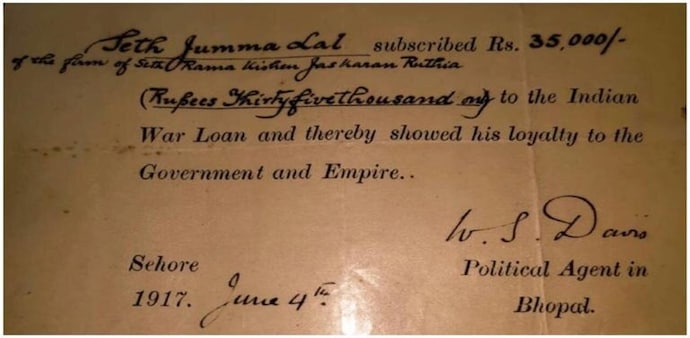
The claim dates back to June 4, 1917, when Bhopal merchant Seth Jumma Lal Ruthiya subscribed to the Indian War Loan.
- Nov 29, 2026,
- Updated Nov 29, 2026 11:59 AM IST
A Bhopal family is still trying to recover a Rs 35,000 investment made by its ancestor in the Indian War Loan in 1917, nearly 109 years after the money was invested. The UK's Debt Management Office (DMO) has said it has no records of the security or its repayment and has suggested that the family approach the original Indian issuer to trace the records, accordin to a report by The Times of India.
The claim is being pursued by Vinay Ruthiya, a descendant of Seth Jumma Lal Ruthiya, who subscribed to the loan on June 4, 1917. Vinay says the family still has the original investment certificate and wants British authorities to examine it to establish the nature and authenticity of the investment.
Vinay said he would continue fighting for what he believes is his family's rightful money. If recovered, he intends to donate the entire amount to welfare initiatives for Indian military personnel.
UK DMO says it has no records
In its November 19 response to TOI under the UK's Freedom of Information Act, the DMO said it did not hold records relating to the 1917 Indian War Loan and was not aware of any previous queries concerning war loans issued in India.
"To proceed with locating and identifying records relating to the 1917 Indian War Loan, engaging with the local issuer of the security is required," the department said, adding that reasonable enquiries with the issuer would be necessary to locate the relevant records.
Don't Miss: 'Never imagined a response': MP family seeks answers on 109-year-old ₹35,000 British loan
The DMO also said it had not been presented with a certificate of title. Vinay, however, maintains that he still possesses the original certificate and questions why British authorities have not examined it.
The certificate is associated with the firm Seth Rama Kishan Jaskaran Ruthia and bears the signature of WS Davis, the then Political Agent. The family claims that neither the principal nor the promised annual interest of 5.5% was ever received.
Family compares it with Britain's war debt
Vinay has pointed to Britain's own handling of its First World War debt. In a press notice issued on December 3, 2014, the UK government announced that it would redeem its entire outstanding 3.5% War Loan, worth £1,938.6 million, on March 9, 2015.
The security had originated as a 5% War Loan issued in 1917 to finance the First World War and was converted into a 3.5% War Loan in 1932. The government announced that the outstanding bonds would be redeemed at par, with the final interest payment made to registered holders.
However, the 2015 redemption concerned British government debt. It does not establish that the Indian War Loan was part of the same liability or that the British government was responsible for its repayment.
Must Read: India's banks face a funding challenge as loan growth races ahead of deposits
DMO says the loans may be different
In an earlier response dated October 16, the DMO said it could find no evidence that the specific Indian loan was, or had ever been, an obligation of the British government.
The department also said British and Indian War Loans might not be comparable because of differences in issuing authorities, currencies and administrative frameworks.
Seth Jumma Lal Ruthiya died in 1937. The DMO's latest response has neither established that the investment remains outstanding nor provided evidence that it was repaid.
Vinay said he would continue pursuing the matter until the fate of the investment was established. He reiterated that any money recovered would be donated towards the welfare of India's military personnel.