
'20 years behind...': Chinese official dismisses India, says 'it can never make all weapons by itself'
“Back in 1978, the size of the Chinese economy and the Indian economy were more or less on par,” Victor Zhikai Gao, Vice President of the Center for China and Globalization, said. “But now, the Chinese economy is about five times as large as the Indian economy.”
- May 16, 2026,
- Updated May 17, 2026 4:25 PM IST
As India and China attempt to cautiously stabilise relations after years of military and diplomatic tensions, fresh remarks by Victor Zhikai Gao, Vice President of the Center for China and Globalization, comparing the two Asian giants have sparked attention for their blunt assessment of India’s economic and military capabilities relative to China.
Speaking during an interview focused on China-India ties, Tibet, and the border dispute, Gao argued that the developmental gap between the two countries has widened dramatically over the past four decades, claiming China is now decades ahead of India in industrial capacity, technology, and defence manufacturing.
MUST READ | ‘Draw border along the Ganges’: Chinese analyst calls India’s McMahon Line claim ‘illegal’
“China and India are totally different,” Gao said, dismissing comparisons that often place the two countries side by side as emerging global powers. “We are probably minimum 20 years, if not 30 years, apart from each other in terms of economic development, science and technological excellence.”
‘China far ahead of India’
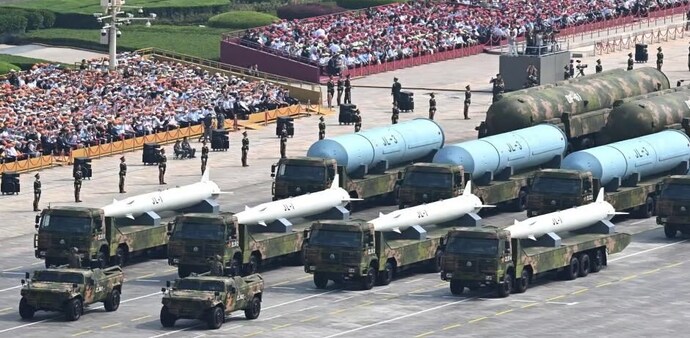
Gao pointed to China’s industrial ecosystem and military manufacturing capabilities as examples of Beijing’s advantage. According to him, China has developed the capacity to independently build advanced military systems across sectors, something he claimed India still lacks.
“China makes all the military weapons by itself — airplanes, warships, you name it,” he said during the interview. “India can never make all the military weapons by itself because it doesn’t have the industrial capabilities and technical expertise to do that.”
DON'T MISS | ‘Vietnam accepted weaknesses, India argued’: Chinese analyst decodes why India lost ‘China+1’ race
The remarks are likely to trigger debate in India, particularly as New Delhi has aggressively pushed its “Make in India” and defence indigenisation programmes in recent years. India has significantly expanded domestic defence production, including missiles, artillery systems, aircraft carriers, drones, and fighter jet manufacturing partnerships.
However, China’s manufacturing scale and technological ecosystem continue to outpace most economies globally, especially in sectors such as electronics, shipbuilding, electric vehicles, artificial intelligence, and infrastructure development.
Comparing the post-1978 trajectories
Gao framed his comparison around the divergent economic paths taken by India and China since the late 1970s, when both economies were considered broadly comparable in size.
“Back in 1978, the size of the Chinese economy and the Indian economy were more or less on par,” he said. “But now, the Chinese economy is about five times as large as the Indian economy.”
IN CASE YOU MISSED IT | From HQ-9 to PL-15: These Chinese weapons failed in front of India during Operation Sindoor
China’s economic transformation after Deng Xiaoping’s reforms turned the country into the world’s manufacturing hub, lifting hundreds of millions out of poverty and making Beijing the world’s second-largest economy.
India, meanwhile, liberalised its economy much later in the 1990s and has emerged as one of the fastest-growing major economies in recent years. India is currently the world’s fifth-largest economy and is expected to continue expanding rapidly due to its large domestic market, young workforce, and growing digital economy.
‘India will lose if it avoids China’
Despite his sharp criticism, Gao also argued that India should engage more deeply with China economically rather than allowing the boundary dispute to dominate bilateral relations. “For India not to engage with China for mutual benefit will be a huge loss for the Indian people,” he said, adding that China remains “one of the most consequential countries in the world today.”
His remarks come at a delicate phase in India-China ties. Relations between the two neighbours sharply deteriorated after the 2020 Galwan Valley clashes in eastern Ladakh, which led to the first combat fatalities on the border in decades. Since then, both sides have held multiple rounds of military and diplomatic talks to ease tensions along the Line of Actual Control (LAC).
DO CHECKOUT | Is Turkey-Pakistan axis & Kashmir push a new threat for India? What this ex-Pentagon official warns
While recent months have seen efforts to improve communication and restore limited engagement, mistrust continues to dominate the relationship, particularly over unresolved border disputes and growing strategic competition in the Indo-Pacific region.
Gao’s comments are also notable because they combine economic messaging with assertive geopolitical rhetoric. Earlier in the same interview, he questioned the legality of the McMahon Line and controversially suggested drawing a hypothetical “Victor Gao Line” along the Ganges river to counter India’s territorial claims in the eastern sector of the border dispute.
As India and China attempt to cautiously stabilise relations after years of military and diplomatic tensions, fresh remarks by Victor Zhikai Gao, Vice President of the Center for China and Globalization, comparing the two Asian giants have sparked attention for their blunt assessment of India’s economic and military capabilities relative to China.
Speaking during an interview focused on China-India ties, Tibet, and the border dispute, Gao argued that the developmental gap between the two countries has widened dramatically over the past four decades, claiming China is now decades ahead of India in industrial capacity, technology, and defence manufacturing.
MUST READ | ‘Draw border along the Ganges’: Chinese analyst calls India’s McMahon Line claim ‘illegal’
“China and India are totally different,” Gao said, dismissing comparisons that often place the two countries side by side as emerging global powers. “We are probably minimum 20 years, if not 30 years, apart from each other in terms of economic development, science and technological excellence.”
‘China far ahead of India’
Gao pointed to China’s industrial ecosystem and military manufacturing capabilities as examples of Beijing’s advantage. According to him, China has developed the capacity to independently build advanced military systems across sectors, something he claimed India still lacks.
“China makes all the military weapons by itself — airplanes, warships, you name it,” he said during the interview. “India can never make all the military weapons by itself because it doesn’t have the industrial capabilities and technical expertise to do that.”
DON'T MISS | ‘Vietnam accepted weaknesses, India argued’: Chinese analyst decodes why India lost ‘China+1’ race
The remarks are likely to trigger debate in India, particularly as New Delhi has aggressively pushed its “Make in India” and defence indigenisation programmes in recent years. India has significantly expanded domestic defence production, including missiles, artillery systems, aircraft carriers, drones, and fighter jet manufacturing partnerships.
However, China’s manufacturing scale and technological ecosystem continue to outpace most economies globally, especially in sectors such as electronics, shipbuilding, electric vehicles, artificial intelligence, and infrastructure development.
Comparing the post-1978 trajectories
Gao framed his comparison around the divergent economic paths taken by India and China since the late 1970s, when both economies were considered broadly comparable in size.
“Back in 1978, the size of the Chinese economy and the Indian economy were more or less on par,” he said. “But now, the Chinese economy is about five times as large as the Indian economy.”
IN CASE YOU MISSED IT | From HQ-9 to PL-15: These Chinese weapons failed in front of India during Operation Sindoor
China’s economic transformation after Deng Xiaoping’s reforms turned the country into the world’s manufacturing hub, lifting hundreds of millions out of poverty and making Beijing the world’s second-largest economy.
India, meanwhile, liberalised its economy much later in the 1990s and has emerged as one of the fastest-growing major economies in recent years. India is currently the world’s fifth-largest economy and is expected to continue expanding rapidly due to its large domestic market, young workforce, and growing digital economy.
‘India will lose if it avoids China’
Despite his sharp criticism, Gao also argued that India should engage more deeply with China economically rather than allowing the boundary dispute to dominate bilateral relations. “For India not to engage with China for mutual benefit will be a huge loss for the Indian people,” he said, adding that China remains “one of the most consequential countries in the world today.”
His remarks come at a delicate phase in India-China ties. Relations between the two neighbours sharply deteriorated after the 2020 Galwan Valley clashes in eastern Ladakh, which led to the first combat fatalities on the border in decades. Since then, both sides have held multiple rounds of military and diplomatic talks to ease tensions along the Line of Actual Control (LAC).
DO CHECKOUT | Is Turkey-Pakistan axis & Kashmir push a new threat for India? What this ex-Pentagon official warns
While recent months have seen efforts to improve communication and restore limited engagement, mistrust continues to dominate the relationship, particularly over unresolved border disputes and growing strategic competition in the Indo-Pacific region.
Gao’s comments are also notable because they combine economic messaging with assertive geopolitical rhetoric. Earlier in the same interview, he questioned the legality of the McMahon Line and controversially suggested drawing a hypothetical “Victor Gao Line” along the Ganges river to counter India’s territorial claims in the eastern sector of the border dispute.