
Artemis 2 mission: Astronauts return to Earth after NASA's first Moon voyage in 50 yrs, splash down in Pacific Ocean
NASA and Navy recovery teams quickly secured the Orion spacecraft and assisted the crew, who celebrated the completion of their 10-day mission.
- Apr 11, 2026,
- Updated Apr 11, 2026 7:25 AM IST
The Artemis II mission successfully concluded with the splashdown of four astronauts in the Pacific Ocean, marking a historic return from humanity’s first crewed journey to the Moon in the 21st century. The crew travelled 406,778 km from Earth, farther than any humans have ventured before.
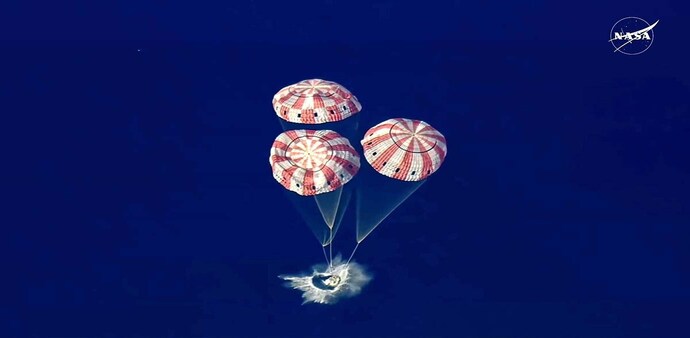
The astronauts, Commander Reid Wiseman, Pilot Victor Glover, and Mission Specialists Christina Koch and Jeremy Hansen, re-entered Earth’s atmosphere at high speeds before deploying parachutes for a safe ocean landing. NASA and Navy recovery teams quickly secured the Orion spacecraft and assisted the crew, who celebrated the completion of their 10-day mission.
Artemis II is regarded as a major milestone in modern space exploration, being the first crewed lunar mission since the Apollo programme. Unlike Artemis I, which tested systems without a crew, Artemis II carried astronauts on a lunar flyby to evaluate life-support systems, navigation, and deep-space operations.
During the mission, the crew orbited the Moon and captured images of the lunar surface and Earth rising over the horizon. These moments reflected iconic visuals from past lunar missions while demonstrating advancements in technology. The astronauts also conducted experiments and system checks essential for future lunar landings.
One of the mission’s most challenging moments was the fiery re-entry into Earth’s atmosphere. Travelling at speeds over 40,000 kmph, the Orion spacecraft faced extreme heat before safely descending under a system of 11 parachutes that slowed it from around 300 mph to 20 mph for splashdown.
The successful return highlighted the effectiveness of the Orion heat shield and recovery procedures. NASA officials described Artemis II as a crucial step toward the next phase of lunar exploration, which includes landing astronauts on the Moon under the Artemis programme.
Data gathered from Artemis II will be vital for planning upcoming missions, especially Artemis III, which aims to place humans on the lunar surface for the first time in over fifty years. The mission’s success signals progress in establishing a sustained human presence beyond low-Earth orbit.
With Artemis II complete, a new era in human spaceflight has begun, promising future missions that will take astronauts not only back to the Moon but eventually onward to Mars and beyond.
The Artemis II mission successfully concluded with the splashdown of four astronauts in the Pacific Ocean, marking a historic return from humanity’s first crewed journey to the Moon in the 21st century. The crew travelled 406,778 km from Earth, farther than any humans have ventured before.
The astronauts, Commander Reid Wiseman, Pilot Victor Glover, and Mission Specialists Christina Koch and Jeremy Hansen, re-entered Earth’s atmosphere at high speeds before deploying parachutes for a safe ocean landing. NASA and Navy recovery teams quickly secured the Orion spacecraft and assisted the crew, who celebrated the completion of their 10-day mission.
Artemis II is regarded as a major milestone in modern space exploration, being the first crewed lunar mission since the Apollo programme. Unlike Artemis I, which tested systems without a crew, Artemis II carried astronauts on a lunar flyby to evaluate life-support systems, navigation, and deep-space operations.
During the mission, the crew orbited the Moon and captured images of the lunar surface and Earth rising over the horizon. These moments reflected iconic visuals from past lunar missions while demonstrating advancements in technology. The astronauts also conducted experiments and system checks essential for future lunar landings.
One of the mission’s most challenging moments was the fiery re-entry into Earth’s atmosphere. Travelling at speeds over 40,000 kmph, the Orion spacecraft faced extreme heat before safely descending under a system of 11 parachutes that slowed it from around 300 mph to 20 mph for splashdown.
The successful return highlighted the effectiveness of the Orion heat shield and recovery procedures. NASA officials described Artemis II as a crucial step toward the next phase of lunar exploration, which includes landing astronauts on the Moon under the Artemis programme.
Data gathered from Artemis II will be vital for planning upcoming missions, especially Artemis III, which aims to place humans on the lunar surface for the first time in over fifty years. The mission’s success signals progress in establishing a sustained human presence beyond low-Earth orbit.
With Artemis II complete, a new era in human spaceflight has begun, promising future missions that will take astronauts not only back to the Moon but eventually onward to Mars and beyond.