
BT Explainer: What brought Noida factory workers to fight on streets
Along with stagnant wages, longer working hours, contractual engagement, rising cooking gas and cooked food prices, the absence of a union and collective bargaining has produced a volatile mix
- Apr 15, 2026,
- Updated Apr 15, 2026 4:54 PM IST
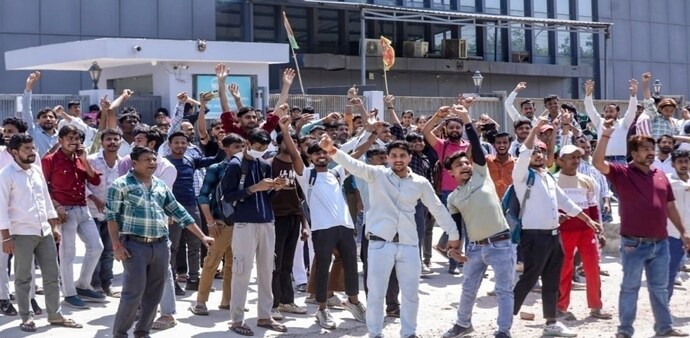
Monday’s violent protest by Noida’s industrial workers was preceded by simmering unrest in industrial hubs across the country since February over their demands for better wages, working conditions and timely payment. It started in Barauni on February 2 and spread to Surat, Jhansi, Panipat and Manesar, before reaching Noida. Most protesters are contractual and migrant workers.
Following the violence, Uttar Pradesh announced an interim hike in minimum wages from April 1. Wages for the unskilled workers were raised from Rs 11,313 to Rs 12,356-13,690, for the semi-skilled from Rs 12,445 to Rs 13,591-15,059 and for skilled workers from Rs 13,940 to Rs 15,224-16,868. It also set up a high-power committee to address workers’ grievances. Yet, minimum wages in the state continue to lag those in Haryana.
Here are other key factors that led to Noida rage.
DON'T MISS | ‘Organised group instigating…’: Noida protests were planned on WhatsApp, social media, says police
No union, collective bargaining or deliberations
“Violence happened because there is no organised trade union to mediate between workers, employers and governments, particularly to address non-revision of statutory minimum wages. The Minimum Wages Advisory Board in Uttar Pradesh has been inactive for 14 years. The Industrial Relations Code (IRC) makes recognitions to trade unions stringent and virtually bans strikes. Where is the question of collective bargaining? Workers feel their rights are being taken away, and so, they are fighting on the streets,” says KN Umesh, national secretary of Left-affiliated trade union CITU.
Economist R Ramakumar of the Tata Institute of Social Sciences says that the absence of unions and collective bargaining was acutely felt when urban workers migrated en masse to rural areas during the 2020 pandemic lockdown and later.
Unions and collective bargaining provide a vent for grievance redressal. However, Indian Labour Conferences, an institutionalised tripartite dialogue between workers, employers and governments, remain suspended since 2015.
DON'T MISS | Is there a Pakistan link behind the Noida protests? What we know so far
Stagnant wage
The Wage Code (WC) of 2019, re-notified and “made effective” from 21 November 2025, along with the other three codes, raised hopes for wage revisions from 1 April 2026. That didn’t happen even as the West Asia war pushed up cooking gas and cooked food prices.
Statutory minimum wages have not been revised for long. The Centre ignored a central expert committee’s January 2019 recommendation to raise the national floor wage to Rs 375 per day from Rs 176. Instead, it notified the WC in August 2019. The code proposes a technical committee to fix work standards and a Central Advisory Board to fix the floor wage. There is no sign of either.
Meanwhile, real wage growth in India averaged 0.23% between FY17 and FY26, SBI Research estimates. Chief Economic Advisor Anantha V Nageswaran has drawn attention to stagnated wages, creeping informalisation (contractual and casual jobs), while India Inc was ‘swimming in excess profits’.
Rising contractual work
The IRC and Social Security Code, both of 2020, introduced fixed-term employment (FTE), a temporary contractual work in industrial establishments with wages and social security at par with permanent employees but without specified tenure.
Explaining FTE, Labour activist Vishwas Utagi says: “Contract workers are hired on daily, weekly, monthly or annual contracts in such a way that no law is applicable to them. Workers are beholden to contractors for any work that comes their way; there is no question of bargaining with contractors for wages or working conditions, and by extension, with employers.”
Contract work, used to lower costs, rose sharply - in organised manufacturing, from 38% to 42% between 2019-2020 and 2023-24 and in CPSEs (excluding banking and insurance) from 34% to 49.2% between FY19 and FY25.
Longer work hours
Agitating workers in Noida and Indian Oil Corporation (IOCL)’s units in Barauni and Panipat wanted working hours to be cut from 12 hours to 8.
Longer working hour, called “spread over” work, was introduced through the WC and Occupational Safety, Health and Working Conditions Code (OSH&WCC) of 2020.
Although weekly working hours are capped at 48 hours, “spread over” is allowed up to 12 hours with rest. Many states like Rajasthan, Maharashtra, Gujarat and Uttar Pradesh have adopted 10-12 hours work.
Simultaneously, the threshold for mandatory health and safety provision has been raised from factories with 10-20 workers to 20-40 workers (with or without power) in the OSH&WCC – adding to the disquiet of workers.
Monday’s violent protest by Noida’s industrial workers was preceded by simmering unrest in industrial hubs across the country since February over their demands for better wages, working conditions and timely payment. It started in Barauni on February 2 and spread to Surat, Jhansi, Panipat and Manesar, before reaching Noida. Most protesters are contractual and migrant workers.
Following the violence, Uttar Pradesh announced an interim hike in minimum wages from April 1. Wages for the unskilled workers were raised from Rs 11,313 to Rs 12,356-13,690, for the semi-skilled from Rs 12,445 to Rs 13,591-15,059 and for skilled workers from Rs 13,940 to Rs 15,224-16,868. It also set up a high-power committee to address workers’ grievances. Yet, minimum wages in the state continue to lag those in Haryana.
Here are other key factors that led to Noida rage.
DON'T MISS | ‘Organised group instigating…’: Noida protests were planned on WhatsApp, social media, says police
No union, collective bargaining or deliberations
“Violence happened because there is no organised trade union to mediate between workers, employers and governments, particularly to address non-revision of statutory minimum wages. The Minimum Wages Advisory Board in Uttar Pradesh has been inactive for 14 years. The Industrial Relations Code (IRC) makes recognitions to trade unions stringent and virtually bans strikes. Where is the question of collective bargaining? Workers feel their rights are being taken away, and so, they are fighting on the streets,” says KN Umesh, national secretary of Left-affiliated trade union CITU.
Economist R Ramakumar of the Tata Institute of Social Sciences says that the absence of unions and collective bargaining was acutely felt when urban workers migrated en masse to rural areas during the 2020 pandemic lockdown and later.
Unions and collective bargaining provide a vent for grievance redressal. However, Indian Labour Conferences, an institutionalised tripartite dialogue between workers, employers and governments, remain suspended since 2015.
DON'T MISS | Is there a Pakistan link behind the Noida protests? What we know so far
Stagnant wage
The Wage Code (WC) of 2019, re-notified and “made effective” from 21 November 2025, along with the other three codes, raised hopes for wage revisions from 1 April 2026. That didn’t happen even as the West Asia war pushed up cooking gas and cooked food prices.
Statutory minimum wages have not been revised for long. The Centre ignored a central expert committee’s January 2019 recommendation to raise the national floor wage to Rs 375 per day from Rs 176. Instead, it notified the WC in August 2019. The code proposes a technical committee to fix work standards and a Central Advisory Board to fix the floor wage. There is no sign of either.
Meanwhile, real wage growth in India averaged 0.23% between FY17 and FY26, SBI Research estimates. Chief Economic Advisor Anantha V Nageswaran has drawn attention to stagnated wages, creeping informalisation (contractual and casual jobs), while India Inc was ‘swimming in excess profits’.
Rising contractual work
The IRC and Social Security Code, both of 2020, introduced fixed-term employment (FTE), a temporary contractual work in industrial establishments with wages and social security at par with permanent employees but without specified tenure.
Explaining FTE, Labour activist Vishwas Utagi says: “Contract workers are hired on daily, weekly, monthly or annual contracts in such a way that no law is applicable to them. Workers are beholden to contractors for any work that comes their way; there is no question of bargaining with contractors for wages or working conditions, and by extension, with employers.”
Contract work, used to lower costs, rose sharply - in organised manufacturing, from 38% to 42% between 2019-2020 and 2023-24 and in CPSEs (excluding banking and insurance) from 34% to 49.2% between FY19 and FY25.
Longer work hours
Agitating workers in Noida and Indian Oil Corporation (IOCL)’s units in Barauni and Panipat wanted working hours to be cut from 12 hours to 8.
Longer working hour, called “spread over” work, was introduced through the WC and Occupational Safety, Health and Working Conditions Code (OSH&WCC) of 2020.
Although weekly working hours are capped at 48 hours, “spread over” is allowed up to 12 hours with rest. Many states like Rajasthan, Maharashtra, Gujarat and Uttar Pradesh have adopted 10-12 hours work.
Simultaneously, the threshold for mandatory health and safety provision has been raised from factories with 10-20 workers to 20-40 workers (with or without power) in the OSH&WCC – adding to the disquiet of workers.