
'Complete ban on mining stays': Environment minister as SC sets up new panel on Aravallis
As things stand, a complete ban on mining stays with regards to new mining leases or renewal of old mining leases, says the union minister
- Dec 29, 2025,
- Updated Dec 29, 2025 4:32 PM IST
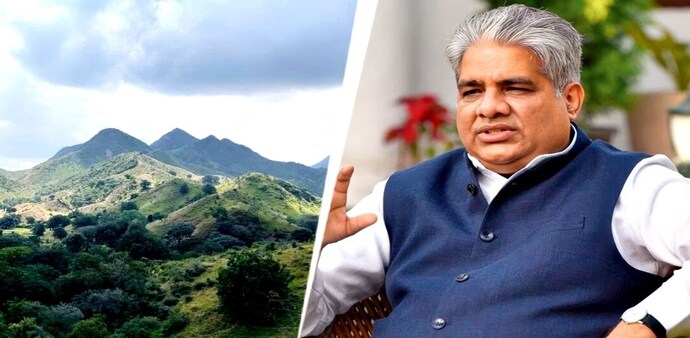
Union Environment Minister Bhupender Yadav on Monday welcomed the Supreme Court's decision to keep parts of its earlier Aravalli verdict in abeyance and to set up a new expert committee.
"I welcome the Supreme Court directions introducing a stay on its order concerning the Aravalli range, and the formation of a new committee to study issues," Yadav said in a post on X. "We stand committed to extending all assistance sought from MOEFCC in the protection and restoration of the Aravalli range."
Clarifying the current legal position, the minister said, "As things stand, a complete ban on mining stays with regards to new mining leases or renewal of old mining leases."
SC keeps November directions in abeyance
Earlier in the day, the Supreme Court kept in abeyance the directions issued in its November 20 verdict that had accepted a uniform definition of the Aravalli hills and ranges. A vacation bench comprising Chief Justice Surya Kant and Justices J K Maheshwari and Augustine George Masih proposed the constitution of a high-powered committee of domain experts to conduct an exhaustive and holistic examination of the issue.
"We deem it necessary to direct that the recommendations submitted by the committee, together with the findings and directions stipulated by this court in the judgment of November 20, 2025, be kept in abeyance," the bench said while hearing a suo motu case titled In Re: Definition of Aravalli Hills and Ranges and Ancillary Issues.
The top court said certain aspects required clarification, issued notice to the Centre and other parties, and posted the matter for further hearing on January 21.
The Aravalli ruling
In its November 20 order, the top court had accepted a uniform definition of the Aravalli hills and ranges and imposed a ban on the grant of fresh mining leases within the Aravalli region spanning Delhi, Haryana, Rajasthan, and Gujarat until expert reports were placed before it.
The court had endorsed the recommendations of a committee constituted by the Ministry of Environment, Forest and Climate Change (MoEFCC) to protect the Aravalli range, regarded as the world's oldest mountain system.
The committee had recommended that an "Aravalli Hill" be defined as any landform in designated Aravalli districts with an elevation of 100 metres or more above its local relief. "Any landform located in the Aravalli districts, having an elevation of 100 metres or more from the local relief, shall be termed as Aravalli Hills," the panel said, adding that the entire landform within the lowest contour, along with supporting slopes and associated landforms, would be deemed part of the Aravalli Hills.
It had further defined an "Aravalli Range" as a collection of two or more such hills located within 500 metres of each other, measured from the outermost point on the boundary of the lowest contour line. The panel said the area between such hills, along with associated features such as hills, hillocks, and supporting slopes, would also be included as part of the Aravalli Range.
The November 20 judgment, a 29-page order delivered in a suo motu matter arising from the long-running environmental litigation in the T N Godavarman Thirumulpad case, had also accepted recommendations prohibiting mining in core or inviolate areas, while allowing limited exceptions carved out by the expert committee. The court had additionally endorsed measures for sustainable mining and steps to prevent illegal mining in the Aravalli hills and ranges.
(With inputs from PTI)
Union Environment Minister Bhupender Yadav on Monday welcomed the Supreme Court's decision to keep parts of its earlier Aravalli verdict in abeyance and to set up a new expert committee.
"I welcome the Supreme Court directions introducing a stay on its order concerning the Aravalli range, and the formation of a new committee to study issues," Yadav said in a post on X. "We stand committed to extending all assistance sought from MOEFCC in the protection and restoration of the Aravalli range."
Clarifying the current legal position, the minister said, "As things stand, a complete ban on mining stays with regards to new mining leases or renewal of old mining leases."
SC keeps November directions in abeyance
Earlier in the day, the Supreme Court kept in abeyance the directions issued in its November 20 verdict that had accepted a uniform definition of the Aravalli hills and ranges. A vacation bench comprising Chief Justice Surya Kant and Justices J K Maheshwari and Augustine George Masih proposed the constitution of a high-powered committee of domain experts to conduct an exhaustive and holistic examination of the issue.
"We deem it necessary to direct that the recommendations submitted by the committee, together with the findings and directions stipulated by this court in the judgment of November 20, 2025, be kept in abeyance," the bench said while hearing a suo motu case titled In Re: Definition of Aravalli Hills and Ranges and Ancillary Issues.
The top court said certain aspects required clarification, issued notice to the Centre and other parties, and posted the matter for further hearing on January 21.
The Aravalli ruling
In its November 20 order, the top court had accepted a uniform definition of the Aravalli hills and ranges and imposed a ban on the grant of fresh mining leases within the Aravalli region spanning Delhi, Haryana, Rajasthan, and Gujarat until expert reports were placed before it.
The court had endorsed the recommendations of a committee constituted by the Ministry of Environment, Forest and Climate Change (MoEFCC) to protect the Aravalli range, regarded as the world's oldest mountain system.
The committee had recommended that an "Aravalli Hill" be defined as any landform in designated Aravalli districts with an elevation of 100 metres or more above its local relief. "Any landform located in the Aravalli districts, having an elevation of 100 metres or more from the local relief, shall be termed as Aravalli Hills," the panel said, adding that the entire landform within the lowest contour, along with supporting slopes and associated landforms, would be deemed part of the Aravalli Hills.
It had further defined an "Aravalli Range" as a collection of two or more such hills located within 500 metres of each other, measured from the outermost point on the boundary of the lowest contour line. The panel said the area between such hills, along with associated features such as hills, hillocks, and supporting slopes, would also be included as part of the Aravalli Range.
The November 20 judgment, a 29-page order delivered in a suo motu matter arising from the long-running environmental litigation in the T N Godavarman Thirumulpad case, had also accepted recommendations prohibiting mining in core or inviolate areas, while allowing limited exceptions carved out by the expert committee. The court had additionally endorsed measures for sustainable mining and steps to prevent illegal mining in the Aravalli hills and ranges.
(With inputs from PTI)