
'Consider oral dope test for pilots': Pilots federation after Air India Phuket-Delhi flight incident
The letter comes days after Air India flight AI2379, flying from Phuket to Delhi on August 4, suddenly lost around 300 feet of altitude following a hydraulic failure, injuring 17 people onboard.
- Aug 18, 2026,
- Updated Aug 18, 2026 4:52 PM IST
The Federation of Indian Pilots (FIP) has urged the Directorate General of Civil Aviation (DGCA) to modernise the way pilots are tested for psychoactive substances. It has proposed faster and wider testing while maintaining safety standards.
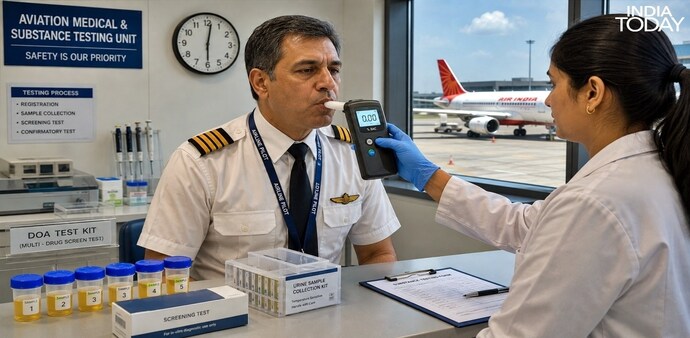
In a formal representation dated August 17, 2026, FIP President Capt. CS Randhawa asked the DGCA to consider introducing oral-fluid, or saliva, drug testing for pilots.
MUST READ | License suspension, more random tests: Tougher dope-test rules on cards after Air India pilot tests positive
The request comes days after Air India flight AI2379, flying from Phuket to Delhi on August 4, lost around 300 feet of altitude after a hydraulic failure, injuring 17 people onboard. The pilot-in-command was later reported to have tested positive for marijuana in a confirmatory test, according to media reports. Air India has since ordered mandatory psychoactive-substance testing for its pilots, with several more pilots reportedly returning non-negative preliminary results.
DON'T MISS | 3 hydraulic warnings, 2 autopilot alerts: New details emerge from Air India Phuket-Delhi flight
What FIP wants
FIP has proposed using oral-fluid testing alongside the existing urine-based system under CAR Section 5 – Air Safety, Series F, Part V, which has been in effect since January 31, 2022.
The federation does not want urine testing to be immediately replaced. Instead, it has suggested a hybrid, risk-based system. Oral-fluid tests could be used for routine, random and high-volume screening, while urine tests could continue for cases requiring a longer detection window.
DO CHECKOUT | Two Air India pilots flagged in initial drug test after Phuket flight incident as airline expands screening
FIP cited international examples, noting that Australia's Civil Aviation Safety Authority "expressly provides for both urine and oral-fluid testing" of aviation personnel. It also said the US Department of Transportation "authorises both urine and oral-fluid specimens," while the UAE's GCAA allows on-site oral-fluid screening followed by laboratory confirmation.
Faster testing at airports
FIP said the main benefit of saliva testing would be faster collection. Oral-fluid collection "is generally simpler, directly observable and capable of being undertaken at or near the workplace or airport."
An accompanying study by FIP said that, using an illustrative assumption of 45 minutes for urine collection and 15 minutes for oral-fluid collection, the switch "could theoretically reduce collection workload by approximately 66.7%."
However, FIP stressed that these are "illustrative planning assumptions and not regulatory performance standards" and should first be tested under Indian conditions.
Positive test does not mean impairment
FIP has also stressed that detecting a substance does not automatically mean a pilot was impaired. The letter states: "Neither urine nor oral-fluid testing, by itself, constitutes a direct impairment test. A screening non-negative result should therefore not automatically be interpreted as proof of impairment, misuse or unsafe performance."
The federation wants the existing process — Screening → Confirmatory Laboratory Testing → Medical Review → Final Regulatory Determination — to continue regardless of the testing method.
It has also sought a confidential medication-disclosure system for pilots taking legitimate medicines. The letter notes that ordinary medicines "may contain substances that can affect alertness, performance or produce a finding in a drug or alcohol test."
More random testing and pilot awareness
FIP has asked the DGCA to increase annual random-testing coverage from the current 10% to at least 25% of pilots, while allowing pilots to be selected more than once a year.
"The objective should not merely be to achieve an annual numerical target," the letter says, "but to establish a testing regime in which the possibility of selection remains credible throughout the year."
The federation also wants a mandatory "Check Before You Take" awareness programme covering cold and cough medicines, sleep aids, herbal supplements and prescription psychiatric medication.
Its proposed approach is: "Educate → Prevent → Test → Confirm → Medically Review → Take Appropriate Action" rather than a "Test → Detect → Punish" model.
12-month pilot programme proposed
FIP has proposed a 12-month controlled pilot at selected airlines and airports to compare oral-fluid and urine testing under Indian conditions before any changes are made to the CAR.
It has offered to share its detailed study with the DGCA and requested a technical consultation involving stakeholders and subject-matter experts.
The Federation of Indian Pilots (FIP) has urged the Directorate General of Civil Aviation (DGCA) to modernise the way pilots are tested for psychoactive substances. It has proposed faster and wider testing while maintaining safety standards.
In a formal representation dated August 17, 2026, FIP President Capt. CS Randhawa asked the DGCA to consider introducing oral-fluid, or saliva, drug testing for pilots.
MUST READ | License suspension, more random tests: Tougher dope-test rules on cards after Air India pilot tests positive
The request comes days after Air India flight AI2379, flying from Phuket to Delhi on August 4, lost around 300 feet of altitude after a hydraulic failure, injuring 17 people onboard. The pilot-in-command was later reported to have tested positive for marijuana in a confirmatory test, according to media reports. Air India has since ordered mandatory psychoactive-substance testing for its pilots, with several more pilots reportedly returning non-negative preliminary results.
DON'T MISS | 3 hydraulic warnings, 2 autopilot alerts: New details emerge from Air India Phuket-Delhi flight
What FIP wants
FIP has proposed using oral-fluid testing alongside the existing urine-based system under CAR Section 5 – Air Safety, Series F, Part V, which has been in effect since January 31, 2022.
The federation does not want urine testing to be immediately replaced. Instead, it has suggested a hybrid, risk-based system. Oral-fluid tests could be used for routine, random and high-volume screening, while urine tests could continue for cases requiring a longer detection window.
DO CHECKOUT | Two Air India pilots flagged in initial drug test after Phuket flight incident as airline expands screening
FIP cited international examples, noting that Australia's Civil Aviation Safety Authority "expressly provides for both urine and oral-fluid testing" of aviation personnel. It also said the US Department of Transportation "authorises both urine and oral-fluid specimens," while the UAE's GCAA allows on-site oral-fluid screening followed by laboratory confirmation.
Faster testing at airports
FIP said the main benefit of saliva testing would be faster collection. Oral-fluid collection "is generally simpler, directly observable and capable of being undertaken at or near the workplace or airport."
An accompanying study by FIP said that, using an illustrative assumption of 45 minutes for urine collection and 15 minutes for oral-fluid collection, the switch "could theoretically reduce collection workload by approximately 66.7%."
However, FIP stressed that these are "illustrative planning assumptions and not regulatory performance standards" and should first be tested under Indian conditions.
Positive test does not mean impairment
FIP has also stressed that detecting a substance does not automatically mean a pilot was impaired. The letter states: "Neither urine nor oral-fluid testing, by itself, constitutes a direct impairment test. A screening non-negative result should therefore not automatically be interpreted as proof of impairment, misuse or unsafe performance."
The federation wants the existing process — Screening → Confirmatory Laboratory Testing → Medical Review → Final Regulatory Determination — to continue regardless of the testing method.
It has also sought a confidential medication-disclosure system for pilots taking legitimate medicines. The letter notes that ordinary medicines "may contain substances that can affect alertness, performance or produce a finding in a drug or alcohol test."
More random testing and pilot awareness
FIP has asked the DGCA to increase annual random-testing coverage from the current 10% to at least 25% of pilots, while allowing pilots to be selected more than once a year.
"The objective should not merely be to achieve an annual numerical target," the letter says, "but to establish a testing regime in which the possibility of selection remains credible throughout the year."
The federation also wants a mandatory "Check Before You Take" awareness programme covering cold and cough medicines, sleep aids, herbal supplements and prescription psychiatric medication.
Its proposed approach is: "Educate → Prevent → Test → Confirm → Medically Review → Take Appropriate Action" rather than a "Test → Detect → Punish" model.
12-month pilot programme proposed
FIP has proposed a 12-month controlled pilot at selected airlines and airports to compare oral-fluid and urine testing under Indian conditions before any changes are made to the CAR.
It has offered to share its detailed study with the DGCA and requested a technical consultation involving stakeholders and subject-matter experts.