
Delhi air pollution: AQI in severe category, most stations record readings over 400
Most of the stations recorded an AQI of over 400, with some areas like Jahangirpuri crossing 450, and many like Ashok Vihar, Mundka, Punjabi Bagh, Rohini and Vivek Vihar dangerously close to that mark, according to SAFAR-India data.
- Nov 20, 2025,
- Updated Nov 20, 2025 8:54 AM IST
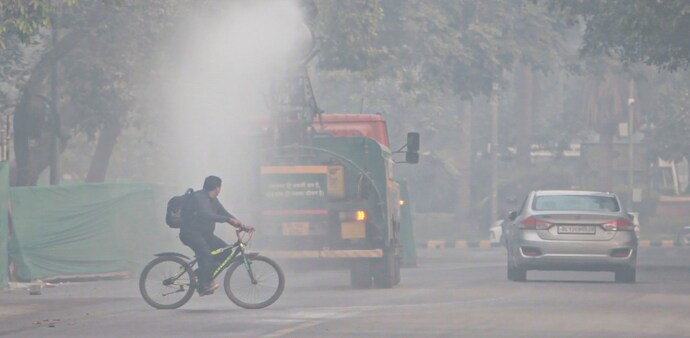
Delhi’s air quality deteriorated sharply on Thursday, with the Air Quality Index (AQI) just a notch below the 400 mark, which is categorised as ‘severe’. At 8:30 am on Thursday, Delhi’s air quality was at 399, as per data by SAFAR-India.
The spike comes after Wednesday, which recorded an AQI of 392.
Most of the stations recorded an AQI of over 400, with some areas like Jahangirpuri crossing 450, and many like Ashok Vihar, Mundka, Punjabi Bagh, Rohini and Vivek Vihar dangerously close to that mark, according to SAFAR-India data.
- Anand Vihar – 420
- Ashok Vihar – 444
- CRRI Mathura Road – 392
- Dwarka Sector 8 – 411
- ITO – 400
- Jahangirpuri – 451
- Jawaharlal Nehru Stadium – 392
- Lodhi Road – 355
- Mandir Marg – 373
- Mundka – 446
- Narela – 392
- Nehru Nagar – 431
- North Campus, DU – 416
- Okhla Phase 2 – 414
- Patparganj – 419
- Punjabi Bagh – 439
- Pusa – 369
- RK Puram – 423
- Rohini – 449
- Shadipur – 393
- Sirifort – 412
- Vivek Vihar – 436
The Ministry of Earth Sciences’ Air Quality Early Warning System had warned on Wednesday that Delhi’s air quality was likely to remain in the ‘very poor’ to ‘severe’ category for at least six more days.
Meanwhile, the Supreme Court instructed the Commission for Air Quality Management (CAQM) to consider issuing directives to schools in Delhi-NCR to delay open-air sports competitions planned for November and December, due to persistent high pollution levels. This direction is part of the court’s intervention to address severe air quality issues in the region, particularly as they affect vulnerable groups such as children.
The bench, led by Chief Justice B R Gavai and Justice K Vinod Chandran, emphasised a proactive approach and announced that the matter would be reviewed monthly to ensure consistent implementation of anti-pollution strategies.
The Chief Justice of India stated, "We request CAQM to take this into consideration and issue necessary directions to shift such sport competition to
The bench permitted CAQM and the Central Pollution Control Board to enforce stricter restrictions under the Graded Response Action Plan as required by evolving circumstances. The Supreme Court also refused to impose year-round restrictions on activities banned under GRAP, but called for long-term solutions to address pollution.
The court addressed the impact of pollution-related restrictions on daily wage labourers, noting that many depend on activities which are banned and thus suffer. The states of Delhi, Uttar Pradesh, Haryana, and Rajasthan were instructed to obtain directions regarding subsistence allowances for affected workers.
Delhi’s air quality deteriorated sharply on Thursday, with the Air Quality Index (AQI) just a notch below the 400 mark, which is categorised as ‘severe’. At 8:30 am on Thursday, Delhi’s air quality was at 399, as per data by SAFAR-India.
The spike comes after Wednesday, which recorded an AQI of 392.
Most of the stations recorded an AQI of over 400, with some areas like Jahangirpuri crossing 450, and many like Ashok Vihar, Mundka, Punjabi Bagh, Rohini and Vivek Vihar dangerously close to that mark, according to SAFAR-India data.
- Anand Vihar – 420
- Ashok Vihar – 444
- CRRI Mathura Road – 392
- Dwarka Sector 8 – 411
- ITO – 400
- Jahangirpuri – 451
- Jawaharlal Nehru Stadium – 392
- Lodhi Road – 355
- Mandir Marg – 373
- Mundka – 446
- Narela – 392
- Nehru Nagar – 431
- North Campus, DU – 416
- Okhla Phase 2 – 414
- Patparganj – 419
- Punjabi Bagh – 439
- Pusa – 369
- RK Puram – 423
- Rohini – 449
- Shadipur – 393
- Sirifort – 412
- Vivek Vihar – 436
The Ministry of Earth Sciences’ Air Quality Early Warning System had warned on Wednesday that Delhi’s air quality was likely to remain in the ‘very poor’ to ‘severe’ category for at least six more days.
Meanwhile, the Supreme Court instructed the Commission for Air Quality Management (CAQM) to consider issuing directives to schools in Delhi-NCR to delay open-air sports competitions planned for November and December, due to persistent high pollution levels. This direction is part of the court’s intervention to address severe air quality issues in the region, particularly as they affect vulnerable groups such as children.
The bench, led by Chief Justice B R Gavai and Justice K Vinod Chandran, emphasised a proactive approach and announced that the matter would be reviewed monthly to ensure consistent implementation of anti-pollution strategies.
The Chief Justice of India stated, "We request CAQM to take this into consideration and issue necessary directions to shift such sport competition to
The bench permitted CAQM and the Central Pollution Control Board to enforce stricter restrictions under the Graded Response Action Plan as required by evolving circumstances. The Supreme Court also refused to impose year-round restrictions on activities banned under GRAP, but called for long-term solutions to address pollution.
The court addressed the impact of pollution-related restrictions on daily wage labourers, noting that many depend on activities which are banned and thus suffer. The states of Delhi, Uttar Pradesh, Haryana, and Rajasthan were instructed to obtain directions regarding subsistence allowances for affected workers.