
Delhi air pollution: Supreme Court seeks report on defunct air monitoring stations in national capital
Chief Justice of India BR Gavai directed the CAQM and CPCB to submit a report detailing the steps being taken to prevent the air quality from deteriorating further.
- Nov 3, 2025,
- Updated Nov 3, 2025 2:02 PM IST
The Supreme Court has sought a report on the defunct air monitoring stations in Delhi amid worsening air pollution. This comes as the apex court was informed that most of the stations are not working, and was questioned how in the absence of crucial data the Graded Response Action Plan (GRAP) could be implemented effectively.
Amicus curiae Aparajita Singh urged the court to issue directions to the the Commission for Air Quality Management (CAQM) and the Central Pollution Control Board (CPCB) to take preemptive measures to control the rising pollution levels.
"They have to act before it becomes severe…There are news reports that the monitoring stations are not working. If the stations are not functioning, we won’t know when to implement GRAP. Let them respond on what the situation is,” the counsel said, highlighting that only 9 out of 37 monitoring stations were operational during Diwali.
“If that’s the case, how will we know when to implement GRAP?” asked the counsel.
Chief Justice of India BR Gavai, in response, directed the CAQM and CPCB to submit a report detailing the steps being taken to prevent the air quality from deteriorating further.
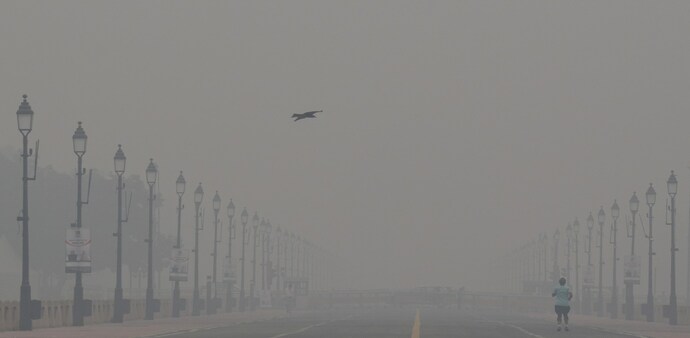
On Monday, a grey haze blanketed Delhi as the city's air quality remained in the 'very poor' category. According to the CPCB, Delhi recorded an overall Air Quality Index (AQI) of 316, indicating persistent pollution levels. Most stations recorded 'very poor' air quality with readings above 300.
Delhi's minimum temperature settled at 17.9 degrees Celsius, 1.9 notches above the season's average, the India Meteorological Department (IMD) said. The maximum temperature is likely to hover around 30 degrees Celsius with mist in the air, the IMD said.
The Supreme Court has sought a report on the defunct air monitoring stations in Delhi amid worsening air pollution. This comes as the apex court was informed that most of the stations are not working, and was questioned how in the absence of crucial data the Graded Response Action Plan (GRAP) could be implemented effectively.
Amicus curiae Aparajita Singh urged the court to issue directions to the the Commission for Air Quality Management (CAQM) and the Central Pollution Control Board (CPCB) to take preemptive measures to control the rising pollution levels.
"They have to act before it becomes severe…There are news reports that the monitoring stations are not working. If the stations are not functioning, we won’t know when to implement GRAP. Let them respond on what the situation is,” the counsel said, highlighting that only 9 out of 37 monitoring stations were operational during Diwali.
“If that’s the case, how will we know when to implement GRAP?” asked the counsel.
Chief Justice of India BR Gavai, in response, directed the CAQM and CPCB to submit a report detailing the steps being taken to prevent the air quality from deteriorating further.
On Monday, a grey haze blanketed Delhi as the city's air quality remained in the 'very poor' category. According to the CPCB, Delhi recorded an overall Air Quality Index (AQI) of 316, indicating persistent pollution levels. Most stations recorded 'very poor' air quality with readings above 300.
Delhi's minimum temperature settled at 17.9 degrees Celsius, 1.9 notches above the season's average, the India Meteorological Department (IMD) said. The maximum temperature is likely to hover around 30 degrees Celsius with mist in the air, the IMD said.