
Delhi chokes on smog: Records season’s worst air as AQI slips into ‘very poor’ category
Ahead of Diwali, the national capital’s pollution curve is rising again. Several monitoring stations showed AQI readings above 350 with predictions of ‘ very poor’ air for the next 2 days.
- Nov 2, 2026,
- Updated Nov 2, 2026 8:49 AM IST
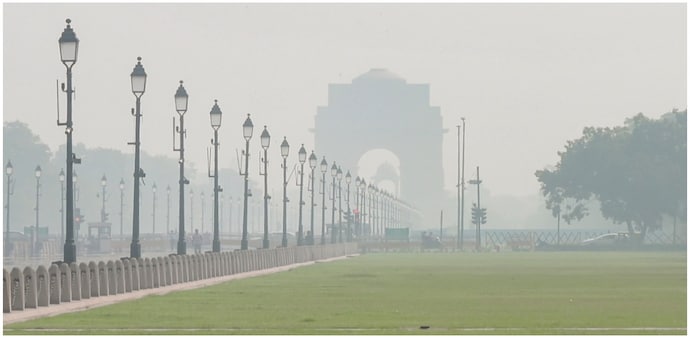
Delhi’s air quality deteriorated sharply today morning as winter conditions set in with the city’s Air Quality Index (AQI) entering the ‘very poor’ category, according to the Central Pollution Control Board (CPCB). The AQI crossed the 300-threshold for the first time on November 2, with a thick haze enveloping the national capital as pollution levels rose sharply after last week’s brief respite brought by rain.
The reading marked a jump of 193 points from Saturday’s average of 117, which had been in the ‘moderate’ category. CPCB’s 4 pm bulletin recorded the city-wide AQI at 261, but pollution levels continued to climb through the evening. The index stood at 272 at 6 pm, 287 by 10 pm and 290 by 11 pm, indicating that Delhi entered Monday under increasingly polluted conditions.
The deterioration came despite a relatively cleaner spell earlier in the week. On October 31, Delhi had recorded its lowest October monthly average AQI in eight years at 166, compared with 223 in October 2025.
Several areas hit ‘very poor’ mark
While the official city average remained in the ‘poor’ band, station-level readings showed much worse air in several neighbourhoods. Preliminary data on the Central Pollution Control Board (CPCB) dashboard put Jahangirpuri at an AQI of 420, Alipur at 382, Bawana at 365 and Dwarka Sector 8 at 357. ITO recorded 351 and Ashok Vihar 327, all in the ‘very poor’ category.
An AQI between 301 and 400 is classified as ‘very poor’ under the CPCB scale, a level at which people with respiratory or heart conditions, children and the elderly face a higher health risk.
Authorities imposed fines exceeding Rs 68 lakh on the first day of curbs and turned back 1,539 non-BS6 vehicles at Delhi borders under Graded Response Action Plan (GRAP) measures. A ban on non-BS6 vehicles remains in force from November 1 to January 31.
Ground reports from the Ghazipur border showed commercial vehicles undergoing verification at toll points, while checking for private vehicles remained minimal during early morning hours.
Weather forecast remains unfavourable
The Air Quality Early Warning System for Delhi has forecast that air quality is likely to remain in the ‘poor’ category on November 2 and November 3. IITM’s assessment similarly expects Delhi’s AQI to stay in the poor range early this week.
The CPCB’s All India AQI portal remains the official source for real-time and daily city-level readings, and residents are advised to check station-specific updates as conditions can vary widely across the capital.
DON'T MISS: Toxic foam is back on the Yamuna and Delhi-NCR AQI has reached 168. Here is what is happening
Health experts generally advise sensitive groups to limit prolonged outdoor exertion when AQI enters the poor or very poor range. With no significant rain expected to clear pollutants, authorities and residents will be watching whether overnight pollution, calm winds and winter conditions push Delhi’s average AQI closer to the ‘very poor’ threshold in the coming days.