
Delhi pollution: Farm fires in Pakistan's Punjab to choke Delhi-NCR further? NASA pics suggest so
Delhi pollution: Farm fires in Pakistan's Punjab to choke Delhi-NCR further? NASA pics suggest so
Smoke is expected to arrive in the Indian territory with the north western winds, leading to further rise in pollution due to no western disturbance at least for a week.
Business Today Desk
- Nov 3, 2026,
- Updated Nov 3, 2026 12:23 PM IST
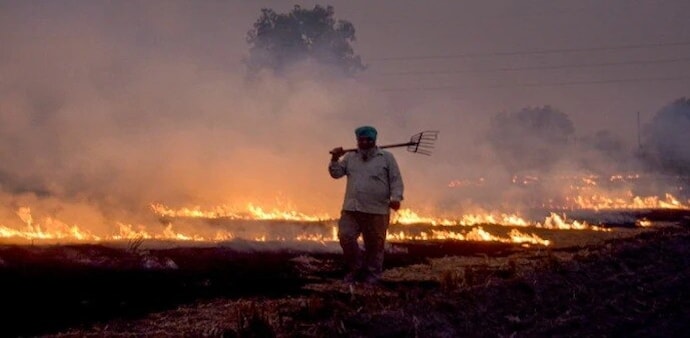
Massive farm fires in Pakistan's Punjab could add to the pollution burden in northern India, northwesternly winds likely to carry smoke and pollutants. The development comes as stubble-burning cases in Indian Punjab are also on the rise.
Smoke is expected to arrive in the Indian territory with the north western winds, exacerbating pollution in Haryana, Delhi, Ghaziabad, and other parts of northern India. The India Meteorological Department (IMD) has predicted north western wind for 4 more days. The lack of a western disturbance for at least a week could further worsen pollution levels.
Advertisement
ALSO READ | Delhi’s air turns ‘very poor’: Is your air purifier ready? Here’s how to clean and maintain it
Crop fires in Pakistan's Punjab 4.2x higher than Indian Punjab
The crop fires detected in Pakistan's Punjab were 4.2 times higher than Indian Punjab in the first 29 days of October, Pakistan's leading news outlet Dawn reported, citing satellite data analysed by environmental monitoring platform HamariHawa.
NASA's Fire Information for Resource Management System (FIRMS) detected 13,241 farm fires in Pakistan's Punjab compared to 3,158 in Indian Punjab. The official figures from the Pollution Control Board, however, stood at 1,007 incidents from the same timeframe.
In Indian Punjab, Tarn Taran (397 farm fires), Amritsar (171 farm fires) and Ferozepur (104 farm fires) were the top hotspots. Other districts that have been impacted are Sangrur, Patiala, Gurdaspur, Kapurthala, and Bathinda.
Advertisement
DON'T MISS | Diwali 2026: What are green crackers? Types, prices, where to buy & rules in India
According to NASA's FIRMS data, 92% of the detected fire spots in Pakistan's Punjab were located on farmland and were likely associated with crop burning.
The situation worsened towards October-end as FIRMS detected 6,655 fire spots were detected during the last 7 days of October, accounting for half of the total number of farm fires during the 29-day period. Of these, October 29 logged the most fires in one day, with 1,327 farm fires recorded in Pakistan's Punjab.
The crop burning in Pakistan's Punjab was concentrated largely in the rice-growing belt around Lahore, with Okara recording the highest number of fire spots at 2,144 between October 1-29. While Gujranwala recorded 1,011 farm fires, Nankana Sahib reported 1,003 instances of crop burning. Together, the three districts recorded 4,158 fire spots, surpassing the 3,158 detections across Indian Punjab during the same period.
Advertisement
Pakpattan reported 922 fire spots, followed by Sheikhupura at 756, Hafizabad at 713, Dera Ghazi Khan at 710, Kasur at 699, Khanewal at 682 and Jhang at 676.
See picture shared by NASA here
Delhi AQI today
The increasing farm fires could worsen air pollution in Delhi-NCR. As of Tuesday morning, the national capital recorded an overall air quality index (AQI) of 331, according to the Central Pollution Control Board (CPCB).
Readings crossed 400 at several monitoring stations, including Narela (406), Vivek Vihar (410), Alipur (413), Bawana (403), Jahangirpuri (449), Rohini (429), and Punjabi Bagh (424).The AQI stood at 396 in Mundka, 368 at Mandir Marg and 352 in Okhla Phase 2.
In Ghaziabad, the AQI stood at 516 as of 8:31 am today, as per AQI.in. The air quality in Ghaziabad was affected by a combination of vehicle emissions, industrial activity, construction, road dust and waste burning.
Read more!