
Delhi pollution: Overall AQI hits 331 despite GRAP measures, IMD predicts 'very poor' air quality over next few days
Delhi’s skies continued to remain shrouded in a thick cloud of smog despite Graded Response Action Plan (GRAP) measures being in place.
- Nov 3, 2026,
- Updated Nov 3, 2026 8:56 AM IST
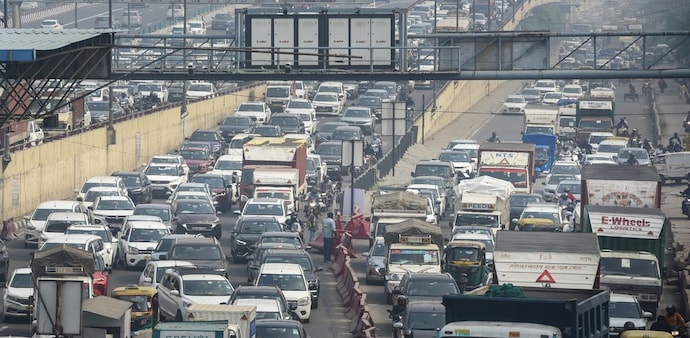
Delhi residents faced polluted air and long traffic jams as the city’s overall Air Quality Index (AQI) stood at 331, while readings crossed 400 at several monitoring stations. Delhi’s skies continued to remain shrouded in a thick cloud of smog despite Graded Response Action Plan (GRAP) measures being in place. Intensified checks under the GRAP led to congestion at interstate borders, with commuters stranded for hours on Monday.
Delhi Traffic Police officials said 7,657 vehicles had been checked at the city’s borders and 609 vehicles that did not meet the prescribed emission standards had been turned back since Sunday. The police also issued 433 challans for no-entry violations.
Delhi AQI crosses 400 at several stations
Jahangirpuri recorded the highest listed AQI at 449, followed by Rohini at 429 and Punjabi Bagh at 424, according to the Central Pollution Control Board. The CPCB data showed that Narela recorded an AQI of 406, while Vivek Vihar reported 410, Alipur 413 and Bawana 403. The AQI was 396 in Mundka, 373 at ITO, 368 at Mandir Marg and 352 in Okhla Phase 2.
GRAP-2 imposed in Delhi-NCR
Given the worsening air quality of the national capital, the Commission for Air Quality Management (CAQM) on Monday imposed GRAP-2 measures across Delhi-NCR. The measures came when the IMD and the Indian Institute of Tropical Meteorology predicted the air quality was likely to remain 'very poor' over the coming days.
Under this, authorities will intensify measures to curb pollution and encourage public transport. Some measures under GRAP-2 include regular mechanical road sweeping, water sprinkling, deployment of anti-smog guns and increased parking fees to discourage private vehicle use.
Pollution checks trigger traffic jams at Delhi borders
Long queues formed on roads connecting the national capital with neighbouring Haryana and Uttar Pradesh as enforcement teams checked whether vehicles complied with prescribed emission standards.
Heavy congestion was reported at the Delhi-Gurugram, Delhi-Noida, Delhi-Ghaziabad, Delhi-Sonipat and Delhi-Najafgarh borders. Traffic on NH-48 remained backed up for several kilometres near the Sirhaul toll plaza at the Delhi-Gurugram border, affecting both the main carriageway and service roads.
Similar traffic jams were reported near Noida and Ghaziabad, where vehicles were stopped for checks. At the Aya Nagar border, teams from the Delhi Traffic Police and the Transport Department turned back vehicles that did not meet the prescribed BS-VI emission standards.
Senior Delhi Traffic Police officers said all borders under different ranges were enforcing the pollution-control guidelines and vehicles below BS-VI standards were being sent back. Fines were also issued for violations and incomplete vehicle documents.
Action against commercial vehicles
The traffic police initiated action to suspend the permits of 76 commercial vehicles for violating no-entry restrictions. Of these, 10 were registered in Delhi and 66 in other states.
The process to suspend the permits of the Delhi-registered vehicles has begun, while recommendations for action against the remaining vehicles have been sent to the respective Regional Transport Authorities, according to the Delhi Traffic Police.
The Central Range of the traffic police also established 12 special traffic pickets at strategic locations to prevent the unauthorised movement of heavy and commercial vehicles during no-entry hours. These locations included Rajghat, IP Flyover, Yudhishthir Setu, Shanti Van Chowk, Burari Flyover, Pinjra T-Point, Inderlok and Chandgi Ram Akhara.