
Ex-Singapore diplomat: 'India doesn't rely on US, it has a long history of relying only on itself'
'I don't think India relies on the US. It has improved its relationship with the US for strategic reasons,' says Bilahari Kausikan
- Aug 13, 2025,
- Updated Aug 13, 2025 4:00 PM IST
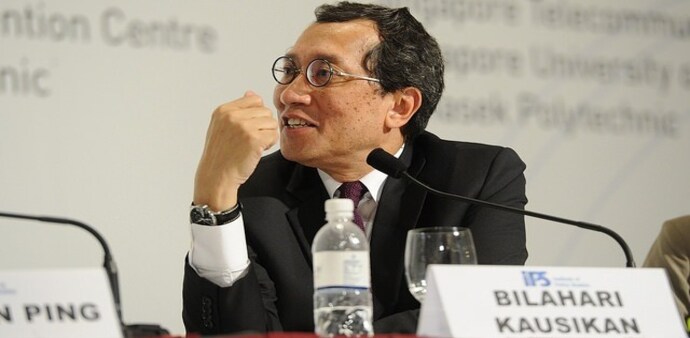
Former Singapore diplomat Bilahari Kausikan has underlined India's tradition of self-reliance, saying New Delhi does not depend on the United States for its security or strategic needs. During an interaction in June, a month after the India-Pakistan conflict, when Washington was perceived to side with Islamabad, Kausikan said: "I don't think India relies on the US. It has improved its relationship with the US for strategic reasons. But India, generally speaking, has a long history of relying only on itself."
"You are not having a bad relationship with China to do the US a favor," he said while responding to a question by an Indian journalist. "You have a strained relationship with China because you have disputes in the Himalayas, because there's an old Chinese saying: one mountain can only have one tiger. And you need to build up your capabilities, and you are doing it."
According to Kausikan, India improved its relationship with the US for reasons beyond China. A more fundamental factor, he continued, is that under several consecutive governments after the first Prime Minister Jawaharlal Nehru, India had aligned itself closely with the Soviet Union. While there were good reasons for this at the time, the Soviet Union no longer exists. India still maintains a relationship with Russia, but it no longer provides the strategic leverage it once did, making the current approach perfectly logical, he added.
The former diplomat, who served as Singapore's Permanent Representative to the United Nations between 1995 and 1998, explained the limits of US reliability, pointing to the volatility of American politics: "I'm often asked this question - is the US reliable? I always answer the same way. Of course, the US is not reliable, but it's indispensable. It's up to me to find a way to work with the US. How can it be reliable when every four years everything is turned upside down, even if the same party is returned to power and occupies the White House? But that is the US system. There's only one US, and that one US is indispensable. So we need to find a way to work with it."
Kausikan said Singapore has always found a way to work with the US, and India will too. "You don't depend on the US to defend you, surely. I don't think so. I know you don't. We don't depend on the US to defend ourselves, we only depend on the US to maintain the overall balance of power in the region in its own interest, not as a favor to us. And I think India has a similar attitude. I don't think India relies on the US to defend it."
Kausikan's observations came amid growing debate over India's engagement with the US, especially after Washington imposed a 50 per cent tariff on Indian goods over crude imports from Russia.
On Tuesday, American economist Jeffrey Sachs said that India should not trust the United States as its main partner and align with BRICS. "It was thought by some that India would become the close economic partner that would replace China's trade. I said that was naive. The US is not going to accept large exports from India any more than it did from China."
Former Singapore diplomat Bilahari Kausikan has underlined India's tradition of self-reliance, saying New Delhi does not depend on the United States for its security or strategic needs. During an interaction in June, a month after the India-Pakistan conflict, when Washington was perceived to side with Islamabad, Kausikan said: "I don't think India relies on the US. It has improved its relationship with the US for strategic reasons. But India, generally speaking, has a long history of relying only on itself."
"You are not having a bad relationship with China to do the US a favor," he said while responding to a question by an Indian journalist. "You have a strained relationship with China because you have disputes in the Himalayas, because there's an old Chinese saying: one mountain can only have one tiger. And you need to build up your capabilities, and you are doing it."
According to Kausikan, India improved its relationship with the US for reasons beyond China. A more fundamental factor, he continued, is that under several consecutive governments after the first Prime Minister Jawaharlal Nehru, India had aligned itself closely with the Soviet Union. While there were good reasons for this at the time, the Soviet Union no longer exists. India still maintains a relationship with Russia, but it no longer provides the strategic leverage it once did, making the current approach perfectly logical, he added.
The former diplomat, who served as Singapore's Permanent Representative to the United Nations between 1995 and 1998, explained the limits of US reliability, pointing to the volatility of American politics: "I'm often asked this question - is the US reliable? I always answer the same way. Of course, the US is not reliable, but it's indispensable. It's up to me to find a way to work with the US. How can it be reliable when every four years everything is turned upside down, even if the same party is returned to power and occupies the White House? But that is the US system. There's only one US, and that one US is indispensable. So we need to find a way to work with it."
Kausikan said Singapore has always found a way to work with the US, and India will too. "You don't depend on the US to defend you, surely. I don't think so. I know you don't. We don't depend on the US to defend ourselves, we only depend on the US to maintain the overall balance of power in the region in its own interest, not as a favor to us. And I think India has a similar attitude. I don't think India relies on the US to defend it."
Kausikan's observations came amid growing debate over India's engagement with the US, especially after Washington imposed a 50 per cent tariff on Indian goods over crude imports from Russia.
On Tuesday, American economist Jeffrey Sachs said that India should not trust the United States as its main partner and align with BRICS. "It was thought by some that India would become the close economic partner that would replace China's trade. I said that was naive. The US is not going to accept large exports from India any more than it did from China."