
Flaming torches, swords and Garba: The centuries-old spirit of Jamnagar's Navratri
Flaming torches, swords and Garba: The centuries-old spirit of Jamnagar's Navratri
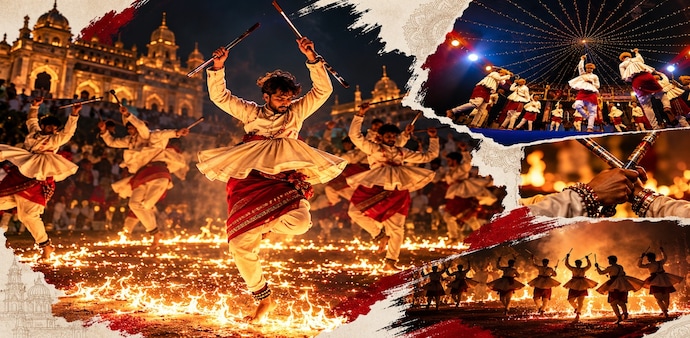
The performance features 12 male dancers dressed in traditional kediyu-choiyanu, the colourful attire associated with Gujarati folk dance
Acharya Parikshit
- Oct 12, 2026,
- Updated Oct 12, 2026 9:44 PM IST
As the rhythmic beats of traditional Gujarati folk music fill the air during Navratri, the city of Jamnagar in Saurashtra comes alive with a distinctive expression of faith and festivity.
Among its most remarkable cultural attractions are Mashal Raas and Talwar Raas, performed by Shri Patel Yuvak Garbi Mandal. Rooted in the region’s folk traditions, these performances transform the dance floor into a vibrant celebration of Gujarat’s spiritual and artistic legacy.
Advertisement
READ THIS: Gen Z’s Garba glow secret? Ahmedabad youth turns to IV drip therapy this Navratri
Mashal Raas: Dancing amid flames
Mashal Raas is one of Jamnagar’s most striking Navratri traditions. Introduced by Shri Patel Yuvak Garbi Mandal in 1957, this distinctive dance form combines devotion to the divine feminine with discipline, synchronisation and daring choreography. The mandal itself has a history spanning several decades, reflecting the community’s enduring commitment to preserving traditional Garbi.
The performance features 12 male dancers dressed in traditional kediyu-choiyanu, the colourful attire associated with Gujarati folk dance. Holding flaming torches, six performers move in an inner circle while six others form an outer circle. Their coordinated movements create intricate patterns inspired by the sathiya (swastika) and trishul (trident), symbols associated with auspiciousness and the divine power of Goddess Durga.
Advertisement
Accompanied by devotional songs such as “Ramti Aave Maadi”, the performance builds towards a dramatic finale involving burning cotton balls and leaps over fire. Beyond its visual spectacle, Mashal Raas represents faith, courage, concentration and collective discipline. Its demanding choreography requires extensive preparation and years of practice.
Talwar Raas: The spirit of valour
Equally captivating is Talwar Raas, in which 14 performers dance with swords, bringing an element of martial tradition to Gujarat’s festive celebrations. The rhythmic movements, coordinated formations and controlled handling of swords create a powerful spectacle that evokes courage, alertness and the warrior spirit.
Advertisement
The performance reflects the broader cultural history of Saurashtra, where folk dances have long preserved stories of bravery, community identity and traditional values. Unlike contemporary dance formats, Talwar Raas places emphasis on precision, synchronisation and the disciplined execution of every movement.
ALSO READ: Navratri 2026: Garba-dandiya events in Delhi-NCR, Check dates, venues, timings, tickets
Preserving Gujarat’s living heritage
For Shri Patel Yuvak Garbi Mandal, these performances are more than annual attractions; they represent a cultural inheritance passed from one generation to the next. Experienced performers guide younger participants, ensuring that the movements, musical rhythms, traditional attire and symbolism remain part of Jamnagar’s cultural landscape.
The mandal also presents other regional forms, including Dantarda Raas and Kanbi Raas, reflecting the diversity of Saurashtra’s folk traditions.
At a time when Navratri celebrations increasingly embrace modern music and contemporary dance styles, Mashal Raas and Talwar Raas stand as powerful reminders of Gujarat’s living heritage. They bring together spirituality, community participation and artistic expression, allowing audiences to experience traditions that cannot be captured by music alone.
As the rhythmic beats of traditional Gujarati folk music fill the air during Navratri, the city of Jamnagar in Saurashtra comes alive with a distinctive expression of faith and festivity.
Among its most remarkable cultural attractions are Mashal Raas and Talwar Raas, performed by Shri Patel Yuvak Garbi Mandal. Rooted in the region’s folk traditions, these performances transform the dance floor into a vibrant celebration of Gujarat’s spiritual and artistic legacy.
Advertisement
READ THIS: Gen Z’s Garba glow secret? Ahmedabad youth turns to IV drip therapy this Navratri
Mashal Raas: Dancing amid flames
Mashal Raas is one of Jamnagar’s most striking Navratri traditions. Introduced by Shri Patel Yuvak Garbi Mandal in 1957, this distinctive dance form combines devotion to the divine feminine with discipline, synchronisation and daring choreography. The mandal itself has a history spanning several decades, reflecting the community’s enduring commitment to preserving traditional Garbi.
The performance features 12 male dancers dressed in traditional kediyu-choiyanu, the colourful attire associated with Gujarati folk dance. Holding flaming torches, six performers move in an inner circle while six others form an outer circle. Their coordinated movements create intricate patterns inspired by the sathiya (swastika) and trishul (trident), symbols associated with auspiciousness and the divine power of Goddess Durga.
Advertisement
Accompanied by devotional songs such as “Ramti Aave Maadi”, the performance builds towards a dramatic finale involving burning cotton balls and leaps over fire. Beyond its visual spectacle, Mashal Raas represents faith, courage, concentration and collective discipline. Its demanding choreography requires extensive preparation and years of practice.
Talwar Raas: The spirit of valour
Equally captivating is Talwar Raas, in which 14 performers dance with swords, bringing an element of martial tradition to Gujarat’s festive celebrations. The rhythmic movements, coordinated formations and controlled handling of swords create a powerful spectacle that evokes courage, alertness and the warrior spirit.
Advertisement
The performance reflects the broader cultural history of Saurashtra, where folk dances have long preserved stories of bravery, community identity and traditional values. Unlike contemporary dance formats, Talwar Raas places emphasis on precision, synchronisation and the disciplined execution of every movement.
ALSO READ: Navratri 2026: Garba-dandiya events in Delhi-NCR, Check dates, venues, timings, tickets
Preserving Gujarat’s living heritage
For Shri Patel Yuvak Garbi Mandal, these performances are more than annual attractions; they represent a cultural inheritance passed from one generation to the next. Experienced performers guide younger participants, ensuring that the movements, musical rhythms, traditional attire and symbolism remain part of Jamnagar’s cultural landscape.
The mandal also presents other regional forms, including Dantarda Raas and Kanbi Raas, reflecting the diversity of Saurashtra’s folk traditions.
At a time when Navratri celebrations increasingly embrace modern music and contemporary dance styles, Mashal Raas and Talwar Raas stand as powerful reminders of Gujarat’s living heritage. They bring together spirituality, community participation and artistic expression, allowing audiences to experience traditions that cannot be captured by music alone.
Read more!