
Independence Day 2026: PM Modi unveils Sapt Dhara roadmap for Viksit Bharat. What it means, list of sectors it focuses on
Independence Day 2026: PM Modi unveils Sapt Dhara roadmap for Viksit Bharat. What it means, list of sectors it focuses on
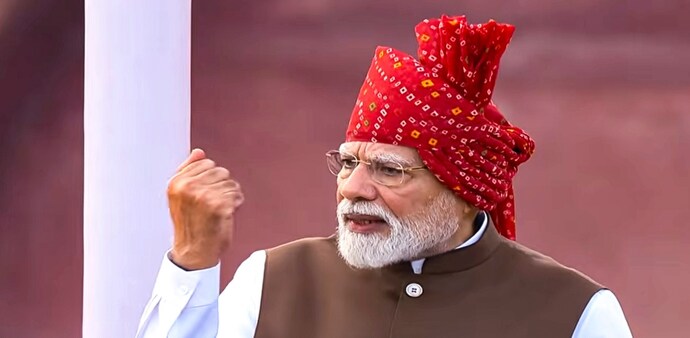
From the Red Fort, Prime Minister Narendra Modi outlined seven focus areas for India's development under 'Shakti ki Sapt Dhara'. He linked the framework to India's economic rise and its goal of becoming a developed country by 2047.
Business Today Desk
- Aug 15, 2026,
- Updated Aug 15, 2026 9:18 AM IST
From the ramparts of the Red Fort, Prime Minister Narendra Modi laid out seven focus areas for India’s development, describing them as “Shakti ki Sapt Dhara”. In his address to the nation, Modi presented “Shakti ki Sapt Dhara” as the framework for India’s development, with manufacturing, agriculture and food processing, technology and innovation, Gati-Shakti, Raksha Shakti, the green and blue economy, and soft power identified as the seven priority areas.
Advertisement
MUST READ | 'At least one Indian bank should...': PM Modi's ambitious target for India Inc ft. Fortune 500
He said the seven areas would guide the country’s growth as it moves towards the goal of a Viksit Bharat by 2047. The seven areas named by Modi were manufacturing, agriculture and food processing, technology and innovation, Gati-Shakti, Raksha Shakti, the green and blue economy, and India’s soft power. He presented them as key pillars of development while also pointing to the country’s economic and industrial progress over the past 12 years.
"Today, I would also like to recall that era when the nation knew, understood, and heard of India's prowess in the form of the 'Sapta Sindhu'. Now, to build a Viksit Bharat, we need a new current. Today, from the ramparts of the Red Fort, I invoke the 'Sapta Dhara' of strength before the nation. In the coming 5 to 7 years, what could not be achieved in the last 5 to 7 decades, through the prowess and power of this Sapta Dhara, we will give the nation new heights, new momentum, and the capability to surpass new goals. Alongside this, the power and potential of our youth will be fully harnessed and integrated into nation-building," said PM Modi.
Advertisement
What is PM Modi's Saptadhara mission?
DO CHECKOUT | 80th Independence Day: India to have more semiconductor plants in 7-8 yrs, says PM Modi
India's journey from 'fragile 5' to world's fastest growing economy
Placing the seven focus areas in a wider economic context, Modi said India has transformed from the “Fragile Five” to the world’s fastest-growing major economy in the last 12 years. He said the world had once placed India’s economy in the “Fragile Five”, but the country had emerged from that position within just 12 years.
Advertisement
After Independence in 1947, he said, India had big dreams, but progress often fell short of the pace the country aspired to achieve. Today, he said, India is moving ahead with unprecedented speed and confidence, and no force can stop the resolve of 140 crore Indians.
He added, “When the world’s most populous nation sets its sights on becoming a developed country, it sends a powerful message to the world and is reshaping how the world sees India,” while saying that any nation becomes great when it achieves its accomplishments.
From the ramparts of the Red Fort, Prime Minister Narendra Modi laid out seven focus areas for India’s development, describing them as “Shakti ki Sapt Dhara”. In his address to the nation, Modi presented “Shakti ki Sapt Dhara” as the framework for India’s development, with manufacturing, agriculture and food processing, technology and innovation, Gati-Shakti, Raksha Shakti, the green and blue economy, and soft power identified as the seven priority areas.
Advertisement
MUST READ | 'At least one Indian bank should...': PM Modi's ambitious target for India Inc ft. Fortune 500
He said the seven areas would guide the country’s growth as it moves towards the goal of a Viksit Bharat by 2047. The seven areas named by Modi were manufacturing, agriculture and food processing, technology and innovation, Gati-Shakti, Raksha Shakti, the green and blue economy, and India’s soft power. He presented them as key pillars of development while also pointing to the country’s economic and industrial progress over the past 12 years.
"Today, I would also like to recall that era when the nation knew, understood, and heard of India's prowess in the form of the 'Sapta Sindhu'. Now, to build a Viksit Bharat, we need a new current. Today, from the ramparts of the Red Fort, I invoke the 'Sapta Dhara' of strength before the nation. In the coming 5 to 7 years, what could not be achieved in the last 5 to 7 decades, through the prowess and power of this Sapta Dhara, we will give the nation new heights, new momentum, and the capability to surpass new goals. Alongside this, the power and potential of our youth will be fully harnessed and integrated into nation-building," said PM Modi.
Advertisement
What is PM Modi's Saptadhara mission?
DO CHECKOUT | 80th Independence Day: India to have more semiconductor plants in 7-8 yrs, says PM Modi
India's journey from 'fragile 5' to world's fastest growing economy
Placing the seven focus areas in a wider economic context, Modi said India has transformed from the “Fragile Five” to the world’s fastest-growing major economy in the last 12 years. He said the world had once placed India’s economy in the “Fragile Five”, but the country had emerged from that position within just 12 years.
Advertisement
After Independence in 1947, he said, India had big dreams, but progress often fell short of the pace the country aspired to achieve. Today, he said, India is moving ahead with unprecedented speed and confidence, and no force can stop the resolve of 140 crore Indians.
He added, “When the world’s most populous nation sets its sights on becoming a developed country, it sends a powerful message to the world and is reshaping how the world sees India,” while saying that any nation becomes great when it achieves its accomplishments.
Read more!