
India needs a rocket force: Ex-Army chief backs plan for targets beyond 450 km
The need to have a conventional missile force comprising long-range rockets is very much there, says former Army Chief Manoj Pande
- Oct 21, 2025,
- Updated Oct 21, 2025 4:26 PM IST
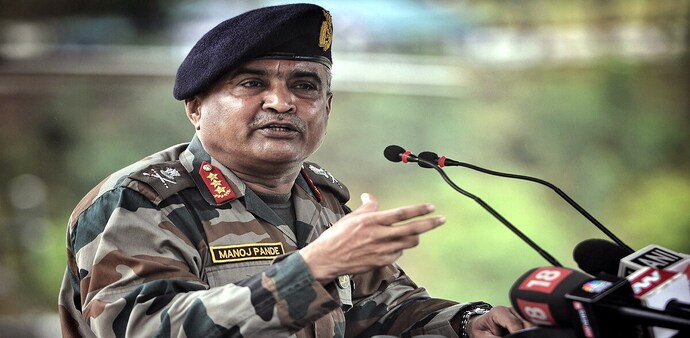
India needs to develop a dedicated rocket force to strengthen its long-range strike capabilities, former Army Chief General Manoj Pande said, noting that modern warfare has underscored the critical role of precision missile systems. He explained the rationale for establishing a conventional missile or rocket force, especially in the context of India's northern borders.
"In the recent conflicts and the ones that are ongoing, we have seen the utilisation of long-range missiles, long-range artillery to very good effect," he said in an interview with BharatShakti Dialogues. "They not only give you longer ranges, they are more accurate. I would also suggest that it is more economical to have these long-range artillery or long-range missiles to have the same kind of effect."
The former army chief pointed out that India's current missile inventory allows engagement of targets up to about 400-450 km. "But beyond that range, while there are targets which are existing which you would want to target as part of your conventional operations and with conventional weapon systems, we do not have any means to do it," he said. Hence, to achieve ranges beyond what we currently have, we need the conventional rocket forces or missile forces, he said.
Highlighting that India already has significant experience in operating missile systems, Pande said this background would be advantageous. "We already have experience in operating missiles. That will hold us in good stead in terms of when we acquire this capability. I don't think, in terms of technology, it requires a major effort. It perhaps requires only tweaking of our existing technologies to meet our specific requirements of a conventional missile force," he noted.
On how such a force might be structured, he said discussions could explore multiple command arrangements. "As to what is the command control arrangements, who would they be under, will it be held centrally or given to the regional commands or theatre command - there are different options that can be discussed," he said.
Summing up the strategic need, Pande added, "The need to have a conventional missile force comprising long-range rockets is very much there."
In August this year, Pakistan announced the creation of its Army Rocket Force, following in the footsteps of its all-weather ally China. China's Rocket Force oversees a vast arsenal of land-based ballistic, cruise, and hypersonic missiles - both nuclear and conventional. It operates as an independent branch of China's armed forces, responsible for deterrence, precision strikes, and strategic support missions.
The rocket force, which is also known as missile force, integrates advanced targeting, command, and control systems that allow coordinated missile operations across multiple ranges and theatres - a model many regional militaries are now studying closely.
India needs to develop a dedicated rocket force to strengthen its long-range strike capabilities, former Army Chief General Manoj Pande said, noting that modern warfare has underscored the critical role of precision missile systems. He explained the rationale for establishing a conventional missile or rocket force, especially in the context of India's northern borders.
"In the recent conflicts and the ones that are ongoing, we have seen the utilisation of long-range missiles, long-range artillery to very good effect," he said in an interview with BharatShakti Dialogues. "They not only give you longer ranges, they are more accurate. I would also suggest that it is more economical to have these long-range artillery or long-range missiles to have the same kind of effect."
The former army chief pointed out that India's current missile inventory allows engagement of targets up to about 400-450 km. "But beyond that range, while there are targets which are existing which you would want to target as part of your conventional operations and with conventional weapon systems, we do not have any means to do it," he said. Hence, to achieve ranges beyond what we currently have, we need the conventional rocket forces or missile forces, he said.
Highlighting that India already has significant experience in operating missile systems, Pande said this background would be advantageous. "We already have experience in operating missiles. That will hold us in good stead in terms of when we acquire this capability. I don't think, in terms of technology, it requires a major effort. It perhaps requires only tweaking of our existing technologies to meet our specific requirements of a conventional missile force," he noted.
On how such a force might be structured, he said discussions could explore multiple command arrangements. "As to what is the command control arrangements, who would they be under, will it be held centrally or given to the regional commands or theatre command - there are different options that can be discussed," he said.
Summing up the strategic need, Pande added, "The need to have a conventional missile force comprising long-range rockets is very much there."
In August this year, Pakistan announced the creation of its Army Rocket Force, following in the footsteps of its all-weather ally China. China's Rocket Force oversees a vast arsenal of land-based ballistic, cruise, and hypersonic missiles - both nuclear and conventional. It operates as an independent branch of China's armed forces, responsible for deterrence, precision strikes, and strategic support missions.
The rocket force, which is also known as missile force, integrates advanced targeting, command, and control systems that allow coordinated missile operations across multiple ranges and theatres - a model many regional militaries are now studying closely.