
BT Explainer: India’s heat map turns alarming: What 45°C+ temperatures mean for the economy, people
BT Explainer: India’s heat map turns alarming: What 45°C+ temperatures mean for the economy, people
India stands at a critical juncture. Its economic ambitions — including becoming the world’s third-largest economy — are now directly tied to how it handles extreme heat.
Subhankar Paul
- Apr 26, 2026,
- Updated May 15, 2026 10:04 PM IST
India’s scorching summer of 2026 is no longer just a weather story — it is rapidly becoming an economic and structural stress test.
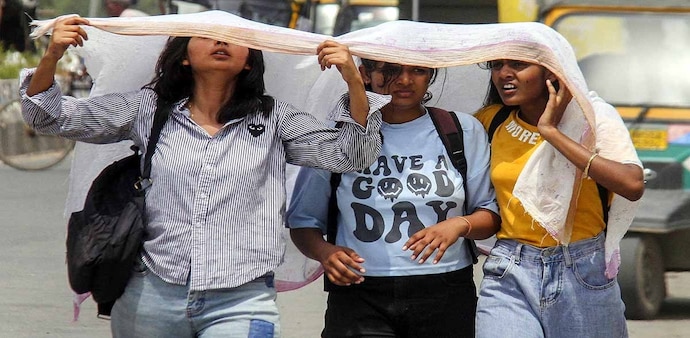
Over the past few weeks, large parts of north and central India — including Rajasthan, Uttar Pradesh, and Delhi — have consistently recorded temperatures above 45°C, with some areas nearing 47°C. This has pushed Indian cities to the top of global heat charts, surpassing even regions in West Asia and Africa that are traditionally associated with extreme heat.
Advertisement
Must read | Scorching reality: India emerges as world’s hottest zone amid extreme heatwave
This pattern reflects a broader shift tied to climate change, where heatwaves in South Asia are becoming longer, earlier, and more intense.
Economic warning beneath the heat
In a widely discussed post on X (formally twitter), Aakash Gupta — a prominent product growth leader and creator, recognised as a top influencer in product management — highlighted how rising temperatures could directly slow India’s economic momentum.
Drawing on projections from institutions like McKinsey & Company, International Labour Organization, International Monetary Fund, and The Lancet, the risks are stark:
Advertisement
- 2.5% to 4.5% of GDP at risk annually by 2030 due to lost labor hours
- $150-$250 billion in economic losses each year
- 34 million full-time jobs effectively lost due to heat exposure
- 167 billion labor hours already lost in 2021 alone
- Heat-related deaths up 55% over two decades
These projections challenge the assumption that India’s growth — including its expected rise past Japan to become the world’s third-largest economy — will continue under “normal” productivity conditions.
Cooling demand vs Power reality
As temperatures rise, so does dependence on air conditioning — but that brings its own crisis.
- Only 8% of Indian households currently have ACs
- Demand is expected to surge, with 130-150 million new units by 2035
- Peak electricity demand already touched 240 GW in 2024
According to projections cited from University of California, Berkeley:
Advertisement
- Room ACs alone could add 180 GW of peak demand by 2035 — roughly equal to Germany’s entire installed capacity
- Meanwhile, the Central Electricity Authority estimates a 26 GW power shortfall by 2028.
The grid paradox
India’s power grid is still about 70% dependent on coal, creating a feedback loop:
- More heat → more AC usage
- More AC usage → more coal-powered electricity
- More coal → more emissions → even more heat
This creates what analysts describe as a “cooling trap” — where the very solution to heat stress worsens the underlying problem.
Growth vs Climate reality
India stands at a critical juncture. Its economic ambitions — including becoming the world’s third-largest economy — are now directly tied to how it handles extreme heat.
The core challenge is no longer just infrastructure expansion, but climate-resilient growth:
- Expanding renewable energy faster than cooling demand
- Redesigning cities for heat mitigation
- Improving labor protections for outdoor workers
- Scaling energy-efficient cooling technologies
The image of Indian cities hitting 42°C in April is more than a climate anomaly — it is, as Gupta put it, “the GDP forecast getting marked down in real time.”
India’s scorching summer of 2026 is no longer just a weather story — it is rapidly becoming an economic and structural stress test.
Over the past few weeks, large parts of north and central India — including Rajasthan, Uttar Pradesh, and Delhi — have consistently recorded temperatures above 45°C, with some areas nearing 47°C. This has pushed Indian cities to the top of global heat charts, surpassing even regions in West Asia and Africa that are traditionally associated with extreme heat.
Advertisement
Must read | Scorching reality: India emerges as world’s hottest zone amid extreme heatwave
This pattern reflects a broader shift tied to climate change, where heatwaves in South Asia are becoming longer, earlier, and more intense.
Economic warning beneath the heat
In a widely discussed post on X (formally twitter), Aakash Gupta — a prominent product growth leader and creator, recognised as a top influencer in product management — highlighted how rising temperatures could directly slow India’s economic momentum.
Drawing on projections from institutions like McKinsey & Company, International Labour Organization, International Monetary Fund, and The Lancet, the risks are stark:
Advertisement
- 2.5% to 4.5% of GDP at risk annually by 2030 due to lost labor hours
- $150-$250 billion in economic losses each year
- 34 million full-time jobs effectively lost due to heat exposure
- 167 billion labor hours already lost in 2021 alone
- Heat-related deaths up 55% over two decades
These projections challenge the assumption that India’s growth — including its expected rise past Japan to become the world’s third-largest economy — will continue under “normal” productivity conditions.
Cooling demand vs Power reality
As temperatures rise, so does dependence on air conditioning — but that brings its own crisis.
- Only 8% of Indian households currently have ACs
- Demand is expected to surge, with 130-150 million new units by 2035
- Peak electricity demand already touched 240 GW in 2024
According to projections cited from University of California, Berkeley:
Advertisement
- Room ACs alone could add 180 GW of peak demand by 2035 — roughly equal to Germany’s entire installed capacity
- Meanwhile, the Central Electricity Authority estimates a 26 GW power shortfall by 2028.
The grid paradox
India’s power grid is still about 70% dependent on coal, creating a feedback loop:
- More heat → more AC usage
- More AC usage → more coal-powered electricity
- More coal → more emissions → even more heat
This creates what analysts describe as a “cooling trap” — where the very solution to heat stress worsens the underlying problem.
Growth vs Climate reality
India stands at a critical juncture. Its economic ambitions — including becoming the world’s third-largest economy — are now directly tied to how it handles extreme heat.
The core challenge is no longer just infrastructure expansion, but climate-resilient growth:
- Expanding renewable energy faster than cooling demand
- Redesigning cities for heat mitigation
- Improving labor protections for outdoor workers
- Scaling energy-efficient cooling technologies
The image of Indian cities hitting 42°C in April is more than a climate anomaly — it is, as Gupta put it, “the GDP forecast getting marked down in real time.”
Read more!