
'Joyous moment': What are the 1,000-year-old Chola plates Modi is bringing back from Netherlands
The artefacts, known as the Anaimangalam Copper Plates and referred to in the Netherlands as the Leiden Plates, had remained in Dutch custody since the 19th century. India had pursued their return since 2012
- May 17, 2026,
- Updated May 17, 2026 7:38 AM IST
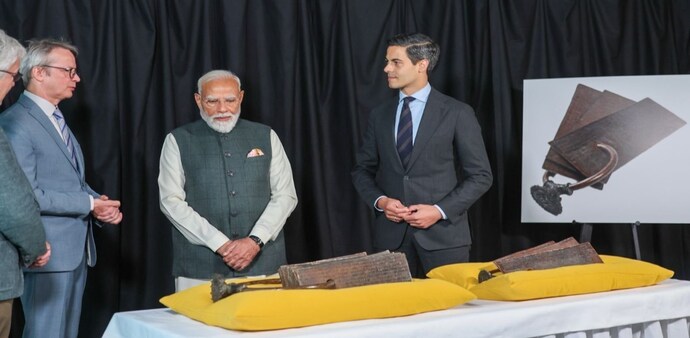
Prime Minister Narendra Modi on Saturday attended a ceremony in the Netherlands marking the return of 11th-century Chola dynasty copper plates to India, calling it "a joyous moment for every Indian".
The artefacts, known as the Anaimangalam Copper Plates and referred to in the Netherlands as the Leiden Plates, had remained in Dutch custody since the 19th century. India had pursued their return since 2012.
"A joyous moment for every Indian! Chola Copper Plates dating back to the 11th Century will be repatriated to India from the Netherlands," Modi said in a social media post after the restitution ceremony.
Don't Miss: PM Modi in Netherlands: Calls current era a ‘decade of disasters’, warns of global poverty crisis
The copper plates comprise 21 large plates and three smaller plates containing inscriptions largely in Tamil, along with sections in Sanskrit. The inscriptions relate to Emperor Rajendra Chola I and formalise an oral commitment made earlier by his father, Rajaraja Chola I.
"The Chola-era copper plates consist of a collection of 21 large and 3 small plates. Most of the inscriptions on them are engraved in Tamil, one of the world's most beautiful languages," Modi said. "Moreover, they proclaim the glory of the Cholas. As Indians, we take immense pride in the Cholas' culture and naval prowess."
The ceremony was also attended by Dutch Prime Minister Rob Jetten.
Why the plates matter
The copper plates are considered among the most significant surviving records of the Chola dynasty and among the most important Tamil heritage artefacts held outside India.
The charters document the gifting of Anaimangalam village to the Chulamanivarma Buddhist vihara in Nagapattinam in present-day Tamil Nadu.
The plates weigh around 30 kg and are bound by a bronze ring carrying the royal seal of the Chola dynasty. One section contains Sanskrit text, while the other is written in Tamil.
According to the Ministry of External Affairs, Rajaraja Chola I had originally issued the order verbally and it was first recorded on palm leaves. His son, Rajendra Chola I, later had the grant inscribed on copper plates to preserve it permanently.
The ministry said the restitution carried emotional and civilisational significance for India. "The restitution of these Chola copper plates assumes significance since they are not merely artefacts of the past, but an invaluable story of India's heritage and civilisation," it said.
How the plates reached the Netherlands
The plates were taken to the Netherlands in the 1700s by Florentius Camper, who was in India as part of a Christian missionary during the period when Nagapattinam was under Dutch control.
They were later preserved at Leiden University, which Modi thanked during the ceremony. "I express my gratitude to the Government of the Netherlands, and in particular to Leiden University, which has preserved these copper plates since the intervening period of the 19th century," he said.
The 24th session of the Intergovernmental Committee on Return and Restitution recognised India's claim as the country of origin and encouraged bilateral discussions on returning the artefacts.
PM Modi's Netherlands visit
Modi is on a three-day visit to the Netherlands from May 15 to 17, his second trip to the country since 2017.
The Netherlands is one of India's largest trade destinations in Europe, with bilateral trade valued at $27.8 billion in 2024-25. It is also India’s fourth-largest investor, with cumulative foreign direct investment of $55.6 billion.
The country is home to more than 90,000 non-resident Indians and persons of Indian origin, as well as over 200,000 members of the Suriname-Hindustani community. Around 3,500 Indian students are enrolled in Dutch universities.
Prime Minister Narendra Modi on Saturday attended a ceremony in the Netherlands marking the return of 11th-century Chola dynasty copper plates to India, calling it "a joyous moment for every Indian".
The artefacts, known as the Anaimangalam Copper Plates and referred to in the Netherlands as the Leiden Plates, had remained in Dutch custody since the 19th century. India had pursued their return since 2012.
"A joyous moment for every Indian! Chola Copper Plates dating back to the 11th Century will be repatriated to India from the Netherlands," Modi said in a social media post after the restitution ceremony.
Don't Miss: PM Modi in Netherlands: Calls current era a ‘decade of disasters’, warns of global poverty crisis
The copper plates comprise 21 large plates and three smaller plates containing inscriptions largely in Tamil, along with sections in Sanskrit. The inscriptions relate to Emperor Rajendra Chola I and formalise an oral commitment made earlier by his father, Rajaraja Chola I.
"The Chola-era copper plates consist of a collection of 21 large and 3 small plates. Most of the inscriptions on them are engraved in Tamil, one of the world's most beautiful languages," Modi said. "Moreover, they proclaim the glory of the Cholas. As Indians, we take immense pride in the Cholas' culture and naval prowess."
The ceremony was also attended by Dutch Prime Minister Rob Jetten.
Why the plates matter
The copper plates are considered among the most significant surviving records of the Chola dynasty and among the most important Tamil heritage artefacts held outside India.
The charters document the gifting of Anaimangalam village to the Chulamanivarma Buddhist vihara in Nagapattinam in present-day Tamil Nadu.
The plates weigh around 30 kg and are bound by a bronze ring carrying the royal seal of the Chola dynasty. One section contains Sanskrit text, while the other is written in Tamil.
According to the Ministry of External Affairs, Rajaraja Chola I had originally issued the order verbally and it was first recorded on palm leaves. His son, Rajendra Chola I, later had the grant inscribed on copper plates to preserve it permanently.
The ministry said the restitution carried emotional and civilisational significance for India. "The restitution of these Chola copper plates assumes significance since they are not merely artefacts of the past, but an invaluable story of India's heritage and civilisation," it said.
How the plates reached the Netherlands
The plates were taken to the Netherlands in the 1700s by Florentius Camper, who was in India as part of a Christian missionary during the period when Nagapattinam was under Dutch control.
They were later preserved at Leiden University, which Modi thanked during the ceremony. "I express my gratitude to the Government of the Netherlands, and in particular to Leiden University, which has preserved these copper plates since the intervening period of the 19th century," he said.
The 24th session of the Intergovernmental Committee on Return and Restitution recognised India's claim as the country of origin and encouraged bilateral discussions on returning the artefacts.
PM Modi's Netherlands visit
Modi is on a three-day visit to the Netherlands from May 15 to 17, his second trip to the country since 2017.
The Netherlands is one of India's largest trade destinations in Europe, with bilateral trade valued at $27.8 billion in 2024-25. It is also India’s fourth-largest investor, with cumulative foreign direct investment of $55.6 billion.
The country is home to more than 90,000 non-resident Indians and persons of Indian origin, as well as over 200,000 members of the Suriname-Hindustani community. Around 3,500 Indian students are enrolled in Dutch universities.