
Military-grade explosives, accidentally triggered? Here’s what investigators have found so far in the Red Fort blast case
Red Fort blast update: The device, described as hastily assembled, is thought to have been transported under pressure after "the suspect was likely spooked after the raid in Faridabad".
- Nov 12, 2025,
- Updated Nov 12, 2025 8:16 AM IST
Investigating agencies probing the powerful blast near Delhi’s iconic Red Fort that killed 12 people suspect the use of military-grade explosives, given the explosion’s high intensity and impact pattern, sources said. The attack was carried out by Mohammad Umar, the doctor-turned-suicide bomber linked to the Faridabad terror module that was busted just hours before Monday’s explosion. During the raid, authorities recovered nearly 2,900 kg of bomb-making material, including ammonium nitrate.
Meanwhile, early findings from the investigation indicate the blast was "accidentally triggered" while an improvised explosive was being moved. Officials believe the detonation occurred after panic set in amid intensive raids by security agencies targeting an inter-state terror module. The incident, which resulted in 12 fatalities, has shifted focus from a possible planned attack to an unintended consequence during transportation, prompting an extensive multi-agency probe.
Investigators have identified Mohammad Umar, a doctor from Pulwama, as the individual driving the car at the time of the blast. Umar is alleged to have links to the terror module that was recently disrupted, with large quantities of explosives recovered, mainly from Faridabad in Haryana. DNA samples have been taken from Umar's mother for identification, and a man named Tariq from south Kashmir's Pulwama district, who supplied the Hyundai i20, has been arrested.
Sources reported that "the explosion was triggered in panic and desperation after raids by the security agencies across multiple locations in Delhi-NCR and Pulwama, J-K, to nab suspects believed to be part of the terror module." The device, described as hastily assembled, is thought to have been transported under pressure after "the suspect was likely spooked after the raid in Faridabad which forced him to relocate hastily, increasing the chance of a mishap. The incident appears to have shifted from a suspected suicide attack to an unintended explosion during transport," according to a senior police officer.
Initially, authorities believed three individuals were in the vehicle when the explosion occurred. However, further investigation has clarified that only Umar was present in the i20 car, which he had repurchased on October 29.
The Pollution Under Control certificate of the car that had passed through several owners, was updated the same day. A detailed review has traced Umar’s movements for 11 hours prior to the incident, including a three-hour wait at the Sunehri Masjid parking lot, where he was reportedly searching for updates about his associates’ arrests.
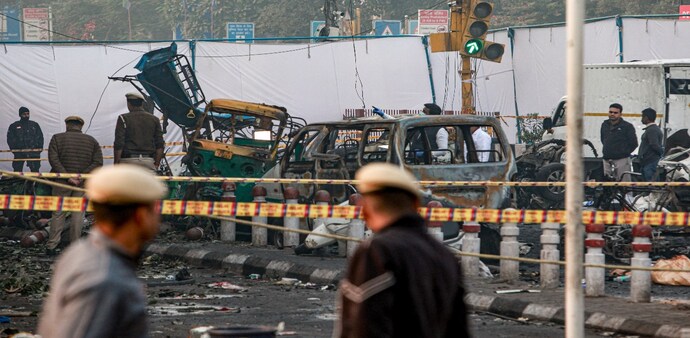
According to the investigation, Umar proceeded towards Chhata Rail Chowk road near the Red Fort, then took a U-turn, with the explosion occurring a few metres before the Red Fort police post. The blast propelled the vehicle several feet and caused damage to the nearby police post.
Of the 12 people who died, seven have been identified, with some mutilated body parts found in the remains of the car.
Preliminary technical analysis suggests "ammonium nitrate, fuel oil and detonators may have been used in the blast that ripped through the slow moving car near a traffic signal."
The Delhi Forensic Science Laboratory has collected 40 samples from the site, including vehicle fragments and human remains. A special team has been constituted to analyse these materials for chemical traces. "The bomb was premature and not fully developed, thus limiting the impact. The explosion did not create a crater and no shrapnel or projectiles were found," according to initial assessments by intelligence teams.
The Delhi Police’s First Information Report described the incident as "a bomb blast" and invoked relevant sections of the Unlawful Activities (Prevention) Act, citing conspiracy and punishment for a terror attack. The probe has now been transferred to the National Investigation Agency (NIA) after a review chaired by Union Home Minister Amit Shah.
Security measures have been markedly intensified across Delhi, with stringent checks on all vehicles entering the city and the closure of the Red Fort metro station. Overnight search operations were conducted in Daryaganj and Paharganj.
The disruption of the terror module just hours before the blast led to the arrest of eight individuals, including three doctors, and the seizure of 2,900 kg of explosives. Both Dr Muzammil Ganaie and Dr Shaheen Sayeed, associated with Al-Falah University in Faridabad, were apprehended, with 360 kg of ammonium nitrate recovered from the university. According to investigators, Shaheen was leading the Jaish-e-Mohammed's women recruitment wing in India, and headed the Jamaat-ul-Mominat, the group's female wing."
While no group has claimed responsibility for the explosion, the investigation is examining possible links to Jaish-e-Mohammed and Ansar Ghazwat-ul-Hind. Police teams have visited Al-Falah University and detained five to six people for questioning, while CCTV footage is being reviewed to understand the activities of the accused prior to the module's disruption.
Investigating agencies probing the powerful blast near Delhi’s iconic Red Fort that killed 12 people suspect the use of military-grade explosives, given the explosion’s high intensity and impact pattern, sources said. The attack was carried out by Mohammad Umar, the doctor-turned-suicide bomber linked to the Faridabad terror module that was busted just hours before Monday’s explosion. During the raid, authorities recovered nearly 2,900 kg of bomb-making material, including ammonium nitrate.
Meanwhile, early findings from the investigation indicate the blast was "accidentally triggered" while an improvised explosive was being moved. Officials believe the detonation occurred after panic set in amid intensive raids by security agencies targeting an inter-state terror module. The incident, which resulted in 12 fatalities, has shifted focus from a possible planned attack to an unintended consequence during transportation, prompting an extensive multi-agency probe.
Investigators have identified Mohammad Umar, a doctor from Pulwama, as the individual driving the car at the time of the blast. Umar is alleged to have links to the terror module that was recently disrupted, with large quantities of explosives recovered, mainly from Faridabad in Haryana. DNA samples have been taken from Umar's mother for identification, and a man named Tariq from south Kashmir's Pulwama district, who supplied the Hyundai i20, has been arrested.
Sources reported that "the explosion was triggered in panic and desperation after raids by the security agencies across multiple locations in Delhi-NCR and Pulwama, J-K, to nab suspects believed to be part of the terror module." The device, described as hastily assembled, is thought to have been transported under pressure after "the suspect was likely spooked after the raid in Faridabad which forced him to relocate hastily, increasing the chance of a mishap. The incident appears to have shifted from a suspected suicide attack to an unintended explosion during transport," according to a senior police officer.
Initially, authorities believed three individuals were in the vehicle when the explosion occurred. However, further investigation has clarified that only Umar was present in the i20 car, which he had repurchased on October 29.
The Pollution Under Control certificate of the car that had passed through several owners, was updated the same day. A detailed review has traced Umar’s movements for 11 hours prior to the incident, including a three-hour wait at the Sunehri Masjid parking lot, where he was reportedly searching for updates about his associates’ arrests.
According to the investigation, Umar proceeded towards Chhata Rail Chowk road near the Red Fort, then took a U-turn, with the explosion occurring a few metres before the Red Fort police post. The blast propelled the vehicle several feet and caused damage to the nearby police post.
Of the 12 people who died, seven have been identified, with some mutilated body parts found in the remains of the car.
Preliminary technical analysis suggests "ammonium nitrate, fuel oil and detonators may have been used in the blast that ripped through the slow moving car near a traffic signal."
The Delhi Forensic Science Laboratory has collected 40 samples from the site, including vehicle fragments and human remains. A special team has been constituted to analyse these materials for chemical traces. "The bomb was premature and not fully developed, thus limiting the impact. The explosion did not create a crater and no shrapnel or projectiles were found," according to initial assessments by intelligence teams.
The Delhi Police’s First Information Report described the incident as "a bomb blast" and invoked relevant sections of the Unlawful Activities (Prevention) Act, citing conspiracy and punishment for a terror attack. The probe has now been transferred to the National Investigation Agency (NIA) after a review chaired by Union Home Minister Amit Shah.
Security measures have been markedly intensified across Delhi, with stringent checks on all vehicles entering the city and the closure of the Red Fort metro station. Overnight search operations were conducted in Daryaganj and Paharganj.
The disruption of the terror module just hours before the blast led to the arrest of eight individuals, including three doctors, and the seizure of 2,900 kg of explosives. Both Dr Muzammil Ganaie and Dr Shaheen Sayeed, associated with Al-Falah University in Faridabad, were apprehended, with 360 kg of ammonium nitrate recovered from the university. According to investigators, Shaheen was leading the Jaish-e-Mohammed's women recruitment wing in India, and headed the Jamaat-ul-Mominat, the group's female wing."
While no group has claimed responsibility for the explosion, the investigation is examining possible links to Jaish-e-Mohammed and Ansar Ghazwat-ul-Hind. Police teams have visited Al-Falah University and detained five to six people for questioning, while CCTV footage is being reviewed to understand the activities of the accused prior to the module's disruption.