
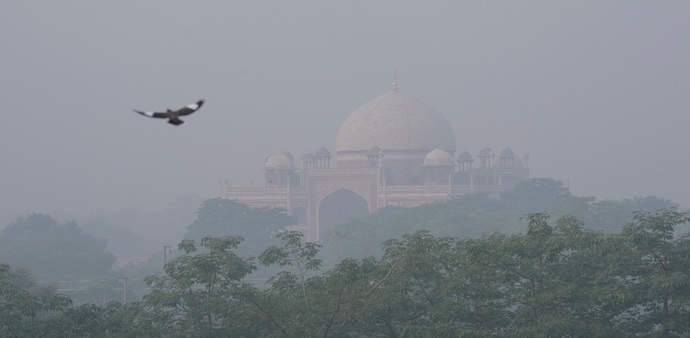
No respite from pollution yet! Delhi's air remains ‘poor’ as AQI hits 228, NCR cities also choke
The forecast similarly expected poor air quality to persist on Friday and Saturday, with ventilation conditions described as unfavourable for dispersion.
- Nov 26, 2026,
- Updated Nov 26, 2026 8:58 AM IST
Diwali may have passed several days ago, but Delhi’s air is still refusing to clear. On Thursday morning, the capital’s overall Air Quality Index (AQI) climbed to 228 at 8 am, placing it firmly in the “poor” category, according to the Central Pollution Control Board (CPCB) data.
The reading was 2 points higher than at the same hour on Wednesday, yet it remained serious enough to trigger a health alert for the entire population.
The portal, maintained by the Delhi Department of Environment, said all 59 monitoring stations were reporting data, with PM2.5 the lead pollutant at 51 stations. PM2.5 refers to fine particles small enough to enter deep into the lungs and bloodstream.
Pollution Levels Across City
The official Delhi AQI dashboard advised residents to “stay in” and run air purifiers, reflecting the severity of the morning conditions. It recorded fog in New Delhi, humidity of 65 per cent and wind speeds of just 5.6 km/h—conditions that can limit the dispersal of pollutants.
Under India’s AQI scale, readings between 201 and 300 are classified as "poor", while 301 to 400 is “very poor". The Air Quality Early Warning System for Delhi describes the “very poor” range as a health alert in which everyone may experience more serious health effects.
Highly Affected Areas
Anand Vihar remained among Delhi’s worst-hit pollution hotspots on Thursday, recording an AQI of 332 in the “very poor” category, according to CPCB data. Delhi University’s North Campus followed at 302, while Pusa-Delhi-IITM, Sirifort and Chandni Chowk reported AQIs of 295, 282 and 276, respectively.
Several NCR cities also continued to record unhealthy air on Thursday, with Meerut reporting the region’s highest city-level AQI at 276, followed by Ghaziabad and Greater Noida at 264 each, according to CPCB data. Gurugram (233), Noida (228) and Delhi (226) also remained in the “poor” category, while Faridabad recorded 172 and Hapur 162.
DON'T MISS: GRAP-3 curbs revoked in Delhi: Will restrictions on BS-3 petrol, BS-4 diesel cars to continue? What we know
Forecast Offers Little Relief
The India Meteorological Department’s bulletin, issued through the Ministry of Earth Sciences’ AIRWISE-Delhi system, forecast “poor” air quality for Thursday, with mainly clear skies, temperatures between 24 and 26 degrees Celsius and winds of up to 15 km/h. It also projected an unfavourable ventilation index, indicating limited capacity for pollutants to disperse.
The forecast similarly expected poor air quality to persist on Friday and Saturday, with ventilation conditions described as unfavourable for dispersion.