
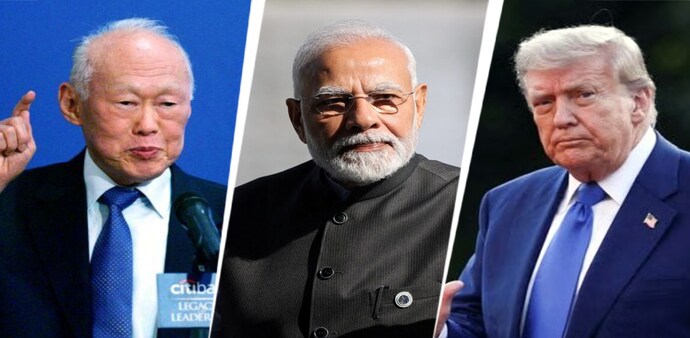
'Not an enemy, just a friend's stupidity': Modi's silence on Trump is a page out of Singapore's Lee Kuan Yew's playbook
New Delhi is trying to let this phase pass, as nothing can be achieved by calling Trump a 'liar' or countering him publicly
- Jul 30, 2025,
- Updated Jul 30, 2025 5:33 PM IST
Diplomacy is not about being straight; it is about being subtle. India would never name or shame its strategic partner, much less the US President. And, it's a smart move. When a relationship is already on the edge, you don't push it off the cliff. Rahul Gandhi is asking exactly that. Gandhi has repeatedly asked Prime Minister Narendra Modi to say - outrightly - that Donald Trump is lying when he claims credit for stopping the India-Pakistan war. Modi won't name Trump, and Gandhi knows it. After all, what Operation Sindoor has shown is that India now has many adversaries in its neighbourhood - not just Pakistan and China as was the belief. Turkey has taken its mask off, and New Delhi is wary of Bangladesh.
In such a situation, when you have difficult relations with the world's number two power (read China), you don't want to upset the real superpower. The last thing India would want, at this juncture, is the US-China-Pakistan axis. Those who think it is highly unlikely at this point should remember - the US is capable of doing anything. Anything means anything. Trump just shook hands with Ahmed al-Sharaa, whom Washington once described as an Al-Qaeda terrorist and is now Syria's President. If that doesn't convince you, remember the Nixon moment of 1972.
New Delhi is trying to let this phase pass, as nothing can be achieved by calling Trump a 'liar' or countering him publicly for his repeated mediation claims. But it will certainly place some pro-Indian voices - and there are many, count JD Vance and Marco Rubio among them - in the Trump administration into a tough spot.
Former ambassador Vivek Katju, weeks after Operation Sindoor, said it is not easy for governments to respond immediately to remarks made by leaders like Trump. If Trump says something, he added, "you can't come back with a snappy one-liner immediately. You've got to think it carefully."
There is a way of dealing with a partner even when you are upset. No matter what you do, remember all the time - 'you are not dealing with an enemy, but the stupidity of a friend.' This is what Lee Kuan Yew, the founding father of modern Singapore, had once said when he was angry at America.
The incident goes back to late August 1965, when Yew's wife Kwa Geok Choo had a worsening medical condition that required surgery. Her gynaecologist, Dr Benjamin Sheares, recommended an American specialist who was the best doctor in this field. Yew tried to get him to Singapore but could not persuade him to do so.
"I was angry and under stress," Yew writes in his memoir From Third World to First. "I expressed my unhappiness that the US government had not been able to help in persuading an American medical specialist to come to Singapore to treat someone dear to me. Then I disclosed publicly for the first time the story of how, four years earlier, a CIA agent had tried to bribe an officer of our Special Branch (our internal intelligence agency)."
In 1961, he writes, the CIA offered this officer a fantastic salary and guaranteed that if his activities were discovered or he got into trouble, they would remove him and his family to America and his future was assured. "Their proposition was so attractive that the officer took three days to consider it before deciding he had to tell his chief, Richard Corridon, about it. Corridon immediately reported to me and I told him to lay a trap. He did and caught three Americans red-handed in an apartment on Orange Grove Road as they were about to administer a polygraph lie-detector test on our Special Branch officer to check his honesty."
Yew writes that one was a member of the US consulate and claimed diplomatic immunity; two were CIA officers, one based in Bangkok, the other in Kuala Lumpur. "They were caught with enough evidence to send them to jail for 12 years. The American consul-general, who knew nothing about it, resigned."
After discussing the matter with his cabinet colleague, Yew adds, he told the British commissioner that Singapore would release these men and their "stupidity would not be made public" if the Americans gave a hundred million US dollars to the Singapore government for economic development. "They offered US$1 million, not to the Singapore government, but to the PAP - an unbelievable insult."
Singapore's celebrated leader further writes that he had to release one American who had diplomatic immunity but held the two CIA officers on detention orders for one year. "At Selkirk's repeated urgings, we released them a month later with a warning never to do this again. We hoped the warning would be heeded, but feared it would not."
Yew said that his attitude in 1961 to America and Americans was summed up in his instructions to Corridon: "Investigate this matter thoroughly, every aspect of it. Leave nothing unturned until you get to the heart of the matter. But remember all the time that we are not dealing with an enemy, but the bloody stupidity of a friend."
Trump is a blip in the larger India-US geostrategic calculus. His repeated claims on ceasefire can, at best - and that too privately - be described as just the 'stupidity of a friend'. Nothing more.
Diplomacy is not about being straight; it is about being subtle. India would never name or shame its strategic partner, much less the US President. And, it's a smart move. When a relationship is already on the edge, you don't push it off the cliff. Rahul Gandhi is asking exactly that. Gandhi has repeatedly asked Prime Minister Narendra Modi to say - outrightly - that Donald Trump is lying when he claims credit for stopping the India-Pakistan war. Modi won't name Trump, and Gandhi knows it. After all, what Operation Sindoor has shown is that India now has many adversaries in its neighbourhood - not just Pakistan and China as was the belief. Turkey has taken its mask off, and New Delhi is wary of Bangladesh.
In such a situation, when you have difficult relations with the world's number two power (read China), you don't want to upset the real superpower. The last thing India would want, at this juncture, is the US-China-Pakistan axis. Those who think it is highly unlikely at this point should remember - the US is capable of doing anything. Anything means anything. Trump just shook hands with Ahmed al-Sharaa, whom Washington once described as an Al-Qaeda terrorist and is now Syria's President. If that doesn't convince you, remember the Nixon moment of 1972.
New Delhi is trying to let this phase pass, as nothing can be achieved by calling Trump a 'liar' or countering him publicly for his repeated mediation claims. But it will certainly place some pro-Indian voices - and there are many, count JD Vance and Marco Rubio among them - in the Trump administration into a tough spot.
Former ambassador Vivek Katju, weeks after Operation Sindoor, said it is not easy for governments to respond immediately to remarks made by leaders like Trump. If Trump says something, he added, "you can't come back with a snappy one-liner immediately. You've got to think it carefully."
There is a way of dealing with a partner even when you are upset. No matter what you do, remember all the time - 'you are not dealing with an enemy, but the stupidity of a friend.' This is what Lee Kuan Yew, the founding father of modern Singapore, had once said when he was angry at America.
The incident goes back to late August 1965, when Yew's wife Kwa Geok Choo had a worsening medical condition that required surgery. Her gynaecologist, Dr Benjamin Sheares, recommended an American specialist who was the best doctor in this field. Yew tried to get him to Singapore but could not persuade him to do so.
"I was angry and under stress," Yew writes in his memoir From Third World to First. "I expressed my unhappiness that the US government had not been able to help in persuading an American medical specialist to come to Singapore to treat someone dear to me. Then I disclosed publicly for the first time the story of how, four years earlier, a CIA agent had tried to bribe an officer of our Special Branch (our internal intelligence agency)."
In 1961, he writes, the CIA offered this officer a fantastic salary and guaranteed that if his activities were discovered or he got into trouble, they would remove him and his family to America and his future was assured. "Their proposition was so attractive that the officer took three days to consider it before deciding he had to tell his chief, Richard Corridon, about it. Corridon immediately reported to me and I told him to lay a trap. He did and caught three Americans red-handed in an apartment on Orange Grove Road as they were about to administer a polygraph lie-detector test on our Special Branch officer to check his honesty."
Yew writes that one was a member of the US consulate and claimed diplomatic immunity; two were CIA officers, one based in Bangkok, the other in Kuala Lumpur. "They were caught with enough evidence to send them to jail for 12 years. The American consul-general, who knew nothing about it, resigned."
After discussing the matter with his cabinet colleague, Yew adds, he told the British commissioner that Singapore would release these men and their "stupidity would not be made public" if the Americans gave a hundred million US dollars to the Singapore government for economic development. "They offered US$1 million, not to the Singapore government, but to the PAP - an unbelievable insult."
Singapore's celebrated leader further writes that he had to release one American who had diplomatic immunity but held the two CIA officers on detention orders for one year. "At Selkirk's repeated urgings, we released them a month later with a warning never to do this again. We hoped the warning would be heeded, but feared it would not."
Yew said that his attitude in 1961 to America and Americans was summed up in his instructions to Corridon: "Investigate this matter thoroughly, every aspect of it. Leave nothing unturned until you get to the heart of the matter. But remember all the time that we are not dealing with an enemy, but the bloody stupidity of a friend."
Trump is a blip in the larger India-US geostrategic calculus. His repeated claims on ceasefire can, at best - and that too privately - be described as just the 'stupidity of a friend'. Nothing more.