
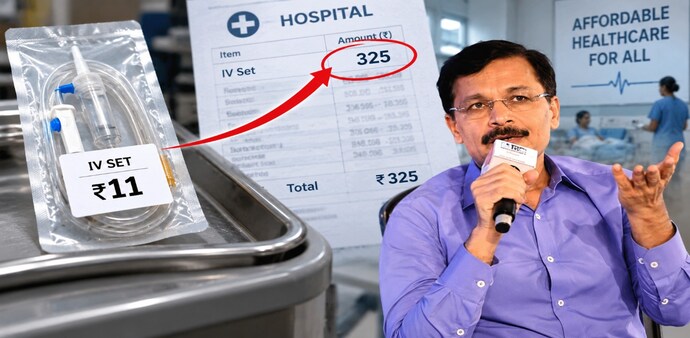
₹11 IV set, ₹325 price tag: Tukaram Mundhe flags over 2,800% markup on medical devices' pricing
The Maharashtra survey examined commonly used surgical consumables used in inpatient care, including IV infusion sets, syringes, nebulisers, oxygen masks and catheters
- Sep 15, 2026,
- Updated Sep 15, 2026 3:15 PM IST
Maharashtra Food and Drugs Administration (FDA) Commissioner Tukaram Mundhe has raised concerns about the sharp gap between procurement prices and the maximum retail prices (MRPs) of several medical devices and hospital consumables, with a state government survey finding markups as high as 2,841% in some cases, Mint reported.
Mundhe has written to the Department of Pharmaceuticals and the National Pharmaceutical Pricing Authority (NPPA), seeking a review of the findings and appropriate regulatory action. His proposals include capping trade margins and bringing essential medical-device categories under structured price monitoring.
READ THIS: 'This business isn’t won on price alone': Anand Mahindra flags India’s medical tourism gap
IV sets, syringes and catheters under scrutiny
The Maharashtra survey examined commonly used surgical consumables used in inpatient care, including IV infusion sets, syringes, nebulisers, oxygen masks and catheters.
The findings highlighted significant differences between the prices at which private hospitals procured these products and the prices ultimately charged to patients. For instance, private hospitals reportedly procured catheters at ₹29.41, while their MRP was ₹310.
Similarly, IV infusion sets purchased for ₹11.05 were billed to patients at ₹325. Mundhe told Mint that the survey had uncovered an unusually large disparity between procurement prices and printed MRPs.
“Our survey has revealed an extraordinary disparity between the trade procurement price and the printed maximum retail prices (MRP) of medical devices used in inpatient care, reaching as high as 2,841% in some cases, including IV sets, syringes, nebulizers and oxygen mask products,” Mundhe told Mint.
Mundhe calls for tighter pricing oversight
Many hospital surgical consumables remain outside the direct ceiling-price mechanism under the Drugs (Prices Control) Order, 2013. Mundhe has argued that the absence of strict statutory controls on several medical-device categories can leave room for significant price differences across the supply chain.
DON'T MISS: FDA suspends licence of IRCTC supplier, 3 ISKCON food establishments in Mumbai
Mundhe said the current regulatory framework needs examination to address what he described as unchecked pricing practices.
“Unlike scheduled medicines under the Drugs (Prices Control) Order, 2013, many categories of medical devices fall outside strict statutory price controls, allowing unchecked pricing practices to persist,” Mundhe wrote in an August 10 communication to the Department of Pharmaceuticals and the NPPA as accessed by Mint.
He has called for margin rationalisation, an inter-agency review and guidelines governing the permissible gap between trade procurement costs and declared MRPs.
‘Patient-protection issue’, says Mundhe
Mundhe has also framed the issue as one of consumer and patient protection, arguing that patients are often unable to determine whether the price charged for a medical product is justified.
“This is not merely a pricing issue; it is a patient-protection issue,” Mundhe told Mint. He added that patients often lack the information needed to assess whether the price they are charged for a hospital product is reasonable.
Mundhe further pointed to the financial impact on patients when products procured at low prices carry exceptionally high MRPs.
“There is a significant asymmetry of information in healthcare, with patients often unable to assess whether the price they are charged is reasonable. When a product procured at a low trade price carries an exceptionally high MRP, the patient ultimately bears the financial burden,” Mundhe told the news outlet.
ALSO READ: ‘Hit with iron rod twice...’: Kargil war veteran assaulted by parking staff in Gurugram
NPPA examining pricing practices
The NPPA is examining whether manufacturers and intermediary supply channels are adding substantial margins before medical devices reach patients, according to officials.
The regulator is reportedly comparing company filings and internal price lists with the findings of the Maharashtra survey. Similar representations have also been received from drug-control authorities in Punjab, Rajasthan and Tamil Nadu, according to the report.
The development could lead to a broader examination of how medical devices and hospital consumables are priced, particularly products that currently fall outside direct statutory price ceilings.
Hospitals, meanwhile, have called for a balanced regulatory approach. Dr Aashish Chaudhry, managing director of Aakash Healthcare, told Mint that hospitals need sufficient profitability to invest in infrastructure, technology and patient safety, while maintaining transparency and protecting patients from unjustified costs.
Maharashtra Food and Drugs Administration (FDA) Commissioner Tukaram Mundhe has raised concerns about the sharp gap between procurement prices and the maximum retail prices (MRPs) of several medical devices and hospital consumables, with a state government survey finding markups as high as 2,841% in some cases, Mint reported.
Mundhe has written to the Department of Pharmaceuticals and the National Pharmaceutical Pricing Authority (NPPA), seeking a review of the findings and appropriate regulatory action. His proposals include capping trade margins and bringing essential medical-device categories under structured price monitoring.
READ THIS: 'This business isn’t won on price alone': Anand Mahindra flags India’s medical tourism gap
IV sets, syringes and catheters under scrutiny
The Maharashtra survey examined commonly used surgical consumables used in inpatient care, including IV infusion sets, syringes, nebulisers, oxygen masks and catheters.
The findings highlighted significant differences between the prices at which private hospitals procured these products and the prices ultimately charged to patients. For instance, private hospitals reportedly procured catheters at ₹29.41, while their MRP was ₹310.
Similarly, IV infusion sets purchased for ₹11.05 were billed to patients at ₹325. Mundhe told Mint that the survey had uncovered an unusually large disparity between procurement prices and printed MRPs.
“Our survey has revealed an extraordinary disparity between the trade procurement price and the printed maximum retail prices (MRP) of medical devices used in inpatient care, reaching as high as 2,841% in some cases, including IV sets, syringes, nebulizers and oxygen mask products,” Mundhe told Mint.
Mundhe calls for tighter pricing oversight
Many hospital surgical consumables remain outside the direct ceiling-price mechanism under the Drugs (Prices Control) Order, 2013. Mundhe has argued that the absence of strict statutory controls on several medical-device categories can leave room for significant price differences across the supply chain.
DON'T MISS: FDA suspends licence of IRCTC supplier, 3 ISKCON food establishments in Mumbai
Mundhe said the current regulatory framework needs examination to address what he described as unchecked pricing practices.
“Unlike scheduled medicines under the Drugs (Prices Control) Order, 2013, many categories of medical devices fall outside strict statutory price controls, allowing unchecked pricing practices to persist,” Mundhe wrote in an August 10 communication to the Department of Pharmaceuticals and the NPPA as accessed by Mint.
He has called for margin rationalisation, an inter-agency review and guidelines governing the permissible gap between trade procurement costs and declared MRPs.
‘Patient-protection issue’, says Mundhe
Mundhe has also framed the issue as one of consumer and patient protection, arguing that patients are often unable to determine whether the price charged for a medical product is justified.
“This is not merely a pricing issue; it is a patient-protection issue,” Mundhe told Mint. He added that patients often lack the information needed to assess whether the price they are charged for a hospital product is reasonable.
Mundhe further pointed to the financial impact on patients when products procured at low prices carry exceptionally high MRPs.
“There is a significant asymmetry of information in healthcare, with patients often unable to assess whether the price they are charged is reasonable. When a product procured at a low trade price carries an exceptionally high MRP, the patient ultimately bears the financial burden,” Mundhe told the news outlet.
ALSO READ: ‘Hit with iron rod twice...’: Kargil war veteran assaulted by parking staff in Gurugram
NPPA examining pricing practices
The NPPA is examining whether manufacturers and intermediary supply channels are adding substantial margins before medical devices reach patients, according to officials.
The regulator is reportedly comparing company filings and internal price lists with the findings of the Maharashtra survey. Similar representations have also been received from drug-control authorities in Punjab, Rajasthan and Tamil Nadu, according to the report.
The development could lead to a broader examination of how medical devices and hospital consumables are priced, particularly products that currently fall outside direct statutory price ceilings.
Hospitals, meanwhile, have called for a balanced regulatory approach. Dr Aashish Chaudhry, managing director of Aakash Healthcare, told Mint that hospitals need sufficient profitability to invest in infrastructure, technology and patient safety, while maintaining transparency and protecting patients from unjustified costs.