
'International trade should be free from pressure...': RSS chief Mohan Bhagwat
RSS Chief Mohan Bhagwat’s remarks came on a day when the additional 25 per cent tariff imposed by US President Donald Trump on India for its purchases of Russian oil came into effect.
- Aug 27, 2025,
- Updated Aug 27, 2025 9:26 PM IST
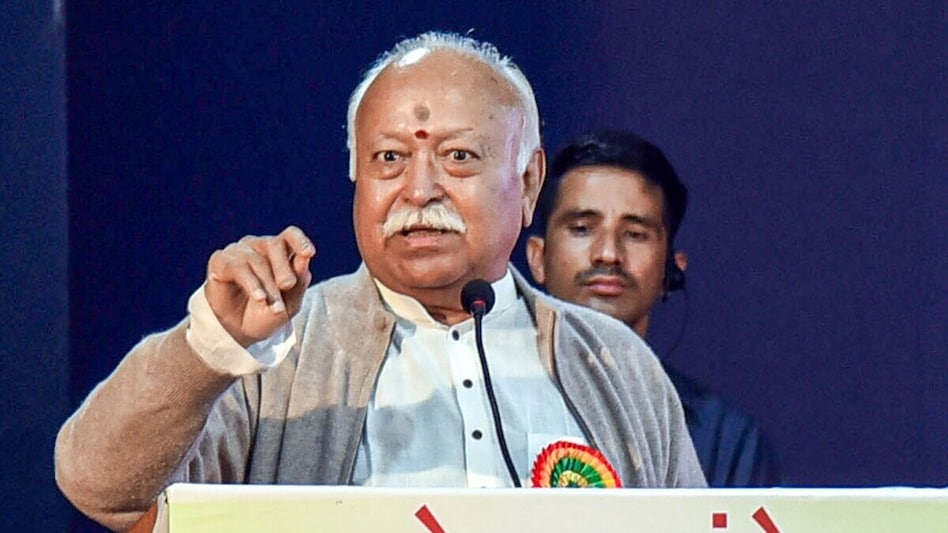
Mohan Bhagwat, the chief of the Rashtriya Swayamsevak Sangh (RSS), emphasised the significance of voluntary international trade as part of India's swadeshi policy during a lecture series marking the centenary of the RSS in New Delhi. He stated, "Self-reliance is the key to everything. Our country must be self-reliant. For self-reliance, priority should be given to the use of indigenous products. The nation’s policy should engage internationally by choice, not under pressure." This statement underlines the RSS's stance on India engaging in international trade on its own terms.
Bhagwat, speaking at the last of the three-day Vyakhyanmala lecture series - held on the occasion of the RSS centenary celebrations, elaborated on the concept of self-reliance, or 'aatmnirbharta'. He clarified that it does not entail halting imports but rather ensuring that trade occurs without compulsion. He remarked, "Being aatmnirbhar (self-reliant) does not mean stopping imports. The world moves because it is interdependent. So export-import will continue. However, there should be no pressure in it." His comments highlight the balance between self-reliance and global interdependence.
Addressing global unrest and the rise of fanaticism, Bhagwat drew historical parallels, mentioning the League of Nations post-First World War and the United Nations after the Second World War. He noted, "After the First World War, the League of Nations was formed. The Second World War still happened. UN was formed. The third world war will not happen like that. But it is not happening, we cannot say this today. There is unrest in the world, conflicts. Fanaticism has increased." His reflections suggest concerns about current global tensions.
Bhagwat also identified wokeism as a significant crisis impacting all nations and future generations. He remarked, "The new words that have come, wokeism, etc. This is a very big crisis. It is on all the countries, on the next generation. The guardians of all the countries are worried. The elders are worried." Bhagwat's comments signal apprehension regarding societal disruptions attributed to wokeism.
In his address, Bhagwat highlighted the potential negative impact of importing goods that could otherwise be produced domestically, saying, "Bringing goods from outside hurts local vendors." This aligns with his broader advocacy for swadeshi, which prioritises indigenous production and self-reliance. He further clarified, "Whatever is made in your country, there is no need to import it from outside."
Concluding his address, Bhagwat reiterated the importance of voluntary policy-making in international engagements, stating, "The country's policy should be done voluntarily, one should not go under pressure." His remarks reinforce the call for policies that align with national interests and are free from external influences.
Mohan Bhagwat, the chief of the Rashtriya Swayamsevak Sangh (RSS), emphasised the significance of voluntary international trade as part of India's swadeshi policy during a lecture series marking the centenary of the RSS in New Delhi. He stated, "Self-reliance is the key to everything. Our country must be self-reliant. For self-reliance, priority should be given to the use of indigenous products. The nation’s policy should engage internationally by choice, not under pressure." This statement underlines the RSS's stance on India engaging in international trade on its own terms.
Bhagwat, speaking at the last of the three-day Vyakhyanmala lecture series - held on the occasion of the RSS centenary celebrations, elaborated on the concept of self-reliance, or 'aatmnirbharta'. He clarified that it does not entail halting imports but rather ensuring that trade occurs without compulsion. He remarked, "Being aatmnirbhar (self-reliant) does not mean stopping imports. The world moves because it is interdependent. So export-import will continue. However, there should be no pressure in it." His comments highlight the balance between self-reliance and global interdependence.
Addressing global unrest and the rise of fanaticism, Bhagwat drew historical parallels, mentioning the League of Nations post-First World War and the United Nations after the Second World War. He noted, "After the First World War, the League of Nations was formed. The Second World War still happened. UN was formed. The third world war will not happen like that. But it is not happening, we cannot say this today. There is unrest in the world, conflicts. Fanaticism has increased." His reflections suggest concerns about current global tensions.
Bhagwat also identified wokeism as a significant crisis impacting all nations and future generations. He remarked, "The new words that have come, wokeism, etc. This is a very big crisis. It is on all the countries, on the next generation. The guardians of all the countries are worried. The elders are worried." Bhagwat's comments signal apprehension regarding societal disruptions attributed to wokeism.
In his address, Bhagwat highlighted the potential negative impact of importing goods that could otherwise be produced domestically, saying, "Bringing goods from outside hurts local vendors." This aligns with his broader advocacy for swadeshi, which prioritises indigenous production and self-reliance. He further clarified, "Whatever is made in your country, there is no need to import it from outside."
Concluding his address, Bhagwat reiterated the importance of voluntary policy-making in international engagements, stating, "The country's policy should be done voluntarily, one should not go under pressure." His remarks reinforce the call for policies that align with national interests and are free from external influences.