
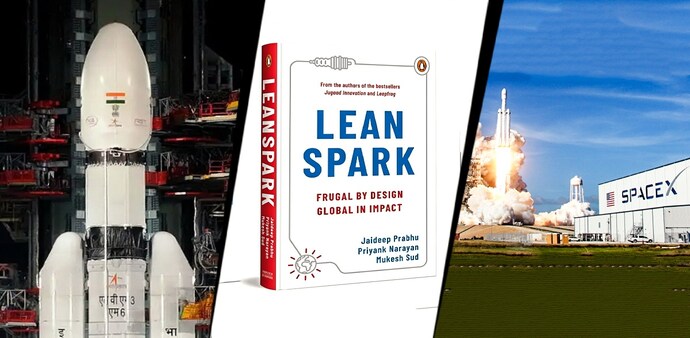
SpaceX, China pose biggest threat to ISRO's cost advantage, warns a new book
Despite all the progress, ISRO now stands at a crossroads, says the book, LeanSpark
- Feb 6, 2026,
- Updated Feb 6, 2026 12:01 PM IST
The Indian Space Research Organisation (ISRO) has achieved remarkable feats with limited resources. From developing India's first satellite, Aryabhata, to the successful landing of Chandrayaan-3, the space agency has repeatedly demonstrated that major breakthroughs in space exploration are possible without massive budgets.
In September 2023, ISRO launched Aditya-L1, India's first space-based solar observatory, designed to study the Sun's outermost layer and its emissions and their impact on space weather. True to "ISRO's frugal innovation approach", Aditya-L1 was developed at a fraction of the cost of comparable missions by other space agencies.
"Despite all this progress, however, ISRO now stands at a crossroads," warns a new book, LeanSpark.
Authored by Jaideep Prabhu, Mukesh Sud and Priyank Narayan, the book identifies two major players posing threats to India's space agency: China and Elon Musk's SpaceX.
Prabhu is a professor of marketing at Cambridge University's Judge Business School, Sud is an associate professor at IIM Ahmedabad, and Narayan is the founding director of the Centre for Entrepreneurship at Ashoka University. The authors argue that for ISRO to maintain its relevance, it must evolve its approach to what they call 'LeanSpark'.
LeanSpark, according to the authors, is a framework for innovation rooted in frugality, adaptability and purposeful ingenuity. While it carries forward the spirit of jugaad, the approach moves beyond makeshift fixes to solutions that are lean, scalable and sustainable. It is about problem-solving that does not compromise on functionality or long-term impact.
The book details how SpaceX has achieved breakthroughs through reusable rockets, including the repeated use of the same Falcon 9 booster more than 15 times. This capability, the authors note, has enabled SpaceX to launch satellites at significantly lower costs while maintaining high reliability.
China, too, has embarked on an aggressive expansion of its space capabilities, "posing a serious challenge to ISRO's position," the book argues. Beijing has announced plans for multiple mega-constellations, including Spacesail (Qianfan), a 15,000-satellite constellation aiming to rival Starlink, with 197 satellites already in orbit.
China aims to capture 8 per cent of the global space market by 2033, growing its space economy to $44 billion. While Chinese firms are currently constrained by their reliance on expendable rockets, they are developing reusable launch systems similar to SpaceX's Falcon 9.
ISRO's historical approach to space exploration has centred on incremental innovation and meticulous cost engineering. That strategy, the authors write, "has begun to show diminishing returns" in the current space economy. For years, ISRO enjoyed a significant cost advantage in the satellite launch market. "However, this edge has been dramatically eroded by SpaceX's reusable rocket technology."
While ISRO continues to optimise existing expendable rocket designs, SpaceX's Falcon 9 boosters - which can be launched, recovered and reused multiple times - have fundamentally altered launch economics, the book says. "The baseline cost of placing a kilogram into orbit with SpaceX is estimated at $5,000, approximately one-tenth of previous industry standards. By contrast, analysts suggest ISRO's costs are now four to five times higher than SpaceX's."
ISRO's launch cadence also remains limited to about four missions a year, compared with dozens annually by SpaceX. "This disparity creates a significant scale disadvantage for ISRO, making it difficult to amortise fixed costs across missions and achieve economies of scale in manufacturing and operations," the authors argue.
Against this backdrop, LeanSpark suggests that ISRO must reinvent itself - not by abandoning jugaad, but by applying its principles in more strategic and sophisticated ways. The authors identify several areas for change, including deeper private-sector engagement, a shift from incremental to disruptive innovation, the adoption of reusable launch systems, and advances in manufacturing.
In September 2022, NewSpace India Limited contracted a consortium by Hindustan Aeronautics Limited and Larsen & Toubro to produce five PSLV-XL launch vehicles. "This approach mirrors successful models in the United States, where NASA's commercial partnerships with companies like SpaceX have revitalised American space capabilities," the book notes.
By leveraging private-sector efficiency and investment, ISRO could increase its launch frequency and refocus internal resources on research and development of next-generation technologies.
While ISRO has excelled at incremental improvements, the authors argue that competing in today's space market will require more disruptive approaches. The agency, they write, "must balance its tradition of frugality with targeted investments in technologies that can fundamentally change its cost structure and capabilities."
Reusable launch systems, advanced manufacturing and in-space propulsion are among some of the areas, the authors say, that ISRO can focus on. "While developing fully reusable rockets like SpaceX's would require substantial investment," the book notes, "ISRO could pursue intermediary approaches that involve recovering and reusing the most expensive components."
The book concludes with a note: "The future won't belong to those who spend the most, but to those who use frugal ingenuity to design for everyone."
The Indian Space Research Organisation (ISRO) has achieved remarkable feats with limited resources. From developing India's first satellite, Aryabhata, to the successful landing of Chandrayaan-3, the space agency has repeatedly demonstrated that major breakthroughs in space exploration are possible without massive budgets.
In September 2023, ISRO launched Aditya-L1, India's first space-based solar observatory, designed to study the Sun's outermost layer and its emissions and their impact on space weather. True to "ISRO's frugal innovation approach", Aditya-L1 was developed at a fraction of the cost of comparable missions by other space agencies.
"Despite all this progress, however, ISRO now stands at a crossroads," warns a new book, LeanSpark.
Authored by Jaideep Prabhu, Mukesh Sud and Priyank Narayan, the book identifies two major players posing threats to India's space agency: China and Elon Musk's SpaceX.
Prabhu is a professor of marketing at Cambridge University's Judge Business School, Sud is an associate professor at IIM Ahmedabad, and Narayan is the founding director of the Centre for Entrepreneurship at Ashoka University. The authors argue that for ISRO to maintain its relevance, it must evolve its approach to what they call 'LeanSpark'.
LeanSpark, according to the authors, is a framework for innovation rooted in frugality, adaptability and purposeful ingenuity. While it carries forward the spirit of jugaad, the approach moves beyond makeshift fixes to solutions that are lean, scalable and sustainable. It is about problem-solving that does not compromise on functionality or long-term impact.
The book details how SpaceX has achieved breakthroughs through reusable rockets, including the repeated use of the same Falcon 9 booster more than 15 times. This capability, the authors note, has enabled SpaceX to launch satellites at significantly lower costs while maintaining high reliability.
China, too, has embarked on an aggressive expansion of its space capabilities, "posing a serious challenge to ISRO's position," the book argues. Beijing has announced plans for multiple mega-constellations, including Spacesail (Qianfan), a 15,000-satellite constellation aiming to rival Starlink, with 197 satellites already in orbit.
China aims to capture 8 per cent of the global space market by 2033, growing its space economy to $44 billion. While Chinese firms are currently constrained by their reliance on expendable rockets, they are developing reusable launch systems similar to SpaceX's Falcon 9.
ISRO's historical approach to space exploration has centred on incremental innovation and meticulous cost engineering. That strategy, the authors write, "has begun to show diminishing returns" in the current space economy. For years, ISRO enjoyed a significant cost advantage in the satellite launch market. "However, this edge has been dramatically eroded by SpaceX's reusable rocket technology."
While ISRO continues to optimise existing expendable rocket designs, SpaceX's Falcon 9 boosters - which can be launched, recovered and reused multiple times - have fundamentally altered launch economics, the book says. "The baseline cost of placing a kilogram into orbit with SpaceX is estimated at $5,000, approximately one-tenth of previous industry standards. By contrast, analysts suggest ISRO's costs are now four to five times higher than SpaceX's."
ISRO's launch cadence also remains limited to about four missions a year, compared with dozens annually by SpaceX. "This disparity creates a significant scale disadvantage for ISRO, making it difficult to amortise fixed costs across missions and achieve economies of scale in manufacturing and operations," the authors argue.
Against this backdrop, LeanSpark suggests that ISRO must reinvent itself - not by abandoning jugaad, but by applying its principles in more strategic and sophisticated ways. The authors identify several areas for change, including deeper private-sector engagement, a shift from incremental to disruptive innovation, the adoption of reusable launch systems, and advances in manufacturing.
In September 2022, NewSpace India Limited contracted a consortium by Hindustan Aeronautics Limited and Larsen & Toubro to produce five PSLV-XL launch vehicles. "This approach mirrors successful models in the United States, where NASA's commercial partnerships with companies like SpaceX have revitalised American space capabilities," the book notes.
By leveraging private-sector efficiency and investment, ISRO could increase its launch frequency and refocus internal resources on research and development of next-generation technologies.
While ISRO has excelled at incremental improvements, the authors argue that competing in today's space market will require more disruptive approaches. The agency, they write, "must balance its tradition of frugality with targeted investments in technologies that can fundamentally change its cost structure and capabilities."
Reusable launch systems, advanced manufacturing and in-space propulsion are among some of the areas, the authors say, that ISRO can focus on. "While developing fully reusable rockets like SpaceX's would require substantial investment," the book notes, "ISRO could pursue intermediary approaches that involve recovering and reusing the most expensive components."
The book concludes with a note: "The future won't belong to those who spend the most, but to those who use frugal ingenuity to design for everyone."