
‘Trade is like water...’: IMF chief says world shifting to multipolar trade order after US tariffs
India, she pointed out, has moved ahead with trade agreements with the UK and the EU, negotiated a tariff agreement with the US, and is working on other deals. That trend, she suggested, reflects a structural shift rather than a collapse in globalisation.
- Feb 20, 2026,
- Updated Feb 20, 2026 2:51 PM IST
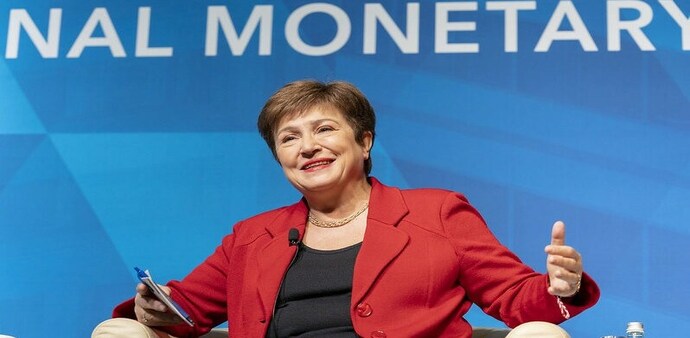
As sweeping tariff announcements from the United States rattled markets, the bigger story, according to IMF Managing Director Kristalina Georgieva, is how the world chose to respond.
Speaking in an exclusive interaction with Business Today, Georgieva said that while the US initially proposed tariffs at significantly higher levels, those measures were later moderated. More telling, however, was the reaction from other economies.
“The rest of the world said thank you, but no thank you,” she observed.
Rather than retreat from global commerce, countries have largely continued to trade under rules built over decades. At the same time, there has been a noticeable uptick in regional and cross-regional trade agreements, she said.
India, she pointed out, has moved ahead with trade agreements with the UK and the EU, negotiated a tariff agreement with the US, and is working on other deals. That trend, she suggested, reflects a structural shift rather than a collapse in globalisation.
“If globally we might be in a more difficult place to have uniform rules, countries would respond by regional, sub-regional integration,” she said.
Georgieva described the emerging landscape as a “multipolar world,” where trade arrangements are increasingly bilateral or plurilateral, making the system more complex but not necessarily weaker. Supply chains, she argued, will continue to cross borders because economies are deeply integrated.
“There is no going back to some place where everybody relies only on its own capacity,” she said, noting that cross-border trade has been a constant throughout human history.
Her metaphor captured the resilience she sees in the system: “Trade is like water. You put an obstacle, it goes around it.”
Even as the global trade architecture evolves, the IMF chief’s assessment is clear — fragmentation may alter the form of globalisation, but it is unlikely to reverse it.
As sweeping tariff announcements from the United States rattled markets, the bigger story, according to IMF Managing Director Kristalina Georgieva, is how the world chose to respond.
Speaking in an exclusive interaction with Business Today, Georgieva said that while the US initially proposed tariffs at significantly higher levels, those measures were later moderated. More telling, however, was the reaction from other economies.
“The rest of the world said thank you, but no thank you,” she observed.
Rather than retreat from global commerce, countries have largely continued to trade under rules built over decades. At the same time, there has been a noticeable uptick in regional and cross-regional trade agreements, she said.
India, she pointed out, has moved ahead with trade agreements with the UK and the EU, negotiated a tariff agreement with the US, and is working on other deals. That trend, she suggested, reflects a structural shift rather than a collapse in globalisation.
“If globally we might be in a more difficult place to have uniform rules, countries would respond by regional, sub-regional integration,” she said.
Georgieva described the emerging landscape as a “multipolar world,” where trade arrangements are increasingly bilateral or plurilateral, making the system more complex but not necessarily weaker. Supply chains, she argued, will continue to cross borders because economies are deeply integrated.
“There is no going back to some place where everybody relies only on its own capacity,” she said, noting that cross-border trade has been a constant throughout human history.
Her metaphor captured the resilience she sees in the system: “Trade is like water. You put an obstacle, it goes around it.”
Even as the global trade architecture evolves, the IMF chief’s assessment is clear — fragmentation may alter the form of globalisation, but it is unlikely to reverse it.