
‘AI is like a tsunami hitting the labour market,' says IMF chief Kristalina Georgieva
IMF chief Kristalina Georgieva said that as per the IMF’s assessment, 40 per cent of jobs globally and 60 per cent of jobs in advanced economies would be impacted by AI in the next few years.
- Feb 20, 2026,
- Updated Feb 20, 2026 1:24 PM IST
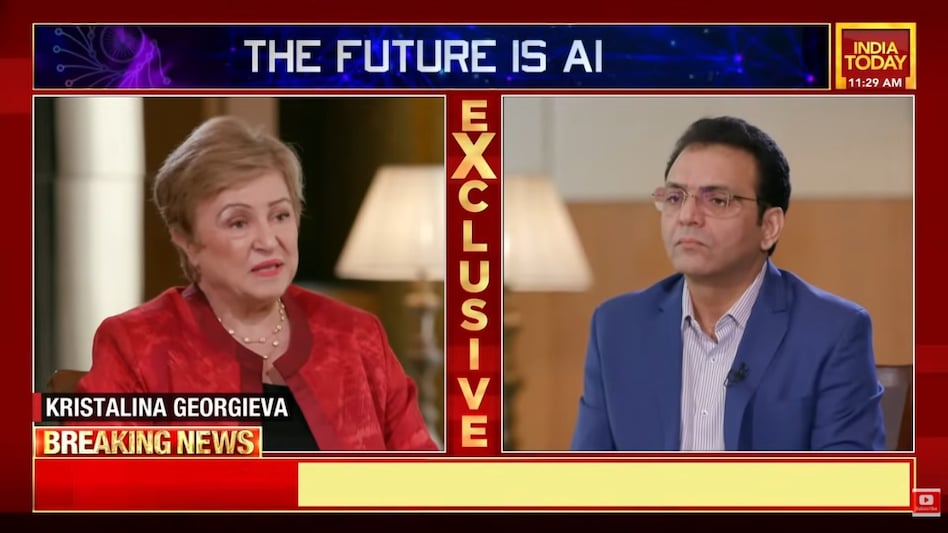
Artificial intelligence (AI) is hitting the labour market – it is creating as well as eliminating jobs – but it is still in our hands to manage, said International Monetary Fund Kristalina Georgieva. She said there is a large demand for AI jobs in the US, and those pay well too.
Speaking with India Today, Georgieva said, “So, what we know is the following. Already there is evidence that the impact on the labour market is very significant. I mean, AI is like a tsunami hitting the labour market.”
She said that as per the IMF’s assessment, 40 per cent of jobs globally and 60 per cent of jobs in advanced economies would be impacted by AI in the next few years – either enhanced, made more productive or replaced. Georgieva said the findings tell a very interesting story.
“Already in the United States, one in 10 jobs require AI-enhanced skills, and it pays more. People in these jobs with more money in their pockets, they spend more, and that creates demand for low-skill workers in restaurants, in hotels, in entertainment. The total impact on employment, surprisingly, in areas we study, is positive. But it is positive because of the increase of low-paying jobs,” she said.
Elaborating on it, the IMF chief said that one part of the labour force is getting paid better because of better skill and the other part is getting jobs with low-pay. In reality, the ones getting squeezed are the jobs in the middle.
“The jobs in the middle that are neither enhanced nor created as low-service jobs, get in relative terms, squeezed. We also see automation eliminating entry-level jobs,” she said.
Recent graduates are worried about employment, she said, adding that this is where the policymakers can help. “We are not helpless. What we can do is first redefine education for the era of AI. Learn to learn and be adaptable in terms of how you adjust to jobs. Two, put in place good social safety nets. So if people for a while are displaced, they have something to lean on for themselves and their families,” she said.
Georgieva gave the example of ‘flexicurity’ in Denmark that combines flexibility with security to help people adjust. “I highly recommend that for this world of AI,” stated Georgieva, also congratulating India for the labour market reforms.
Watch the full conversation here:
Artificial intelligence (AI) is hitting the labour market – it is creating as well as eliminating jobs – but it is still in our hands to manage, said International Monetary Fund Kristalina Georgieva. She said there is a large demand for AI jobs in the US, and those pay well too.
Speaking with India Today, Georgieva said, “So, what we know is the following. Already there is evidence that the impact on the labour market is very significant. I mean, AI is like a tsunami hitting the labour market.”
She said that as per the IMF’s assessment, 40 per cent of jobs globally and 60 per cent of jobs in advanced economies would be impacted by AI in the next few years – either enhanced, made more productive or replaced. Georgieva said the findings tell a very interesting story.
“Already in the United States, one in 10 jobs require AI-enhanced skills, and it pays more. People in these jobs with more money in their pockets, they spend more, and that creates demand for low-skill workers in restaurants, in hotels, in entertainment. The total impact on employment, surprisingly, in areas we study, is positive. But it is positive because of the increase of low-paying jobs,” she said.
Elaborating on it, the IMF chief said that one part of the labour force is getting paid better because of better skill and the other part is getting jobs with low-pay. In reality, the ones getting squeezed are the jobs in the middle.
“The jobs in the middle that are neither enhanced nor created as low-service jobs, get in relative terms, squeezed. We also see automation eliminating entry-level jobs,” she said.
Recent graduates are worried about employment, she said, adding that this is where the policymakers can help. “We are not helpless. What we can do is first redefine education for the era of AI. Learn to learn and be adaptable in terms of how you adjust to jobs. Two, put in place good social safety nets. So if people for a while are displaced, they have something to lean on for themselves and their families,” she said.
Georgieva gave the example of ‘flexicurity’ in Denmark that combines flexibility with security to help people adjust. “I highly recommend that for this world of AI,” stated Georgieva, also congratulating India for the labour market reforms.
Watch the full conversation here: