
What IMF chief said on inequality, job disruption, and need for AI guardrails. Watch here
She also discussed the risks of inequality, the need for regulatory guardrails, and why India’s approach to democratising AI could offer a model for the developing world.
- Feb 20, 2026,
- Updated Feb 20, 2026 3:05 PM IST
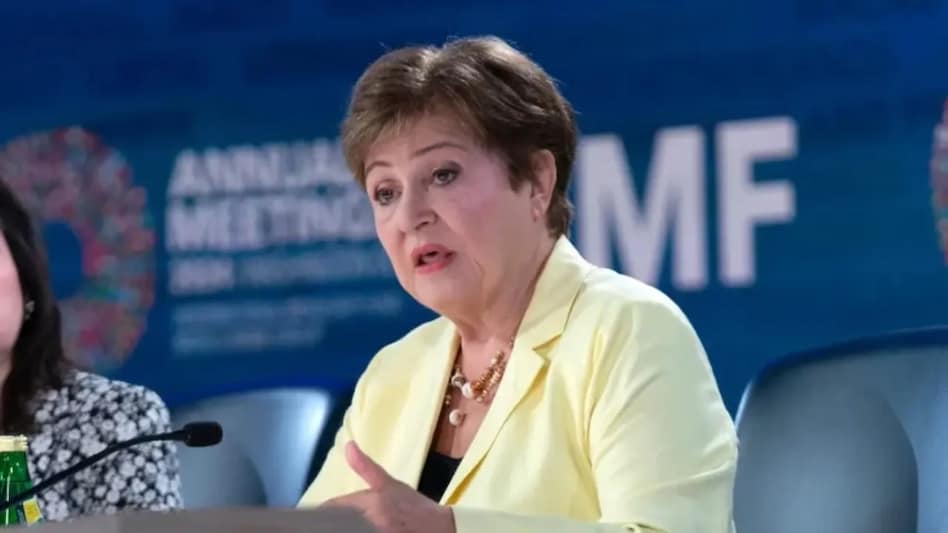
Kristalina Georgieva, Managing Director of the International Monetary Fund, spoke to Business Today on the sidelines of the AI Impact Summit in New Delhi. Georgieva shared her views on how artificial intelligence is reshaping economies, labour markets, and global growth in an exclusive interaction. She also discussed the risks of inequality, the need for regulatory guardrails, and why India’s approach to democratising AI could offer a model for the developing world.
You are here at the AI Impact Summit in New Delhi, a massive gathering. And given all that you've been seeing and observing, I want your first key takeaways about the AI Summit and what do you think it has really delivered so far?
It is great to be in India, especially for an event so dynamic and inspiring. What the summit does is to bring not just the world together, but to bring the developing world in India to meet with those that are ahead on this journey. What India is doing in AI is phenomenal because the goal of India is to democratise AI.
What is the biggest risk we face?
That AI is going to open the accordion of opportunities too widely. The haves and the have-nots may have a big distance in between. What India is saying is it need not be that way.
We can work to make AI a source of benefit for the whole of society and we, India, are determined to help the rest of the world, especially the Global South, to benefit from AI.
My two big takeaways:
- One, AI is already here and the speed with which it is affecting the way we work, we live, we interact with each other is so high—the highest in the history of technological transformation. We risk falling behind if we don't lean forward with everything we have.
- Two, it is a tremendous source of excitement and opportunity, but it also brings risks and we have to embrace the opportunities of higher productivity, higher growth, and manage the risks, especially the risks of displacement of workers.
And that, for us at the IMF, is a very important objective — to help our members grab the opportunities and manage the risks. Here in India, during the AI Summit, I learned a lot about ways we can do it.
On the labor front — and you're an economist all your life — how significant is this risk?
For the developing world, labor displacement will be a bigger risk, one would imagine, than other parts of the world.
What we know is the following: already there is evidence that the impact on labor markets is very significant. AI is like a tsunami hitting the labor market.
We assess 40% of jobs globally, 60% in advanced economies, to be impacted by AI in the next years — either enhanced, made more productive, or replaced.
Already in the United States, one in 10 jobs require AI-enhanced skills, and those jobs pay more. People earning more spend more, creating demand for lower-skill workers in services like restaurants, hotels, and entertainment.
The total impact on employment, surprisingly, in areas we study, is positive — but it is positive because of the increase in low-paying jobs.
So one part of the labor force earns more, another gets jobs with less pay — who is squeezed?
The middle. The jobs in the middle that are neither enhanced nor newly created get squeezed. We also see automation eliminating entry-level jobs.
So recent graduates worry — where is the job for me?
This is where policymakers must focus. We are not helpless. First, redefine education for the AI era — learn to learn and be adaptable. Second, put in place strong social safety nets so displaced workers have support.
There is a very good system in Denmark that combines flexibility with security. I highly recommend that model for the AI world.
We create flexibility in the labor market and combine it with helping people adjust.
There is also an AI arms race — the US, China, and India taking different paths. Is India’s model the right one?
For India, this is the right way. India invested over the years in digital public infrastructure. That foundation makes AI more accessible and applicable.
India created digital ID for 1.4 billion people, boosting the digital economy. Now comes AI, and designing models for specific sectors — healthcare, education, public services — is appropriate.
That democratisation of AI is impressive in India.
For developing countries, India’s model may be more applicable than the high-tech corporate model of the United States or approaches seen in China.
What should we worry about most?
Guardrails. We want AI for good, not for evil. We want AI that protects dignity and human rights.
This requires stronger ethical foundations and collective global guardrails. Engagements like this summit help bring technologists and policymakers together to manage a transformative technology that could lift global growth by 0.8%.
What does that mean in practical terms?
It means global growth could move above pre-pandemic levels. Right now it is anemic at about 3.3%. AI can help us break out of the path of low growth and high debt—if we manage it wisely and work together.
How do we ensure regulation does not curb innovation?
That is the trickiest question. We must identify the biggest risks and design guardrails carefully. Innovation drives prosperity, and excessive regulation can suffocate it.
India has worked hard to reduce regulatory burden. Creating space for innovation while managing risks is the balance we must aspire to.
Can and should Europe also deregulate?
Georgieva, who previously served as EU Commissioner and Vice President of the European Commission, said the focus in Europe is on simplification rather than dismantling safeguards.
In Europe, there is recognition that red tape must be reduced. I know this well from my time at the European Commission. Europe needs deeper capital markets, freer movement of skills, and a unified energy system — all with simpler regulatory requirements, she said.
“All of this – has to be done with optimal regulatory requirements, not with the regulatory capacity of Europe that it has today. So, yes, simplify,” Georgieva said.
She argued that Europe must fully implement its single market and remove structural barriers that limit business scale across the bloc. “Europe must implement its single market to the fullest, something that Mario Draghi and Taletta have been advocating for,” she said.
“Europe needs a 28th regime for firms. So if you go to Europe and you register in Germany, what you do is applicable in all 27 countries. Europe needs capital market union. Europe needs free movement of skills across the union and a unified energy system.”
What about the long-term impact of changing tariff regimes?
Kristalina Georgieva: When tariffs were announced at high levels, they later moderated. The rest of the world responded by deepening trade agreements rather than retreating from trade.
We are in a multipolar world. Trade relations may become more bilateral or regional, but trade will continue. Supply chains will still cross borders. Trade is like water — you put an obstacle, it goes around it.
Are you worried some countries will be left behind?
My biggest worry is that we are in a more shock-prone world — pandemic, war, inflation, climate shocks — one after another.
Many countries have exhausted fiscal buffers and carry high debt. When the next shock comes, rich countries may not be able to provide the same support.
Smaller and poorer nations will be hit hardest, and global solidarity has weakened. I welcome emerging economies like Brazil and India stepping up to nurture cooperation.
Right now, we have 50 IMF programs — one next door in Sri Lanka — because many countries are in difficulty.
India is a bright spot in global growth. But is weakening climate consensus a concern?
It is a worry for everybody who cares about future generations. Climate risks are real and already materializing, including in vulnerable parts of India.
But this is also an opportunity for leadership. The International Solar Alliance is one example of how India can step forward for its own people and the world.
India contributes significantly to global growth and, as a dynamic innovation-driven economy, offers a path that many other countries are eager to follow.
Kristalina Georgieva, Managing Director of the International Monetary Fund, spoke to Business Today on the sidelines of the AI Impact Summit in New Delhi. Georgieva shared her views on how artificial intelligence is reshaping economies, labour markets, and global growth in an exclusive interaction. She also discussed the risks of inequality, the need for regulatory guardrails, and why India’s approach to democratising AI could offer a model for the developing world.
You are here at the AI Impact Summit in New Delhi, a massive gathering. And given all that you've been seeing and observing, I want your first key takeaways about the AI Summit and what do you think it has really delivered so far?
It is great to be in India, especially for an event so dynamic and inspiring. What the summit does is to bring not just the world together, but to bring the developing world in India to meet with those that are ahead on this journey. What India is doing in AI is phenomenal because the goal of India is to democratise AI.
What is the biggest risk we face?
That AI is going to open the accordion of opportunities too widely. The haves and the have-nots may have a big distance in between. What India is saying is it need not be that way.
We can work to make AI a source of benefit for the whole of society and we, India, are determined to help the rest of the world, especially the Global South, to benefit from AI.
My two big takeaways:
- One, AI is already here and the speed with which it is affecting the way we work, we live, we interact with each other is so high—the highest in the history of technological transformation. We risk falling behind if we don't lean forward with everything we have.
- Two, it is a tremendous source of excitement and opportunity, but it also brings risks and we have to embrace the opportunities of higher productivity, higher growth, and manage the risks, especially the risks of displacement of workers.
And that, for us at the IMF, is a very important objective — to help our members grab the opportunities and manage the risks. Here in India, during the AI Summit, I learned a lot about ways we can do it.
On the labor front — and you're an economist all your life — how significant is this risk?
For the developing world, labor displacement will be a bigger risk, one would imagine, than other parts of the world.
What we know is the following: already there is evidence that the impact on labor markets is very significant. AI is like a tsunami hitting the labor market.
We assess 40% of jobs globally, 60% in advanced economies, to be impacted by AI in the next years — either enhanced, made more productive, or replaced.
Already in the United States, one in 10 jobs require AI-enhanced skills, and those jobs pay more. People earning more spend more, creating demand for lower-skill workers in services like restaurants, hotels, and entertainment.
The total impact on employment, surprisingly, in areas we study, is positive — but it is positive because of the increase in low-paying jobs.
So one part of the labor force earns more, another gets jobs with less pay — who is squeezed?
The middle. The jobs in the middle that are neither enhanced nor newly created get squeezed. We also see automation eliminating entry-level jobs.
So recent graduates worry — where is the job for me?
This is where policymakers must focus. We are not helpless. First, redefine education for the AI era — learn to learn and be adaptable. Second, put in place strong social safety nets so displaced workers have support.
There is a very good system in Denmark that combines flexibility with security. I highly recommend that model for the AI world.
We create flexibility in the labor market and combine it with helping people adjust.
There is also an AI arms race — the US, China, and India taking different paths. Is India’s model the right one?
For India, this is the right way. India invested over the years in digital public infrastructure. That foundation makes AI more accessible and applicable.
India created digital ID for 1.4 billion people, boosting the digital economy. Now comes AI, and designing models for specific sectors — healthcare, education, public services — is appropriate.
That democratisation of AI is impressive in India.
For developing countries, India’s model may be more applicable than the high-tech corporate model of the United States or approaches seen in China.
What should we worry about most?
Guardrails. We want AI for good, not for evil. We want AI that protects dignity and human rights.
This requires stronger ethical foundations and collective global guardrails. Engagements like this summit help bring technologists and policymakers together to manage a transformative technology that could lift global growth by 0.8%.
What does that mean in practical terms?
It means global growth could move above pre-pandemic levels. Right now it is anemic at about 3.3%. AI can help us break out of the path of low growth and high debt—if we manage it wisely and work together.
How do we ensure regulation does not curb innovation?
That is the trickiest question. We must identify the biggest risks and design guardrails carefully. Innovation drives prosperity, and excessive regulation can suffocate it.
India has worked hard to reduce regulatory burden. Creating space for innovation while managing risks is the balance we must aspire to.
Can and should Europe also deregulate?
Georgieva, who previously served as EU Commissioner and Vice President of the European Commission, said the focus in Europe is on simplification rather than dismantling safeguards.
In Europe, there is recognition that red tape must be reduced. I know this well from my time at the European Commission. Europe needs deeper capital markets, freer movement of skills, and a unified energy system — all with simpler regulatory requirements, she said.
“All of this – has to be done with optimal regulatory requirements, not with the regulatory capacity of Europe that it has today. So, yes, simplify,” Georgieva said.
She argued that Europe must fully implement its single market and remove structural barriers that limit business scale across the bloc. “Europe must implement its single market to the fullest, something that Mario Draghi and Taletta have been advocating for,” she said.
“Europe needs a 28th regime for firms. So if you go to Europe and you register in Germany, what you do is applicable in all 27 countries. Europe needs capital market union. Europe needs free movement of skills across the union and a unified energy system.”
What about the long-term impact of changing tariff regimes?
Kristalina Georgieva: When tariffs were announced at high levels, they later moderated. The rest of the world responded by deepening trade agreements rather than retreating from trade.
We are in a multipolar world. Trade relations may become more bilateral or regional, but trade will continue. Supply chains will still cross borders. Trade is like water — you put an obstacle, it goes around it.
Are you worried some countries will be left behind?
My biggest worry is that we are in a more shock-prone world — pandemic, war, inflation, climate shocks — one after another.
Many countries have exhausted fiscal buffers and carry high debt. When the next shock comes, rich countries may not be able to provide the same support.
Smaller and poorer nations will be hit hardest, and global solidarity has weakened. I welcome emerging economies like Brazil and India stepping up to nurture cooperation.
Right now, we have 50 IMF programs — one next door in Sri Lanka — because many countries are in difficulty.
India is a bright spot in global growth. But is weakening climate consensus a concern?
It is a worry for everybody who cares about future generations. Climate risks are real and already materializing, including in vulnerable parts of India.
But this is also an opportunity for leadership. The International Solar Alliance is one example of how India can step forward for its own people and the world.
India contributes significantly to global growth and, as a dynamic innovation-driven economy, offers a path that many other countries are eager to follow.