
Winter smog deepens: Delhi’s overall AQI stands at 224, air turns ‘very poor’ in pockets
The deterioration in air quality coincided with a rise in winter chill across the Capital. Meteorological conditions, including lower temperatures and reduced wind movement, tend to trap pollutants closer to the ground, worsening the concentration of particulate matter in the air.
- Nov 25, 2026,
- Updated Nov 25, 2026 10:38 AM IST
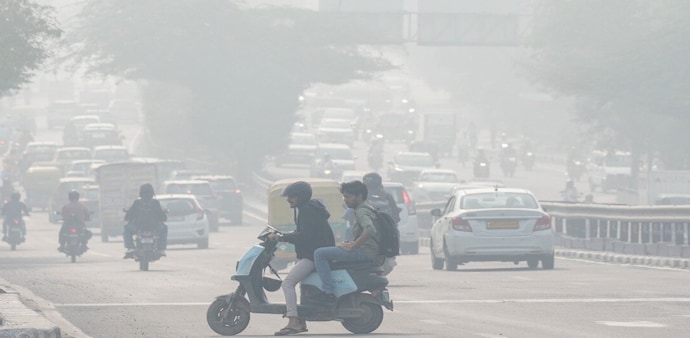
Delhi woke up to another polluted morning on Wednesday, with the city’s overall Air Quality Index (AQI) recorded at 224 at 9 am, placing it in the “poor” category, according to the Delhi government’s environment department. The air quality remained a concern across large parts of the Capital, with several monitoring stations reporting readings above 300, which falls in the “very poor” range.
Calm winds and a stronger temperature inversion trapped pollutants near the ground, while PM2.5 remained the dominant pollutant at 44 of 56 monitoring stations.
Several Areas in ‘Very Poor’ Zone
The Delhi Technological University (DTU) area recorded an AQI of 326, while Anand Vihar logged 358 and North Campus 308, according to data cited by the Delhi government. IGNOU Maidan Garhi and Burari Crossing also recorded an AQI of 304 each.
An AQI between 201 and 300 is classified as "poor", a range that can cause breathing discomfort to most people on prolonged exposure. Readings between 301 and 400 are categorised as “very poor,” posing a higher health risk, particularly for children, the elderly and people with respiratory or heart conditions.
NCR Conditions
Air quality across the National Capital Region remained uneven, with several cities also recording “poor” readings, according to CPCB data.
Panchgaon in Haryana recorded the highest AQI in the region at 297, followed by Gurugram at 275, according to CPCB real-time data. Meerut logged 252, Ghaziabad 244, Bhiwadi 231, Bahadurgarh 235 and Dharuhera 227.
Noida recorded an AQI of 212, while Bulandshahr and Greater Noida stood at 219 and 212 respectively, keeping them in the “poor” category.
Winter Conditions Worsen Pollution
The deterioration in air quality coincided with a rise in winter chill across the Capital. Meteorological conditions, including lower temperatures and reduced wind movement, tend to trap pollutants closer to the ground, worsening the concentration of particulate matter in the air.
Delhi’s Air Quality Early Warning System, AIRWISE-Delhi, had recorded the city’s AQI at 222 at 8 pm on Tuesday, also placing it in the “poor” category under Graded Response Action Plan (GRAP) Stage 1. The system is maintained by the Indian Institute of Tropical Meteorology and provides air-quality forecasts and decision-support information for Delhi.
DON'T MISS: GRAP-3 curbs revoked in Delhi: Will restrictions on BS-3 petrol, BS-4 diesel cars to continue? What we know
Health Advisory Issued
Health experts generally advise residents, especially children, the elderly and those with respiratory or heart conditions, to limit outdoor exertion and use masks in high-traffic areas. The AIRWISE-Delhi source-apportionment estimates attributed 20.5 per cent of the estimated PM2.5 load to vehicular emissions, 2.3 per cent to stubble burning near Delhi and 1.9 per cent to waste burning.