
BT AI Summit 2025: Digital AI agents will join meetings in a few years, says L&T AI chief Naveen Kamat
“Over the last decade we have been through a digital transformation…over the last couple of years we have been in a mission mode on how to use AI," said L&T AI chief Naveen Kamat.
- Oct 29, 2025,
- Updated Oct 29, 2025 4:17 PM IST
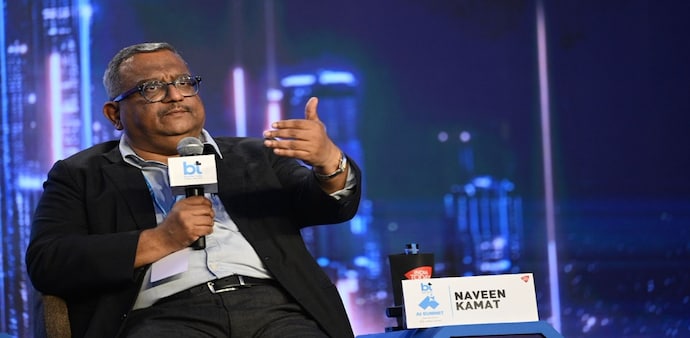
Not only will artificial intelligence (AI) reduce the hours that’s required to get a job manually done, it is also possible that a digital agent will be attending meetings with other employees, said L&T Chief AI Officer, Naveen Kamat. Kamat also spoke of how a traditional company such as the construction major uses and foresees the use of AI.
Speaking at BT AI Summit 2025, Kamat said, “In a few years from now we would probably have meetings that would be attended by digital AI agents, like other employees. The human-machine interaction will actually come to life.”
He however added that as companies and employers, it is important to be cognizant of the fact that a situation involving 100-200 agents, which they are unable to manage, does not arise.
Kamat agreed that as a company that has around 800 projects, including construction of bridges and airports etc, at any given point, using AI is slightly difficult, unlike the manufacturing space. He acknowledged the use of agentic AI that has been impactful in the company.
“Over the last decade we have been through a digital transformation…over the last couple of years we have been in a mission mode on how to use AI…how to execute on projects and planning,” he said. Kamat said looking into and responding to a tender used to take 1-2 months. “We want to use AI to look and respond to tenders to cut down on the time,” he said.
Kamat also acknowledged the potential of AI at project sites is immense, and that the usage is also beginning to evolve at construction sites.
“The way we look at our AI strategy is to see what’s required in our many processes, to bring in an autonomous workflow. A lot of our solutions can be brought about by agentic AI. It could be more involved in problems with greater gestation time, said Kamat.
“Increasingly the barriers between technical and non-technical teams are dissolving. I think in any project we are embarking on, we are working with multidisciplinary, cross-functioning teams. We are looking if processes need to be re-engineered for AI to be impactful,” said Kamat.
Not only will artificial intelligence (AI) reduce the hours that’s required to get a job manually done, it is also possible that a digital agent will be attending meetings with other employees, said L&T Chief AI Officer, Naveen Kamat. Kamat also spoke of how a traditional company such as the construction major uses and foresees the use of AI.
Speaking at BT AI Summit 2025, Kamat said, “In a few years from now we would probably have meetings that would be attended by digital AI agents, like other employees. The human-machine interaction will actually come to life.”
He however added that as companies and employers, it is important to be cognizant of the fact that a situation involving 100-200 agents, which they are unable to manage, does not arise.
Kamat agreed that as a company that has around 800 projects, including construction of bridges and airports etc, at any given point, using AI is slightly difficult, unlike the manufacturing space. He acknowledged the use of agentic AI that has been impactful in the company.
“Over the last decade we have been through a digital transformation…over the last couple of years we have been in a mission mode on how to use AI…how to execute on projects and planning,” he said. Kamat said looking into and responding to a tender used to take 1-2 months. “We want to use AI to look and respond to tenders to cut down on the time,” he said.
Kamat also acknowledged the potential of AI at project sites is immense, and that the usage is also beginning to evolve at construction sites.
“The way we look at our AI strategy is to see what’s required in our many processes, to bring in an autonomous workflow. A lot of our solutions can be brought about by agentic AI. It could be more involved in problems with greater gestation time, said Kamat.
“Increasingly the barriers between technical and non-technical teams are dissolving. I think in any project we are embarking on, we are working with multidisciplinary, cross-functioning teams. We are looking if processes need to be re-engineered for AI to be impactful,” said Kamat.