
BT BIG STORY | Private-label divide: Why Blinkit and Instamart are placing opposite bets
BT BIG STORY | Private-label divide: Why Blinkit and Instamart are placing opposite bets
Blinkit sees brand-building costs and channel conflict, while Instamart says owned products can strengthen margins, retention, and differentiation
Palak Agarwal
- Oct 26, 2026,
- Updated Oct 26, 2026 6:05 AM IST
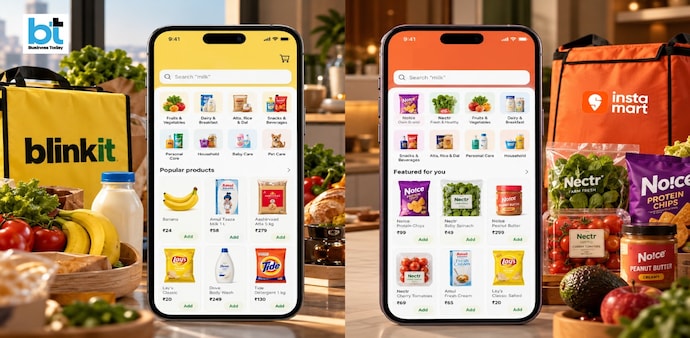
As quick-commerce platforms look beyond delivery speed and discounts to build sustainable growth, Blinkit and Swiggy’s Instamart are taking contrasting approaches to private labels—a strategy increasingly seen as a potential lever for improving margins and customer retention.
The divergence came into focus after Eternal reported its results on Wednesday and Swiggy released its earnings on Thursday, with the companies offering differing views on whether building their own brands can create a durable competitive advantage.
Advertisement
Blinkit chief executive Albinder Dhindsa has argued that private labels must either generate incremental demand or improve the economics of existing demand after accounting for the costs of developing and marketing the products. In Blinkit’s assessment, the model does not currently meet either test.
Building a successful private label, Dhindsa said, requires more than putting a platform’s name on a product. It involves sustained investment in product development, manufacturing, quality control, inventory management, sampling and marketing to drive repeat purchases. Established brands, he believes, are better equipped to build these capabilities.
Blinkit believes private labels could create a conflict with third-party sellers on its platform, while promoting external brands offers opportunities to earn advertising revenue. It remains open to greater supply-chain control where it adds value, particularly in fruits and vegetables, where its Hyperpure business provides sourcing and quality-control benefits without the need to build a separate consumer-facing brand.
Advertisement
Swiggy’s Instamart, meanwhile, is positioning private labels as part of a broader differentiation strategy, arguing that assortment, rather than simply offering more products, can help build a distinctive consumer proposition as delivery speed becomes standard and aggressive pricing proves difficult to sustain.
Its Switch proposition combines owned brands such as No!ce and Nectr with partnerships with around 400 brands, offering what the company describes as superior alternatives across core categories.
Swiggy, in its Q2FY27 results, mentioned that Switch products featured in over 20% of platform orders across more than 60 categories as of September 2026. Its clean-food private label, No!ce, featured in over one in eight orders across 500-plus SKUs. Customers buying No!ce showed 15 percentage points higher retention, with products often priced near incumbent brands despite offering superior quality, the company said.
Advertisement
Speaking to Business Today, Shobit Singhal, Associate Director, Equity Research at Anand Rathi Institutional Equities, said Blinkit’s approach reflects the potential conflict between operating a marketplace and competing with the brands on it. Promoting its own labels could prompt existing brand partners to reconsider their investments on the platform, including advertising spending, if they believe their products are being denied visibility. Strong brand partnerships, by contrast, can help Blinkit generate advertising revenue without taking on the costs of building consumer brands, he said.
In a recent conversation with Business Today, Apoorve Goyal, Managing Director, India Investments at Prosus—an early backer of Swiggy—said private labels give quick-commerce platforms greater control over pricing, margins and customer relationships, while potentially driving repeat purchases. He added that No!ce could help Instamart acquire and retain customers by giving them a reason to return for specific products and buy other essentials on the platform.
However, as Dhindsa and analysts have noted, the economics differ for retailers and FMCG companies. In an earlier interaction with Business Today, Anand Ramanathan, consumer industry leader at Deloitte, said private labels offer clear upside for retailers through better margins. For an FMCG company already earning gross margins of 40% or more, however, product development and launch costs could squeeze profitability, he added.
Advertisement
“Swiggy is under pressure to demonstrate a clear path to profitability, and private labels offer a potential lever to improve margins. But building and scaling brands requires a different set of capabilities and could risk alienating existing brand partners, which contribute to the platform’s advertising revenue,” said Ashwini Mehta, Head of Equity Research at Ambit Capital.
In Case You Missed It: Swiggy Q2 results: Loss narrows to Rs 922 cr, revenue jumps 36%; Instamart loss at Rs 895 cr
FMCG companies are also taking note of the shift. Shuvadip Banerjee, Chief Digital Marketing Officer at ITC Ltd, earlier said there was ample headroom for new-age and established brands to coexist as the quick-commerce ecosystem and consumer choices continue to evolve. To reach digital-first audiences, legacy companies are acquiring new-age direct-to-consumer brands, he said.
“We have also acquired many new-age start-up brands over the last few years, such as Yoga Bar, Prasuma and 24 Mantra, that cater to unique consumer needs and are present on q-commerce channels,” Banerjee added.
Satish Meena of Datum Intelligence believes scaling private labels across categories could prove difficult because consumers continue to value trust, product quality and the stories behind established brands. While private labels may gain traction in select categories, competing with legacy FMCG companies and differentiated B2C brands could be challenging, he said.
Advertisement
Industry experts note that platforms rely on brands for assortment, customer traffic and advertising revenue, even as they increasingly seek to build brands of their own. That tension is making brands more selective about how much they spend to secure visibility. Some experts also warned that if No!ce becomes a significant part of Instamart’s assortment, brand partners could shift spending to rival platforms where they receive greater visibility.
“Building a brand from the ground up requires a completely different mindset from operating an aggregator that facilitates delivery and ordering on a platform,” Mehta said. He added that private labels could hurt the advertising margins on which platforms rely. Manufacturing products—or outsourcing their production—is also not necessarily a platform’s core competency.
“You could lose engagement on the platform because brands are not just listing their products for sale; they are also spending advertising money with you, which contributes substantially to profitability,” he added.
These competing approaches highlight a central question for quick commerce: can private labels deliver enough margin and customer loyalty to justify the cost of building brands, or are platforms better served by distributing established and emerging brands while monetising discovery and visibility?
Read more!