
Gulf tensions: JSW Infra says its storage tank hit by drone debris in Fujairah Oil Zone
The incident occurred against the backdrop of the ongoing conflict involving the US, Israel and Iran, which has heightened security risks across the Gulf region.
- Mar 3, 2026,
- Updated Mar 3, 2026 9:44 PM IST
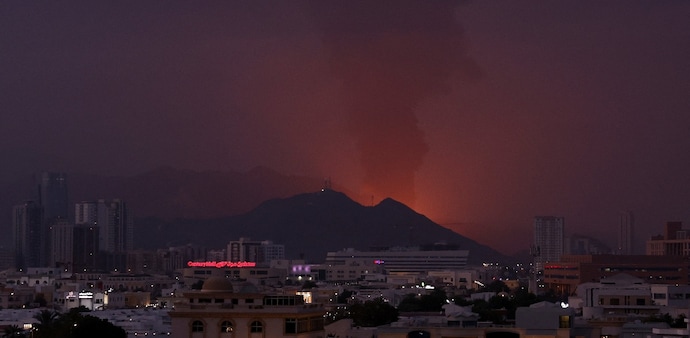
JSW Infrastructure on Tuesday said one of its 15 storage tanks at the Fujairah Liquid Terminal in the UAE sustained damage after debris from an intercepted drone fell within the facility premises, triggering a fire that was later brought under control.
The incident occurred against the backdrop of the ongoing conflict involving the US, Israel and Iran, which has heightened security risks across the Gulf region. Local media reported that an Iranian drone was intercepted over the Fujairah Oil Industry Zone (FOIZ) on Tuesday morning. Debris from the interception is understood to have landed at the JSW-operated facility, causing limited damage.
The company said local authorities and its onsite safety teams responded swiftly to contain the situation. No injuries were reported at the terminal, and the remaining 14 storage tanks have been secured.
“Adequate insurance coverage for the facility is already in place. A thorough technical assessment is underway to evaluate the structural impact and determine the restoration plan,” JSW Infrastructure said in a statement.
The Fujairah liquid storage terminal, operated by JSW Terminal (Middle East) FZE — a wholly owned subsidiary of JSW Infrastructure — was acquired in November 2023 from Swiss commodity trader Mercuria Group. The facility comprises 15 storage tanks with a cumulative capacity of 465,000 cubic metres, equivalent to nearly 3 million barrels of oil — roughly matching a day’s crude production in the UAE.
Fujairah is one of the region’s most strategic energy hubs and a major global bunkering centre, handling a significant share of the UAE’s oil exports. Storage terminals in the area primarily hold fuel for overseas supply, making them critical nodes in international energy trade flows.
The latest incident adds to growing concerns over the vulnerability of civilian and energy infrastructure in the Gulf. In recent days, the conflict has expanded beyond direct military targets. Reports indicate that Iran previously targeted Saudi Arabia’s Aramco Ras Tanura refinery, while civilian sites and Dubai International Airport have also faced threats as hostilities intensify.
JSW Infrastructure, part of the diversified JSW Group with interests spanning steel, cement, paint and automobiles, is India’s second-largest private port operator. The company specialises in maritime infrastructure and operates one liquid storage terminal and two dry bulk terminals in Fujairah.
Listed in 2023, JSW Infrastructure currently has a market capitalisation exceeding ₹52,000 crore. While the structural impact of Tuesday’s incident is still being assessed, the company indicated that operations at the terminal remain under control and that contingency measures are in place.
The episode underscores the spillover risks facing energy logistics infrastructure in the Gulf as geopolitical tensions continue to escalate, with implications for regional oil flows and maritime security.
JSW Infrastructure on Tuesday said one of its 15 storage tanks at the Fujairah Liquid Terminal in the UAE sustained damage after debris from an intercepted drone fell within the facility premises, triggering a fire that was later brought under control.
The incident occurred against the backdrop of the ongoing conflict involving the US, Israel and Iran, which has heightened security risks across the Gulf region. Local media reported that an Iranian drone was intercepted over the Fujairah Oil Industry Zone (FOIZ) on Tuesday morning. Debris from the interception is understood to have landed at the JSW-operated facility, causing limited damage.
The company said local authorities and its onsite safety teams responded swiftly to contain the situation. No injuries were reported at the terminal, and the remaining 14 storage tanks have been secured.
“Adequate insurance coverage for the facility is already in place. A thorough technical assessment is underway to evaluate the structural impact and determine the restoration plan,” JSW Infrastructure said in a statement.
The Fujairah liquid storage terminal, operated by JSW Terminal (Middle East) FZE — a wholly owned subsidiary of JSW Infrastructure — was acquired in November 2023 from Swiss commodity trader Mercuria Group. The facility comprises 15 storage tanks with a cumulative capacity of 465,000 cubic metres, equivalent to nearly 3 million barrels of oil — roughly matching a day’s crude production in the UAE.
Fujairah is one of the region’s most strategic energy hubs and a major global bunkering centre, handling a significant share of the UAE’s oil exports. Storage terminals in the area primarily hold fuel for overseas supply, making them critical nodes in international energy trade flows.
The latest incident adds to growing concerns over the vulnerability of civilian and energy infrastructure in the Gulf. In recent days, the conflict has expanded beyond direct military targets. Reports indicate that Iran previously targeted Saudi Arabia’s Aramco Ras Tanura refinery, while civilian sites and Dubai International Airport have also faced threats as hostilities intensify.
JSW Infrastructure, part of the diversified JSW Group with interests spanning steel, cement, paint and automobiles, is India’s second-largest private port operator. The company specialises in maritime infrastructure and operates one liquid storage terminal and two dry bulk terminals in Fujairah.
Listed in 2023, JSW Infrastructure currently has a market capitalisation exceeding ₹52,000 crore. While the structural impact of Tuesday’s incident is still being assessed, the company indicated that operations at the terminal remain under control and that contingency measures are in place.
The episode underscores the spillover risks facing energy logistics infrastructure in the Gulf as geopolitical tensions continue to escalate, with implications for regional oil flows and maritime security.