
Indian airlines’ tryst with foreign CEOs
After IndiGo appointed an expat, Air India is seeking a foreign CEO to continue its transformation amid growing operational challenges.
- Apr 7, 2026,
- Updated Apr 7, 2026 4:38 PM IST
Air India is looking for an international aviation executive to lead the airline after the exit of Campbell Wilson. IndiGo recently announced the appointment of IATA DG Willie Walsh as its CEO.
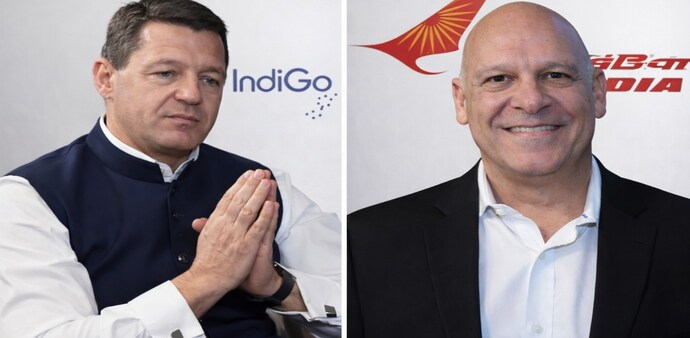
India’s two largest domestic carriers, IndiGo and Air India, were headed by foreign nationals till recently. Pieter Elbers resigned as IndiGo CEO last month, while Wilson’s resignation was officially announced by Air India on Tuesday.
According to sources, Air India has been on the lookout for an international aviation expert for the last few months to lead the carrier, and there have been discussions on a few names. The Air India board has constituted a committee to find Wilson’s successor, the airline announced.
What makes domestic players choose foreign CEOs over Indian executives?
Sanjay Lazar, aviation expert and CEO of Avialaz, says over the last 3 decades, many Indian carriers appointed foreign CEOs, starting with Wolfgang Prock Schauer, former IndiGo COO, Neil Mills, chief executive of SpiceJet, and even Austrian Gustav Baldauf, former COO of Air India, right up to Peter Elbers and Campbell Wilson.
MUST READ: After IndiGo, Air India set to hike fares amid Iran war. Details here
However, Indian stint of most of these foreign executives were mired in controversies. “It has to do with the perception that there is a dearth of internal talent within Indian aviation, despite having some great names like Aditya Ghosh (co-founder of Akasa), Sanjeev Kapoor (CEO of Jet Airways), Michael Mascarenhas (former Air India MD), Capt Gopinath (Air Deccan founder) and many more. There should have been enough in-house talent, given that our aviation market is now entering a mature phase,” he says.
Lazar points out at too much internal politics and insecurity amongst many Indian mid-level aviation executives. “Internally, there are also clashes sometimes with high-profile owners at times, as a result, great Indian aviation talent moves overseas to other airlines. This causes the importing of foreign CEOs,” he further explains.
MUST READ: IndiGo's new CEO Willie Walsh’s troubles with Indian aviation policy
With the largest aircraft orders placed by both airlines, a large chunk of these orders includes wide-body aircraft as they look to expand their international operations. To successfully deliver the international expansion goals, domestic airlines look for a leader who has experience in running long-haul operations while keeping the operational cost nominal.
“Foreign CEOS help airlines with the perception that we are building a world-class product with world-class international leaders; it also cuts across the internal office politics and groupism that in-house talent brings. Sadly, very few of them have delivered stellar results until now. In my opinion, we have some great Indian CEOs of hospitality and FMCG companies who could easily don aviation roles,” says Lazar.
IndiGo’s appointment of Walsh is seen as a move to expand its international operations while keeping costs low. Walsh is known in the industry for a massive cost-cutting strategy in his previous roles at British Airways and Irish flag carrier Aer Lingus.
MUST READ: 'No way Trump can...': Analyst decodes Iran's 10-point plan to US, Israel
According to aviation analysts, Air India and IndiGo are both eyeing international expansion, keeping in mind the high revenue generation from international sectors over domestic ones. Also, Indian airlines have not completely utilised their international flying rights, while there is a huge growth potential in the international sector.
With stiff competition and a price-sensitive market, the domestic aviation growth is expected to be single-digit for the next few years, while several credit rating agencies have assessed double-digit international growth.
Air India is looking for an international aviation executive to lead the airline after the exit of Campbell Wilson. IndiGo recently announced the appointment of IATA DG Willie Walsh as its CEO.
India’s two largest domestic carriers, IndiGo and Air India, were headed by foreign nationals till recently. Pieter Elbers resigned as IndiGo CEO last month, while Wilson’s resignation was officially announced by Air India on Tuesday.
According to sources, Air India has been on the lookout for an international aviation expert for the last few months to lead the carrier, and there have been discussions on a few names. The Air India board has constituted a committee to find Wilson’s successor, the airline announced.
What makes domestic players choose foreign CEOs over Indian executives?
Sanjay Lazar, aviation expert and CEO of Avialaz, says over the last 3 decades, many Indian carriers appointed foreign CEOs, starting with Wolfgang Prock Schauer, former IndiGo COO, Neil Mills, chief executive of SpiceJet, and even Austrian Gustav Baldauf, former COO of Air India, right up to Peter Elbers and Campbell Wilson.
MUST READ: After IndiGo, Air India set to hike fares amid Iran war. Details here
However, Indian stint of most of these foreign executives were mired in controversies. “It has to do with the perception that there is a dearth of internal talent within Indian aviation, despite having some great names like Aditya Ghosh (co-founder of Akasa), Sanjeev Kapoor (CEO of Jet Airways), Michael Mascarenhas (former Air India MD), Capt Gopinath (Air Deccan founder) and many more. There should have been enough in-house talent, given that our aviation market is now entering a mature phase,” he says.
Lazar points out at too much internal politics and insecurity amongst many Indian mid-level aviation executives. “Internally, there are also clashes sometimes with high-profile owners at times, as a result, great Indian aviation talent moves overseas to other airlines. This causes the importing of foreign CEOs,” he further explains.
MUST READ: IndiGo's new CEO Willie Walsh’s troubles with Indian aviation policy
With the largest aircraft orders placed by both airlines, a large chunk of these orders includes wide-body aircraft as they look to expand their international operations. To successfully deliver the international expansion goals, domestic airlines look for a leader who has experience in running long-haul operations while keeping the operational cost nominal.
“Foreign CEOS help airlines with the perception that we are building a world-class product with world-class international leaders; it also cuts across the internal office politics and groupism that in-house talent brings. Sadly, very few of them have delivered stellar results until now. In my opinion, we have some great Indian CEOs of hospitality and FMCG companies who could easily don aviation roles,” says Lazar.
IndiGo’s appointment of Walsh is seen as a move to expand its international operations while keeping costs low. Walsh is known in the industry for a massive cost-cutting strategy in his previous roles at British Airways and Irish flag carrier Aer Lingus.
MUST READ: 'No way Trump can...': Analyst decodes Iran's 10-point plan to US, Israel
According to aviation analysts, Air India and IndiGo are both eyeing international expansion, keeping in mind the high revenue generation from international sectors over domestic ones. Also, Indian airlines have not completely utilised their international flying rights, while there is a huge growth potential in the international sector.
With stiff competition and a price-sensitive market, the domestic aviation growth is expected to be single-digit for the next few years, while several credit rating agencies have assessed double-digit international growth.