
Suzuki to invest ₹70,000 crore in India over 6 years to fuel EV and export ambitions
The investment will be spread across manufacturing, R&D, and sustainability initiatives. Rs 32,000 crore is earmarked for expanding production capacity to 1 million units annually.
- Aug 26, 2025,
- Updated Aug 26, 2025 12:17 PM IST
Suzuki Motor Corporation will invest a staggering Rs 70,000 crore in India over the next 5–6 years, marking its largest-ever commitment to the country and positioning it as a global hub for electric vehicles and clean mobility.
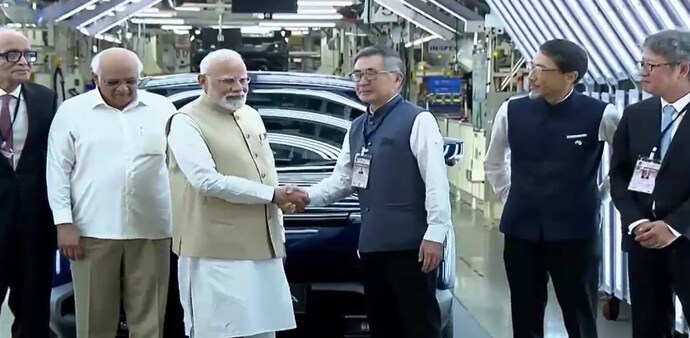
Prime Minister Narendra Modi and Suzuki Motor Corporation President Toshihiro Suzuki jointly flagged off the e-VITARA—Suzuki’s first global battery electric vehicle (BEV)—at the company’s Hansalpur plant in Ahmedabad, signaling a new era in India-Japan automotive collaboration.
The investment will be spread across manufacturing, R&D, and sustainability initiatives. Rs 32,000 crore is earmarked for expanding production capacity to 1 million units annually. Another Rs 23,240 crore will fund development of new models, including four BEVs by 2030, starting with the e-VITARA. Rs 15,000 crore will support carbon-neutral initiatives and manufacturing quality upgrades.
“Suzuki’s commitment to localizing over 80% of EV battery value will significantly cut India’s import dependence,” the company said. Battery manufacturing is central to Suzuki’s plan to position India as its EV export base to over 100 countries, including Japan and Europe.
Beyond electric cars, Suzuki’s roadmap includes broadening its hybrid and CNG offerings and launching a biogas project using cattle waste for renewable fuel—an initiative aligning with India's clean energy goals while supporting rural economies.
Maruti Suzuki, Suzuki’s Indian arm, aims to triple its exports to 7.5 lakh units annually by 2030-31. Already contributing 40% of India’s total passenger vehicle exports, the company is aggressively expanding into new markets under the government’s “Make in India” program.
By 2030, Suzuki-Maruti plans to capture a 50% market share in India and lead the EV space in manufacturing, sales, and global distribution. “India is not just a manufacturing base—it's our strategic growth engine,” said Toshihiro Suzuki.
Suzuki Motor Corporation will invest a staggering Rs 70,000 crore in India over the next 5–6 years, marking its largest-ever commitment to the country and positioning it as a global hub for electric vehicles and clean mobility.
Prime Minister Narendra Modi and Suzuki Motor Corporation President Toshihiro Suzuki jointly flagged off the e-VITARA—Suzuki’s first global battery electric vehicle (BEV)—at the company’s Hansalpur plant in Ahmedabad, signaling a new era in India-Japan automotive collaboration.
The investment will be spread across manufacturing, R&D, and sustainability initiatives. Rs 32,000 crore is earmarked for expanding production capacity to 1 million units annually. Another Rs 23,240 crore will fund development of new models, including four BEVs by 2030, starting with the e-VITARA. Rs 15,000 crore will support carbon-neutral initiatives and manufacturing quality upgrades.
“Suzuki’s commitment to localizing over 80% of EV battery value will significantly cut India’s import dependence,” the company said. Battery manufacturing is central to Suzuki’s plan to position India as its EV export base to over 100 countries, including Japan and Europe.
Beyond electric cars, Suzuki’s roadmap includes broadening its hybrid and CNG offerings and launching a biogas project using cattle waste for renewable fuel—an initiative aligning with India's clean energy goals while supporting rural economies.
Maruti Suzuki, Suzuki’s Indian arm, aims to triple its exports to 7.5 lakh units annually by 2030-31. Already contributing 40% of India’s total passenger vehicle exports, the company is aggressively expanding into new markets under the government’s “Make in India” program.
By 2030, Suzuki-Maruti plans to capture a 50% market share in India and lead the EV space in manufacturing, sales, and global distribution. “India is not just a manufacturing base—it's our strategic growth engine,” said Toshihiro Suzuki.